















Photoelectric Sensor Switch, Photoelectric Sensor
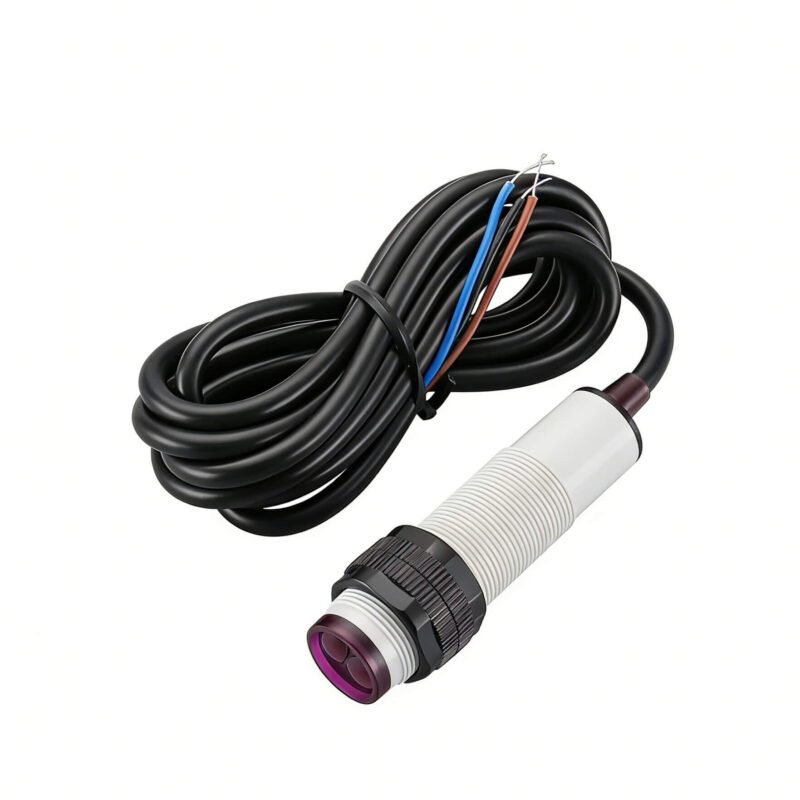
Photoelectric Sensor Switch, Photoelectric Sensor
Key Features
- Fast non-contact object detection for automated industrial control and positioning systems
- Multiple sensing modes support flexible installation across diverse machine applications
- Sensing distance options from short-range to long-distance industrial detection needs
- Available in NPN and PNP outputs for broad PLC compatibility
- Typical response time ≤1 ms for high-speed production line operation
- Reliable detection of cartons, plastics, metals, bottles, and packaging materials
- Industrial-grade housing ensures stable performance in demanding factory environments
- Power and output indicators simplify setup, alignment, and troubleshooting processes
- IP65/IP67 protection options available for dust and moisture resistance
- sales@connector-sensor.com
- +86 15120067961
Photoelectric Sensor Switch – Reliable Object Detection for Industrial Automation
Product Description
Photoelectric sensor switch, or called photoelectric switch sensor, is a highly reliable non-contact detection device designed for industrial automation, packaging machinery, conveyor systems, material handling, and production line control. By using emitted light to detect the presence, absence, position, or movement of an object, it provides fast, accurate, and stable switching output for a wide range of factory automation applications.
Compared with traditional mechanical switches, a photoelectric sensor switch offers longer service life, faster response speed, and higher detection accuracy without physical contact. It is widely used to improve machine efficiency, process consistency, and system safety, especially in environments where high-speed detection and repeatable performance are essential.
These switchs are available in multiple sensing modes, including through-beam, retro-reflective, and diffuse reflective, making it suitable for detecting metal, plastic, glass, paper, carton, liquid containers, and irregular objects.
Advantages of Photoelectric Sensor Switch
- Non-contact object detection for reliable and wear-free operation
- Fast response speed for high-speed automation and conveyor applications
- Multiple sensing modes available for different industrial detection tasks
- Long sensing distance options for flexible equipment installation
- Stable switching performance under continuous industrial use
- High repeatability and accuracy for precise object positioning
- Available in NPN, PNP, NO, and NC outputs for PLC compatibility
- Compact housing design for easy integration into tight machine spaces
- Strong anti-interference capability against ambient light and electrical noise
- Durable industrial construction suitable for demanding factory environments
- OEM/ODM customization support for machinery brands and automation projects
- Consistent bulk production quality for distributors and equipment manufacturers
- Low maintenance and long service life compared with mechanical switches
Photoelectric Sensor Switch Specifications
| Parameter | Specification |
| Product Name | Photoelectric Sensor Switch |
| Sensor Type | Photoelectric Proximity Detection Sensor |
| Detection Principle | Optical Light-Based Object Detection |
| Sensing Modes | Through-Beam / Retro-Reflective / Diffuse Reflective |
| Sensing Distance | 10 cm – 20 m (depending on model) |
| Light Source | Infrared LED / Visible Red LED (optional) |
| Output Type | NPN / PNP |
| Output Mode | Normally Open (NO) / Normally Closed (NC) |
| Supply Voltage | 10–30 V DC |
| Response Time | ≤1 ms (typical) |
| Repeat Accuracy | ≤1 mm (depending on model) |
| Load Current | Up to 200 mA |
| Protection Circuit | Reverse polarity / Short circuit / Overload protection |
| Indicator | Power Indicator / Output Status Indicator |
| Housing Material | ABS / PBT / Metal housing optional |
| Cable Type | 2 m cable / M8 / M12 connector optional |
| Protection Rating | IP65 / IP67 (depending on model) |
| Operating Temperature | –25°C to +55°C |
| Installation Type | Threaded cylindrical / Rectangular mounting |
| Application Objects | Cartons, plastics, metals, bottles, labels, packages |
| Compliance | RoHS / CE (depending on model) |
Typical Applications of Photoelectric Sensor Switch
Industrial Automation & Factory Equipment
- Object detection on automated production lines
- Position sensing for moving machine parts
- Presence/absence detection in assembly systems
- Counting products in high-speed manufacturing processes
Packaging & Conveyor Systems
- Carton and package detection on conveyor belts
- Label presence and package positioning
- Bottle, can, and container detection
- Sorting and transfer line automation
Material Handling & Logistics
- Pallet and box detection in warehouse systems
- Automated storage and retrieval systems (AS/RS)
- Entry/exit object sensing for logistics equipment
- Jam prevention and material flow monitoring
Food & Beverage Equipment
- Package detection in filling and sealing lines
- Bottle alignment and transport control
- Product counting in food packaging machines
- Non-contact detection in hygiene-sensitive environments
Electronics & Assembly Equipment
- PCB positioning and component transfer detection
- Presence sensing for automated fixtures
- Pick-and-place auxiliary detection
- Small part alignment and process control
Printing, Textile & Paper Machinery
- Sheet presence detection
- Web edge or material movement monitoring
- Roll material position confirmation
- Label and printed object sensing
FAQ
1. What is a photoelectric sensor switch used for?
A photoelectric sensor switch is used for non-contact object detection in industrial automation systems. It can detect the presence, absence, position, or movement of objects on conveyors, packaging machines, assembly lines, and logistics equipment.
2. What is the difference between through-beam, retro-reflective, and diffuse photoelectric sensors?
- Through-beam sensors use a separate emitter and receiver for the longest sensing distance and highest stability.
- Retro-reflective sensors detect objects using a reflector and are ideal for general industrial applications.
- Diffuse reflective sensors detect objects directly without a reflector, making installation easier in compact systems.
3. Can your photoelectric sensor switch work with PLC systems?
Yes. Our sensors are available with NPN and PNP outputs, and many models support NO/NC switching modes, making them compatible with most PLC, relay, and industrial control systems.
4. Can it detect dark, shiny, or transparent objects?
Standard models can detect many common materials, but for transparent bottles, glossy surfaces, or dark targets, we recommend selecting a more suitable configuration such as background suppression, polarized retro-reflective, or specialized optical models.
5. What sensing distance options are available?
The sensing distance depends on the model and sensing mode. We offer options ranging from short-range compact detection to long-distance industrial sensing up to several meters or more.
6. Is the photoelectric sensor switch suitable for harsh industrial environments?
Yes. Many models are designed with industrial-grade housings, anti-interference performance, and IP65/IP67 protection, making them suitable for dust, vibration, and general factory environments.
Related Sensor Products
- Through-Beam Photoelectric Sensor
- Retro-Reflective Photoelectric Sensor
- Diffuse Reflective Photoelectric Sensor
- Background Suppression Photoelectric Sensor
- Laser Photoelectric Sensor
- Fiber Optic Photoelectric Sensor
Send Message to get Datasheet.
Strict Production Process
Engineers develop optimized electronic circuits and structural designs based on real application needs.
High-quality components and materials are carefully selected from trusted suppliers to ensure long-term reliability.
Automated SMT and precision soldering technologies are used to build stable and high-performance circuit boards.
Sensor elements or connector terminals are assembled with the PCB and housing to ensure accurate operation and strong mechanical stability.
Each product undergoes strict calibration and functional testing to guarantee accuracy and stable performance.
Every unit is carefully inspected, labeled, and securely packaged to ensure it arrives safely and performs reliably for your applications.
Strict Production Process of Yafeite