












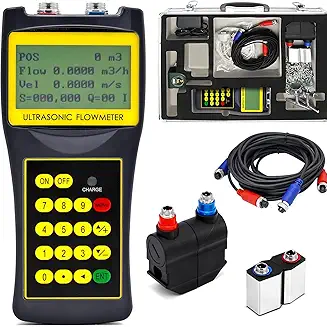
Ultrasonic Flow Meter – Non-Invasive, Accurate Flow Measurement for Liquids & Gases
Product Description
The Ultrasonic Flow Meter is an advanced, non-contact digital device designed for precise measurement of liquid and gas flow rates in pipes without interrupting operations. Unlike traditional invasive sensors, it uses ultrasonic transit-time or Doppler technology to measure flow velocity externally, eliminating pipe cutting, pressure loss, and contamination risks.
Featuring high-accuracy transducers and intelligent signal processing, this flow meter delivers real-time volumetric flow data for water, chemicals, oils, and gases. Its clamp-on design and wireless connectivity options make it perfect for industrial process control, water management, HVAC systems, and energy monitoring applications where downtime costs money.
With factory calibration, bi-directional flow detection, and robust environmental protection, the Ultrasonic Flow Meter solves common pain points like installation complexity, maintenance costs, and measurement inaccuracies in demanding fluid systems.
Advantages of Ultrasonic Flow Meter
-
Non-invasive clamp-on installation – no pipe cutting or flow disruption
-
High accuracy ±1% for liquids, ±2% for gases across wide pipe sizes
-
Wide measurement range – DN15 to DN6000 pipes (½” to 240″)
-
Bi-directional flow detection for precise net flow calculation
-
Multiple liquid compatibility – water, chemicals, oils, slurries, gases
-
Long battery life >24 months or continuous AC power options
-
Real-time data output via RS485, Modbus, 4-20mA, or wireless
-
IP67 waterproof rating for harsh industrial environments
-
Automatic temperature compensation for consistent accuracy
-
RoHS compliant and globally certified for international deployment
Ultrasonic Flow Meter Specifications
| Parameter | Specification |
|---|---|
| Sensor Type | Clamp-on ultrasonic transit-time/Doppler |
| Flow Range | 0.01 – 30 m/s velocity |
| Accuracy | ±1% (liquids), ±2% (gases) |
| Pipe Size | DN15-DN6000 (½”-240″) |
| Output Type | 4-20mA, RS485 Modbus, OCT pulse, relay |
| Operating Temperature | –30°C to +160°C (transducer) |
| Liquid Temperature | –30°C to +160°C |
| Protection Rating | IP67 |
| Power Supply | DC 9-36V or AC 85-265V |
| Battery Life | >24 months (portable models) |
| Display | LCD with flow rate, totalizer, velocity |
| Communication | RS485, Modbus RTU, HART optional |
| Calibration | Factory calibrated, traceable NIST |
| Compliance | RoHS, CE, ISO9001 |
Typical Applications of Ultrasonic Flow Meter
Water & Wastewater Management
-
Municipal water distribution and leakage detection
-
Wastewater treatment plant flow monitoring
-
Irrigation and agricultural water usage measurement
Industrial Process Control
-
Chemical processing and corrosive liquid monitoring
-
Oil & gas pipeline flow measurement
-
HVAC chilled/hot water flow balancing
Energy Management
-
District heating/cooling efficiency monitoring
-
Boiler feedwater and steam condensate measurement
-
Building energy consumption audits
HVAC & Building Automation
-
Chiller plant optimization and TRV validation
-
Cooling tower performance monitoring
-
Variable flow pumping systems
Related Flow & Sensor Products
Friendly Link: