
















Strain Gauge vs Piezoelectric Sensor: Complete Comparison Guide

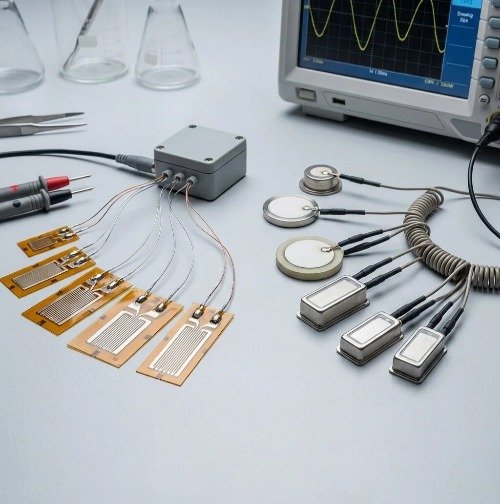
When selecting sensors for force, pressure, or weight measurements, the choice between strain gauge and piezoelectric sensors is crucial. An incorrect selection can lead to measurement failures, signal loss, or unnecessary system costs.
This guide simplifies your decision-making process through clear comparisons, real-world data, and practical selection tips.
1. What are Strain Gauge Sensor and Piezoelectric Sensor?
Strain Gauge Sensors
A strain gauge is a passive resistive sensor used to measure strain (deformation) when a material is subjected to external force. These sensors are typically bonded to a structure using a high-performance adhesive such as cyanoacrylate. They detect extremely small deformations — as low as 1 microstrain (µε = 1e-6 strain) — making them ideal for precise measurement tasks.
Common uses include load cells, pressure sensors, torque sensors, and structural health monitoring (SHM) systems. Their major advantage is long-term accuracy and stability, ideal for static or slow-loading applications.
Piezoelectric Sensors
Piezoelectric sensors operate based on the piezoelectric effect, which means certain materials (like quartz, PZT, or barium titanate) generate an electrical charge when mechanical stress is applied. The output charge is proportional to the applied force and can be measured as voltage using a charge amplifier.
Unlike strain gauges, piezoelectric sensors are self-generating and best suited for fast-changing, high-frequency forces such as vibration, shock, and impact. They’re widely used in industrial testing, engine diagnostics, vibration analysis, and medical imaging.
2. How Strain Gauge Work
Strain gauge sensors rely on resistance change to detect deformation. The sensor is attached to a structure’s surface — when that structure bends or stretches due to force, the strain gauge’s resistance changes proportionally. Using a Wheatstone bridge circuit, even tiny changes in resistance can be detected and converted into voltage signals.
Key features:
- Requires precise bridge circuitry for accuracy.
- Excellent for static or low-frequency measurements.
- Ideal for industrial weighing systems, material testing, and pressure monitoring.
3. How Piezoelectric Sensor Work
Piezoelectric sensors generate an electric charge when subjected to mechanical stress. The generated charge is directly proportional to the applied force, making them extremely sensitive and responsive. These sensors can detect rapid pressure fluctuations or transient events with remarkable fidelity.
Key features:
- No external power required for sensing (only for signal amplification).
- High-frequency response — capable of capturing microsecond events.
- Ideal for vibration, impact, blast pressure, and acoustic measurements.
4. Strain Gauge vs Piezoelectric Sensor: Key Differences
| Feature | Strain Gauge Sensor | Piezoelectric Sensor |
|---|---|---|
| Sensing principle | Measures resistance change under strain | Generates charge under stress |
| Response type | Best for static or slowly varying forces | Best for dynamic or transient forces |
| Accuracy | Excellent for static measurements | Excellent for dynamic measurements |
| Durability | Sensitive to moisture and temperature | More robust in harsh environments |
| Signal type | Resistance / mV output | Charge or voltage output |
| Power | Requires external excitation | Self-generating element |
| Typical applications | Weighing, load, pressure sensing | Vibration, shock, fast force detection |
| Cost | Lower sensor cost, more wiring | Higher sensor cost, simpler setup |
5. Advantages and Disadvantages
Strain Gauge Sensors
Advantages:
- High accuracy for static or slow-varying measurements.
- Long-term stability and repeatability.
- Cost-effective and widely available measurement solution.
Disadvantages:
- Cannot accurately track rapid or transient forces.
- Sensitive to temperature drift or humidity.
- Requires complex circuitry (e.g., Wheatstone bridge, amplifiers).
Piezoelectric Sensors
Advantages:
- Excellent for dynamic, high-frequency forces and impacts.
- No external excitation needed for sensing.
- Performs well under extreme temperatures or vibrations.
Disadvantages:
- Can’t measure static or DC-type forces (charge leakage).
- Typically requires a charge amplifier.
- Higher initial cost compared to strain gauges.
6. Typical Applications
Strain Gauge Sensor Applications
- Industrial weighing systems: platform scales, conveyor or hopper scales.
- Pressure monitoring: diaphragm-type pressure sensors.
- Structural and mechanical testing: material fatigue, beam deflection.
- Torque measurement: in robotics, rotating machines, or drivetrains.
Piezoelectric Sensor Applications
- Vibration and shock analysis: automotive crash testing, machine diagnostics.
- High-speed pressure events: internal combustion, explosion detection.
- Sound and ultrasound: microphones, medical transducers, acoustic imaging.
7. Strain Gauge vs Piezoelectric Sensor: Quick Comparison Table
| Property | Strain Gauge | Piezoelectric |
|---|---|---|
| Load Type | Static & low-frequency | Dynamic only |
| Force Range | 5 N – 40 MN | 5 kN – 1 MN |
| Frequency Response | Up to kHz | Up to 100 kHz |
| Output | mV/V (bridge-based) | pC/N or V (charge-based) |
| Size & Rigidity | Larger, more elastic | Compact, ultra-stiff |
| Cost & Installation | Lower cost, requires bonding | Higher cost, easier mounting |
8. How to Choose the Right Sensor
Selecting the best sensor means balancing application type, precision needs, environment, and budget.
8.1: Identify Load Type (Static vs Dynamic)
- For static or long-term load monitoring → choose Strain Gauge.
- For dynamic or fast-changing forces → choose Piezoelectric.
8. 2: Determine Accuracy and Stability Requirements
- Need high precision for weight or pressure control? → Strain Gauge.
- Need precise instant response for vibration or impact? → Piezoelectric.
8.3: Evaluate Operating Environment
- Hot or harsh environments (e.g., >150 °C or heavy vibration) → Piezoelectric (Quartz type).
- Controlled indoor environment or moderate temperature range → Strain Gauge (with temperature compensation).
8.4: Balance Cost vs System Complexity
- Tight budget and low-frequency use → Strain Gauge System.
- High-speed or aerospace-grade sensing → Piezoelectric System (with charge amplifier).
9. FAQ
Q1: Can piezoelectric sensors measure static force?
No. The generated charge will leak over time, so static or constant forces can’t be measured accurately. Use strain gauge sensors instead.
Q2: Why do strain gauges sometimes fail in humid environments?
Moisture may affect adhesive bonding and resistance stability. Always use properly sealed or encapsulated sensors with anti-moisture coatings.
Q3: Which is more accurate for small loads?
Strain gauges are more accurate for low-force applications (from a few newtons upward).
Q4: Which is better for high-vibration conditions?
Piezoelectric sensors, as they have much higher frequency response and environmental durability.
10. Conclusion
Both strain gauge and piezoelectric sensors are essential tools in modern measurement systems — each addressing different needs rather than competing.
- If your goal is static, precise, long-term measurement of force, pressure, or weight, a strain gauge sensor is the reliable and cost-efficient choice.
- If you need fast, dynamic, high-frequency signal acquisition under tough conditions, go for a piezoelectric sensor.
By clearly identifying whether your system handles static or dynamic forces, along with understanding your environment, accuracy goals, and budget, you can choose the optimal sensing solution and ensure consistent measurement performance over time.