
















Top 8 Engine Sensors: Functions & Failure Symptoms

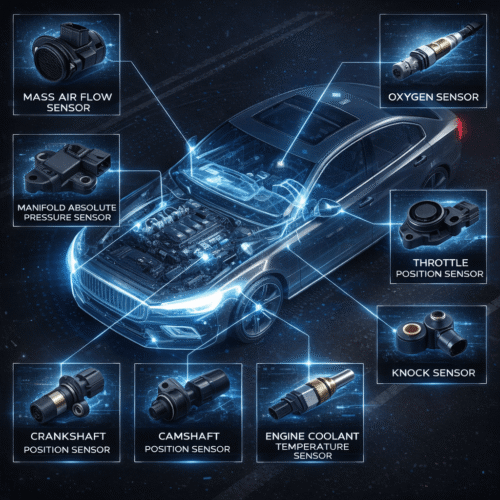
Modern vehicles rely on an intricate network of sensors to keep the engine running smoothly. These sensors serve as the engine’s nervous system, constantly feeding data to the Engine Control Unit (ECU) so it can make split-second adjustments for optimal performance, fuel efficiency, and emissions control. When one of these sensors fails, you’ll likely notice problems ranging from poor acceleration to expensive repairs.
1. What Are Engine Sensors?
Engine sensors are electronic devices that monitor various aspects of engine operation. They track physical parameters like temperature, pressure, air volume, and mechanical position, then convert this information into electrical signals that the ECU can understand.
The ECU uses this data to fine-tune critical engine functions. It adjusts the air-fuel mixture for complete combustion, controls when the spark plugs fire, maximizes fuel economy, reduces harmful emissions, and prevents the engine from overheating or sustaining damage. When a sensor malfunctions, the ECU loses its ability to make these adjustments correctly. The result is often poor performance, higher fuel consumption, or in some cases, a vehicle that won’t run at all.
2. The 8 Most Common Engine Control Sensors
Let’s explore the eight sensors you’ll find in virtually every modern internal combustion engine.
2.1 Mass Air Flow (MAF) Sensor
The MAF sensor sits in the intake duct between the air filter and the throttle body. Its job is to measure exactly how much air is entering the engine. The ECU takes this information and calculates precisely how much fuel to inject, aiming for the ideal air-fuel ratio of approximately 14.7:1 for gasoline engines.
When the MAF sensor fails, you’ll typically notice the engine idling roughly or hesitating during acceleration. Fuel consumption often increases noticeably, and emissions may rise. The check engine light will almost certainly illuminate. If ignored, prolonged driving with a bad MAF sensor can eventually damage the expensive three-way catalytic converter.
2.2 Oxygen (O2) Sensor
You’ll find oxygen sensors mounted in the exhaust stream, typically one before the catalytic converter and another after it. These sensors measure the oxygen content in the exhaust gases, telling the ECU whether the combustion process is running rich (too much fuel) or lean (too little fuel). The ECU uses this feedback to continuously adjust fuel delivery. The post-cat sensor also monitors whether the catalytic converter is working properly.
A failing oxygen sensor usually causes higher fuel consumption and increased emissions. The engine may feel sluggish, and the check engine light will come on. Since the ECU can no longer maintain the correct air-fuel mixture, an O2 sensor failure can eventually lead to premature catalytic converter failure.
2.3 Manifold Absolute Pressure (MAP) Sensor
The MAP sensor mounts directly on the intake manifold, where it measures the pressure inside. This reading tells the ECU how much load the engine is under. When you accelerate hard, the throttle opens, manifold pressure rises, and the ECU knows to deliver more fuel and adjust ignition timing accordingly.
Common symptoms of a bad MAP sensor include hesitation during acceleration, rough idle, and even stalling. Fuel economy usually suffers as well. In severe cases, the engine may run excessively rich or lean, causing drivability problems and potential damage.
2.4 Throttle Position Sensor (TPS)
The TPS attaches to the throttle body and monitors the position of the throttle plate. Essentially, it tells the ECU how far you’ve pressed the accelerator pedal. This information helps the ECU determine fuel delivery and engine response.
When the TPS fails, you might notice a lag when you step on the gas. The idle may fluctuate unpredictably. If your vehicle has an automatic transmission, shifting may become harsh or erratic. The overall driving experience feels disconnected, with sluggish throttle response.
2.5 Crankshaft Position Sensor (CKP)
The crankshaft position sensor mounts near the crankshaft or flywheel. It tracks both the position and rotational speed of the crankshaft. This is arguably the most critical sensor in the entire engine management system. Without its signal, the ECU doesn’t know when to fire the spark plugs or inject fuel. The engine simply won’t start.
Symptoms of a failing CKP sensor include hard starting or complete no-start conditions. The engine may stall unexpectedly while driving. You might also experience misfiring or shaking during operation.
2.6 Camshaft Position Sensor (CMP)
The camshaft position sensor mounts near the cylinder head or camshaft. It tells the ECU the position of the camshaft, which allows the ECU to determine which cylinder is on its compression stroke. Working together with the crankshaft sensor, it enables precise sequential fuel injection and controls variable valve timing systems.
When this sensor fails, you’ll likely experience difficulty starting the engine. Power delivery may feel reduced, and fuel economy will probably drop. The engine may still run, but not optimally.
2.7 Knock Sensor (KS)
The knock sensor bolts directly to the engine block. It listens for the characteristic vibrations caused by engine knock or detonation, which occurs when fuel ignites unevenly in the cylinders. When the sensor detects knocking, the ECU instantly retards ignition timing to prevent engine damage.
A failed knock sensor means the ECU can’t hear knocking when it happens. You may notice reduced power and higher fuel consumption, but the most concerning symptom is an audible pinging or knocking sound from the engine during acceleration. Ignoring this can lead to catastrophic engine failure over time.
2.8 Engine Coolant Temperature (ECT) Sensor
The ECT sensor threads into the engine’s coolant passages, typically near the cylinder head. It measures the temperature of the engine coolant. The ECU uses this information to enrich the mixture during cold starts for easier starting, control when the cooling fans turn on, and maintain proper engine operating temperature.
Common signs of ECT sensor failure include hard starting, especially in cold weather. Fuel economy often suffers, and the engine may run hotter than normal or overheat. In some cases, the cooling fans may run continuously or not at all.
3. FAQ
3.1 What happens when an engine sensor fails?
When a sensor fails, the ECU receives incorrect information about what’s happening inside the engine. This leads to improper adjustments to fuel delivery, ignition timing, and emissions controls. The result is usually reduced power, poor fuel economy, and increased emissions. Some sensor failures can prevent the engine from running at all.
3.2 How do you diagnose a faulty engine sensor?
Modern vehicles use the OBD-II diagnostic system. When a sensor malfunctions, the ECU stores a diagnostic trouble code. A mechanic or technician can connect a scanner to the vehicle’s diagnostic port to read these codes, which point to the likely problem area. Further testing with a multimeter or oscilloscope often confirms the diagnosis.
3.3 What are some common sensor trouble codes?
You’ll frequently encounter codes like P0101 (MAF sensor performance problem), P0135 (O2 sensor heater circuit failure), P0325 (knock sensor circuit malfunction), P0335 (crankshaft position sensor circuit failure), and P0115 (engine coolant temperature sensor circuit malfunction). These codes provide a starting point for diagnosis, though the exact meaning can vary slightly between vehicle manufacturers.
4. Conclusion
Engine control sensors form the backbone of modern automotive electronics. By constantly monitoring air flow, pressure, temperature, and mechanical position, these eight sensors give the ECU the information it needs to keep your engine running efficiently, cleanly, and reliably. The mass air flow sensor, oxygen sensors, MAP sensor, throttle position sensor, crankshaft and camshaft position sensors, knock sensor, and coolant temperature sensor appear on virtually every vehicle with an internal combustion engine.
Understanding what these sensors do and recognizing the symptoms of their failure can save you from expensive repairs down the road. When the check engine light comes on or your engine isn’t running right, knowing which sensor might be causing the problem helps you make informed decisions about maintenance and repairs.