



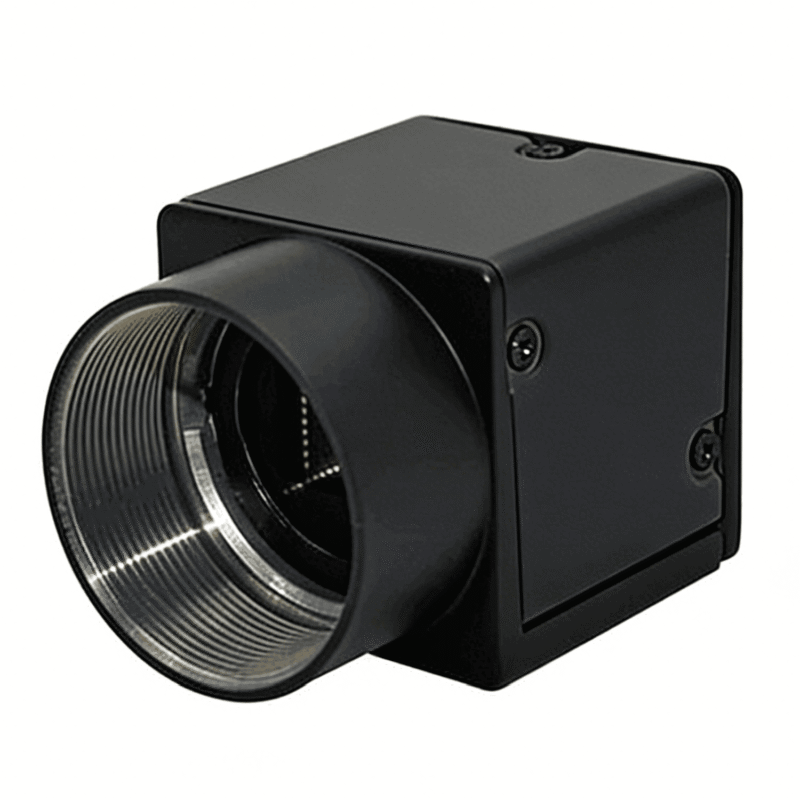
Dynamic Vision Sensor – High-Speed Event-Based Camera for Real-Time Industrial & Robotics Applications
Product Description
Dynamic Vision Sensor (DVS) is an advanced event-based camera designed for ultra-fast motion detection and real-time vision processing in industrial, robotic, and AI-driven applications. Unlike conventional frame-based cameras, the DVS captures changes in brightness at the pixel level, delivering microsecond-level latency and dramatically reducing data load.
Its compact, modular design and high dynamic range make it ideal for robotics navigation, industrial quality control, gesture recognition, autonomous vehicles, and high-speed machine vision systems. With low power consumption and robust performance under challenging lighting conditions, the DVS simplifies integration into smart devices and AI-powered vision systems.
Engineered for developers and engineers, this sensor supports flexible interfaces and software compatibility for seamless deployment in real-time applications, reducing computational overhead while ensuring reliable motion detection and visual data capture.
Advantages of Dynamic Vision Sensor
Event-based vision for microsecond response and ultra-fast motion detection
High dynamic range for robust performance in varying lighting conditions
Minimal data bandwidth requirement for efficient processing
Compact, lightweight, and modular design for easy integration
Low power consumption suitable for embedded systems and battery-powered devices
Supports robotics navigation, autonomous vehicles, and industrial automation
Flexible software SDK and API for rapid prototyping and integration
Reliable operation under high-speed and high-frequency motion scenarios
Accurate detection of motion even in complex or low-contrast environments
Compatible with AI, computer vision, and edge computing platforms
Dynamic Vision Sensor Specifications
| Parameter | Specification |
|---|---|
| Sensor Type | Event-Based Dynamic Vision Sensor |
| Pixel Resolution | 640 × 480 (typical, model-dependent) |
| Temporal Resolution | Microsecond-level latency |
| Dynamic Range | >120 dB |
| Frame Rate | Event-driven (asynchronous, no fixed frame rate) |
| Output Type | Event stream (Address-Event Representation, AER) |
| Power Consumption | <100 mW (typical) |
| Interface | USB3.0, GigE, or custom AER interface |
| Operating Temperature | –20°C to +60°C |
| Response Time | <1 ms |
| Calibration | Factory calibrated |
| Packaging Options | Module or standalone sensor board |
| Compliance | CE, RoHS |
FAQ
1. What makes a Dynamic Vision Sensor different from a traditional camera?
Unlike standard cameras that capture full image frames, a DVS only records changes in pixel brightness, drastically reducing latency and data bandwidth.
2. Can the DVS operate in low-light or very bright environments?
Yes. Its high dynamic range (over 120 dB) allows it to perform reliably in challenging lighting—such as shadows, glare, or direct sunlight.
3. What type of data output does the DVS provide?
It outputs event data in Address-Event Representation (AER) format, which encodes when and where each pixel change occurred.
4. How does the DVS benefit robotics or drones?
The sensor’s ultra-fast response enables real-time motion detection and navigation, improving stability and reducing reaction delay in autonomous systems.
5. Is the DVS compatible with AI or edge computing frameworks?
Yes. The output can be integrated with Python, ROS, TensorFlow Lite, and edge computing devices for event-based AI processing.
6. What is the typical latency of a DVS compared to a standard camera?
While conventional cameras operate at 30–60 frames per second (≈16–33 ms latency), a DVS achieves sub-1 ms latency for real-time visual events.
7. How much data does an event-based sensor generate?
Since it only records pixel changes, data size can be up to 100× smaller than a full-frame video feed for equivalent motion scenarios.
8. Can the DVS be used outdoors or in industrial settings?
Yes. It’s designed to handle wide temperature ranges and extreme lighting, making it suitable for both indoor and outdoor vision applications.
Related Vision Sensor Products:
You may also be interested in the following vision sensors for automation and smart systems:
| Smart Vision Sensor |
| Machine Vision Sensor |
| 2D Vision Sensor |
| 3D Vision Sensor |
| AI Vision Sensor |
| Robotic Vision Sensor |
| Color Vision Sensor |
| Stereo Vision Sensor |
| CMOS Image Sensor |
Friendly Link: