


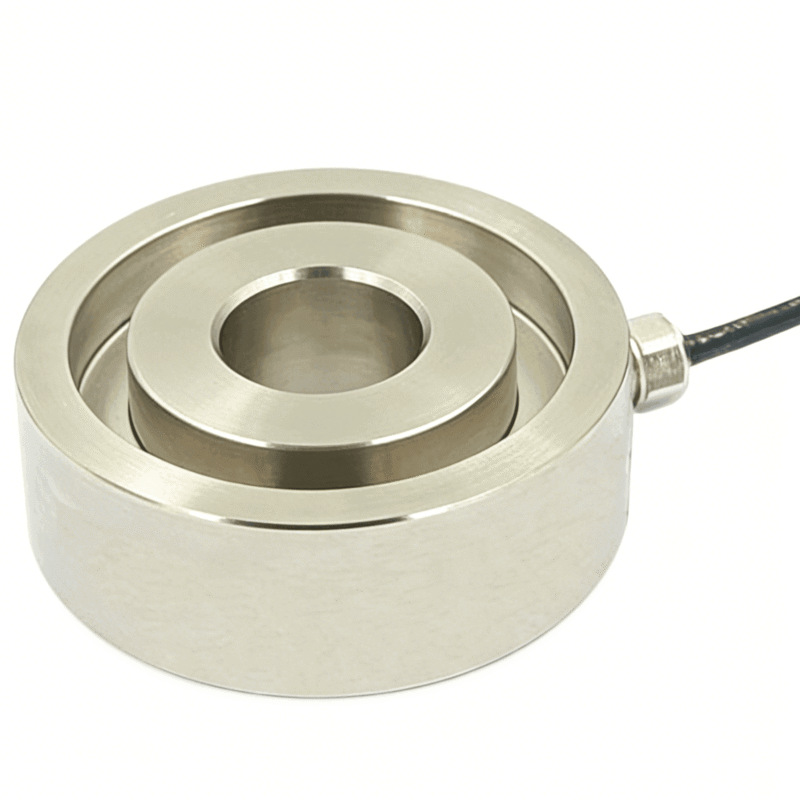
Donut Load Cell – Through-Hole Compression Force Sensor for Bolted & Axial Load Measurement
Product Description
The Donut Load Cell, also known as a through-hole load cell, is a precision compression sensor designed to measure axial or clamping forces applied through a center hole. Its robust, washer-like design makes it ideal for applications such as bolt preload monitoring, press fitting, clamping force measurement, and structural load testing.
Built from high-grade stainless steel or alloy steel, the sensor provides excellent strength, temperature stability, and resistance to side loading, ensuring consistent accuracy in demanding industrial environments. The center bore allows easy mounting over bolts, shafts, or structural members, making integration simple within both new designs and retrofitted systems.
As a factory-direct manufacturer, we support OEM/ODM projects, customized dimensions, and output options for integration with PLCs, test systems, or IoT platforms — helping B2B clients streamline their product development and maintain high measurement reliability.
Advantages of Donut Load Cell
Ring-type design for easy bolt and axial load measurement
High accuracy and repeatability in compression direction
Robust stainless-steel construction for long-term stability
Temperature-compensated and factory calibrated
Compact and low-profile for easy system integration
Resistant to side loading and shock forces
Compatible with analog (mV/V) and digital outputs (RS485, Modbus)
Ideal for industrial test benches and automation systems
OEM/ODM customization for size, bore diameter, and output type
Manufacturer-direct supply ensures consistency and competitive cost
Donut Load Cell Specifications
Typical Applications of Donut Load Cell
Industrial Automation
Monitoring axial loads in bolt assemblies and clamping fixtures
Press-fit and hydraulic force measurement
Assembly line force calibration and control systems
Weighing & Testing Equipment
Torque and tension validation
Structural load and force analysis
Calibration and testing benches
Machine & Equipment Integration
Bolt preload and tension monitoring in fasteners
Spindle and shaft force measurement
Compact assembly tools and automation setups
Aerospace & Automotive
Chassis load testing and torque control
Bearing preload and component force analysis
FAQ
1. What is a donut load cell used for?
It’s designed to measure compression or clamping forces through a central hole — ideal for bolt tension, press fitting, and axial load monitoring applications.
2. How do I install a donut load cell?
Place the sensor over a bolt, rod, or structural element so that compressive force passes directly through the sensor’s bore. Proper alignment ensures accurate readings.
3. What bore sizes are available?
Standard inner diameters range from 5 mm to 100 mm, but we offer custom dimensions for OEM and system integration projects.
4. Can it be used in dynamic load applications?
Yes. The sensor is structurally optimized for dynamic and cyclical loads with fast response and minimal mechanical deflection.
5. What materials are used in construction?
We use stainless steel for corrosion resistance and alloy steel for general-purpose or heavy-duty applications.
6. Is digital output available?
Yes. Optional RS485 or Modbus RTU output versions are available for direct connection to PLCs or data acquisition systems.
7. Can the load cell withstand harsh environments?
Yes. Models with IP67 protection are suitable for industrial and semi-outdoor environments with dust, humidity, or oil exposure.
8. Do you provide OEM or branded customization?
Absolutely. We support OEM/ODM customization for capacity, bore size, connector type, and private labeling for B2B customers.
Related Load Cell Products
Friendly Link: