



Diffuse Reflective Photoelectric Sensor
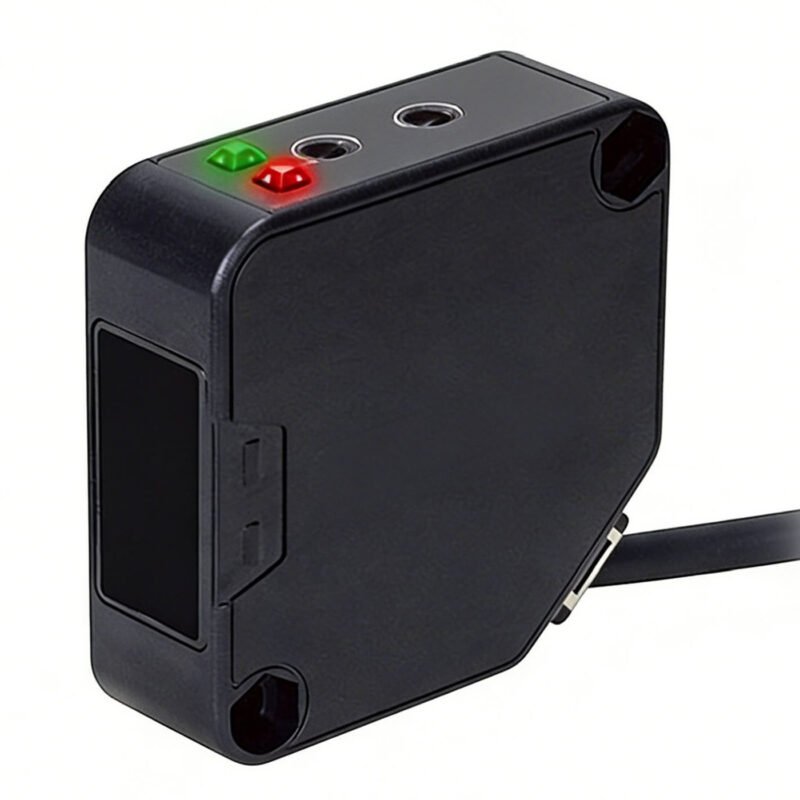
Diffuse Reflective Photoelectric Sensor
Key Features
Integrated emitter and receiver design simplifies installation
Detects reflective surfaces within 10–800 mm accurately
Infrared or red LED light ensures stable, consistent detection
Fast response under 1 ms for precise automation timing
IP67-rated housing for harsh industrial environments
Adjustable sensitivity for objects of various colors and reflectivity
Supports NPN/PNP output for easy PLC communication
Low power consumption ideal for embedded control systems
Indicator LEDs for quick setup and operational feedback
OEM/ODM customization available for machinery manufacturers
- sales@connector-sensor.com
- +86 15120067961
- Cable Assemblies9 products
- Connectors126 products
- Sensors121 products
- Automotive Sensors11 products
- Position Sensors1 product
- Proximity Sensors1 product
- Flow Sensors9 products
- Force Sensors21 products
- Gas Sensors18 products
- Photoelectric Sensors14 products
- Pressure Sensors19 products
- Temperature and Humidity Sensors3 products
- Temperature Sensors24 products
- Vision Sensors10 products
- IMU Sensor1 product
- Optoelectronic Modules1 product
Diffuse Reflective Photoelectric Sensor – Reliable, Compact Optical Detection for Smart Industrial Automation
Product Description
Diffuse Reflective Photoelectric Sensor is a compact, high-accuracy optical detection device designed to detect objects based on reflected light intensity. Unlike through-beam or retro-reflective types, it integrates the emitter and receiver into a single housing, simplifying installation and reducing wiring costs — ideal for flexible industrial automation setups.
Featuring a high-sensitivity photodiode and digital signal processing, this sensor ensures stable detection even for shiny, dark, or transparent objects. With adjustable detection distance, anti-interference circuitry, and strong environmental resistance, it meets the demands of OEM machinery manufacturers, system integrators, and industrial clients who require both precision and durability.
As a professional factory supplier, we offer customizable optical distances, housing designs, and output configurations (NPN, PNP, NO/NC). Our sensors are fully compatible with top global brands such as Omron, Sick, Keyence, and Panasonic, offering reliable quality with competitive pricing and OEM/ODM support for partners worldwide.
Advantages of Diffuse Reflective Photoelectric Sensor
One-piece design with built-in emitter and receiver saves space and wiring cost
Short to mid-range detection (typically 10–800 mm, model-dependent)
High sensitivity for detecting light or reflective objects
Stable performance in environments with ambient light or vibration
Fast response time (<1 ms) ensures accurate detection on high-speed lines
Adjustable sensing distance and background suppression for flexible use
Multiple output types (NPN/PNP, NO/NC) compatible with global PLCs
Compact IP66/IP67 housing for industrial-grade protection
Factory-direct supply, OEM/ODM service available for bulk buyers
RoHS and CE certified for international distribution
Diffuse Reflective Photoelectric Sensor Specifications
| Parameter | Specification |
|---|---|
| Sensor Type | Diffuse Reflective Photoelectric Sensor |
| Detection Range | 10 mm – 800 mm (typical, adjustable) |
| Light Source | Infrared LED / Red LED (visible light) |
| Response Time | <1 ms |
| Output Type | NPN or PNP, Normally Open / Normally Closed |
| Operating Voltage | 10–30V DC |
| Current Consumption | ≤30 mA |
| Ambient Light Immunity | Up to 10,000 lux |
| Operating Temperature | –25°C to +55°C |
| Protection Rating | IP66 / IP67 |
| Housing Material | ABS / Metal (customizable) |
| Connection | PVC cable or M12 connector |
| Indicator | LED status for power and detection |
| Certification | CE, RoHS |
| Mounting Method | Bracket or front panel mount |
Typical Applications of Diffuse Reflective Photoelectric Sensor
Industrial Automation
Part presence detection on conveyors and assembly lines
Counting and sorting systems in packaging or logistics industries
End-of-line inspection for objects of varying colors and reflectivity
Electronics and PCB Manufacturing
Small component placement and alignment verification
Detection of PCBs or connectors during automated processes
Food, Beverage & Consumer Goods
Bottle, cap, or label detection in high-speed filling machines
Non-contact sensing in packaging and labeling systems
Textile & Printing Equipment
Color, mark, or material edge detection for weaving or printing lines
Factory OEM & Robotics Integration
Compact installation in robotic grippers, safety monitoring, or subsystem designs
FAQ
1. How does a diffuse reflective photoelectric sensor work?
It emits light toward a target and detects the reflected beam. When the reflected signal exceeds a set threshold, it triggers an output response.
2. What detection distance can I expect?
Typical detection range is 10 mm–800 mm, depending on model, color, and reflectivity of the target surface.
3. How is it different from a through-beam sensor?
Through-beam sensors use separate emitter and receiver units for long-distance detection, while diffuse reflective types combine both in one housing for short to mid-range use.
4. Can it detect dark or shiny materials?
Yes. With adjustable sensitivity and background suppression, it can detect objects with varying color, texture, or gloss levels.
5. Is this sensor compatible with major brands?
Absolutely. It’s pin- and function-compatible with Omron E3F, Sick WTB, Panasonic CX, and Keyence PZ series.
6. Can your factory provide OEM or branded customization?
Yes, we offer logo engraving, housing color, cable length, and sensitivity tuning for OEM customers.
7. What industries usually use diffuse reflective sensors?
They’re widely used in packaging, robotics, warehouse automation, printing, electronics, and food production lines.
8. What quality certifications do these sensors have?
All models are CE and RoHS certified, with strict QC tests before shipment to ensure industrial-grade reliability.
Related Photoelectric Sensor Products:
Send Message to get Datasheet.
Strict Production Process
Engineers develop optimized electronic circuits and structural designs based on real application needs.
High-quality components and materials are carefully selected from trusted suppliers to ensure long-term reliability.
Automated SMT and precision soldering technologies are used to build stable and high-performance circuit boards.
Sensor elements or connector terminals are assembled with the PCB and housing to ensure accurate operation and strong mechanical stability.
Each product undergoes strict calibration and functional testing to guarantee accuracy and stable performance.
Every unit is carefully inspected, labeled, and securely packaged to ensure it arrives safely and performs reliably for your applications.
Strict Production Process of Yafeite