



SFP Transceivers
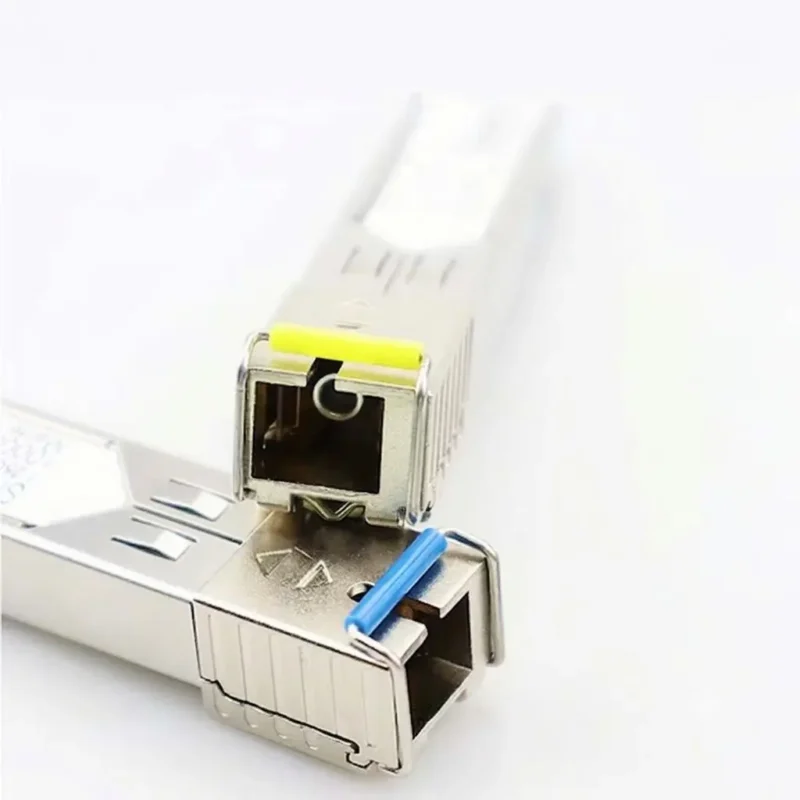
SFP Transceivers
Features
Comprehensive portfolio covering multi-rate 1G SFP, 10G SFP+, and 25G SFP28 interconnect solutions
Fully compliant with industry MSA specifications to ensure standardized mechanical and electrical designs
Programmed and thoroughly tested for reliable platform recognition across major OEM hardware systems
Supports digital diagnostic monitoring (DDM/DOM) to trace real-time optical link performance parameters
Premium zinc-alloy housings engineered to optimize heat dissipation and protect internal laser diodes
Hardened wide-temperature modules rated for stable continuous operations from -40°C up to 85°C
Advanced BiDi WDM transceivers designed to double operational fiber bandwidth over single-strand links
High-efficiency RJ45 copper transceivers supporting reliable metallic Ethernet routing up to 100 meters
Structured engineering selection matrices designed to streamline technical link budgeting and procurement verification
Fully certified to CE, FCC, and RoHS benchmarks with comprehensive datasheet download availability
- sales@connector-sensor.com
- +86 15120067961
- Connectors121 products
- Sensors121 products
- Optoelectronic Modules1 product
SFP Transceiver Modules for Fiber & Copper Networks
Explore a reliable selection of SFP, SFP+, and SFP28 transceivers engineered for enterprise networking, telecommunications, data centers, and industrial automation. Our portfolio supports multi-rate Ethernet standards and varied transmission reaches to ensure stable network connectivity across your infrastructure.
Standardized Specification: Fully compliant with MSA benchmarks (SFF-8472, SFF-8431) for cross-vendor hardware deployment.
Tested Interoperability: Each SFP module is individually programmed for reliable platform recognition and link integrity.
Integrated Telemetry: Supports Digital Diagnostic Monitoring (DDM), also known as DOM, for real-time optical network maintenance.
Product Categories by Data Rate
1G SFP Modules (Gigabit Ethernet)
Cost-effective solutions for edge access, enterprise local area networks (LANs), and legacy hardware expansion. Supports common optical and copper interfaces for flexible local patching.
10G SFP+ Transceivers
The standard benchmark for enterprise core switching, Storage Area Networks (SAN), and mid-range carrier aggregation. Optimized for high-bandwidth server-to-switch clustering and network consolidation.
25G SFP28 Transceivers
High-density optics built for next-generation Top-of-Rack (ToR) switching, cloud data centers, and 5G mobile fronthaul networks. Provides an efficient migration path toward 100G network architectures.
Optical Media & Specification Selection Guide
| Data Rate | Standard | Wavelength | Fiber Type | Connector | Reach | Typical Application |
| 1G | 1000BASE-SX | 850nm | Multimode (OM2/OM3) | Duplex LC | 550m | Intra-building server racks, local network patching |
| 1G | 1000BASE-LX | 1310nm | Single-mode (OS2) | Duplex LC | 10km | Inter-building campus backbones, media converters |
| 1G | 1000BASE-T | Electrical | Copper (Cat5e) | RJ-45 | 100m | Local metallic Ethernet routing, switch-to-appliance |
| 10G | 10GBASE-SR | 850nm | Multimode (OM3/OM4) | Duplex LC | 300m | Enterprise core switching, high-speed virtualization |
| 10G | 10GBASE-LR | 1310nm | Single-mode (OS2) | Duplex LC | 10km | Metropolitan area networking, enterprise backbones |
| 10G | 10GBASE-ER | 1550nm | Single-mode (OS2) | Duplex LC | 40km | Long-haul carrier transport, utility backbone networks |
| 10G | 10GBASE-ZR | 1550nm | Single-mode (OS2) | Duplex LC | 80km | Regional infrastructure links, long-distance telecom |
| 10G | 10GBASE-T | Electrical | Copper (Cat6a) | RJ-45 | 30m | High-speed server clustering, short-run metallic links |
| 25G | 25GBASE-SR | 850nm | Multimode (OM4) | Duplex LC | 100m | Next-generation cloud data centers, ToR architectures |
| 25G | 25GBASE-LR | 1310nm | Single-mode (OS2) | Duplex LC | 10km | 5G mobile fronthaul deployment, core aggregation |
| 1G / 10G | BiDi SFP | WDM Pair | Single-mode (OS2) | Simplex LC | 10km – 40km | Single-strand fiber link optimization, capacity scaling |
OEM Platform Compatibility
Our third-party compatible SFP optical transceivers are programmed for platform recognition and thoroughly tested for multi-vendor interoperability. These modules conform to MSA standards to ensure stable interoperability and consistent software integration with major switch and router hardware platforms, including:
Cisco Systems (Catalyst, Nexus, Meraki)
HPE Aruba (ArubaOS-CX, ProCurve)
Juniper Networks (EX, QFX, MX Series)
Ubiquiti Networks (UniFi, EdgeSwitch)
Mikrotik (RouterOS Systems)
Other major platforms (Dell, Intel, Mellanox, Netgear)
Technical Features & Performance
Proactive DDM / DOM Monitoring
Compliant with the SFF-8472 standard, our SFP transceivers support integrated Digital Diagnostic Monitoring (DDM), also known as DOM. This telemetry bus tracks real-time operational parameters directly through your system console to assist in predictive link maintenance:
Optical Transmitter (TX) Power
Optical Receiver (RX) Power
Laser Bias Current
Internal Module Temperature
Supply Voltage
Hardened Industrial-Grade Availability
For harsh environments, we also offer industrial-grade SFP modules designed to withstand challenging conditions with specialized shielding and thermal engineering:
Extended Operational Temperature: Rated for continuous performance from -40°C to 85°C.
Enhanced Thermal Management: Zinc-alloy housings engineered to maximize heat dissipation and component longevity.
Electromagnetic Protection: Reinforced internal shielding to mitigate high EMI on automation and factory floors.
Targeted Network Applications
Enterprise Data Centers: Reliable high-density server-to-switch and switch-to-switch clustering.
Telecom Backhaul: Long-distance transport links for metropolitan and cross-regional networks.
Industrial Automation: Hardened network infrastructure for outdoor security, utility grids, and transportation hubs.
Storage Area Networks (SAN): Low-latency, high-throughput Fibre Channel connectivity for enterprise storage arrays.
FAQ
1.What is an SFP transceiver?
An SFP (Small Form-factor Pluggable) transceiver is a compact, hot-pluggable network interface module used for data communications. It bridges the hardware motherboard of devices like switches and routers with fiber optic or copper networking cables.
2. What is the difference between SFP and SFP+?
The primary difference is the supported data rate. A standard SFP module typically handles speeds up to 1Gbps, while an SFP+ (SFP Plus) transceiver is an enhanced form factor designed to support data rates of 10Gbps and higher.
3.What is the difference between SFP and SFP28?
SFP28 is an evolved version of SFP+, specifically optimized for 25Gbps per channel lanes. While sharing the same structural dimensions, SFP28 transceivers utilize upgraded electrical routing and clocking to handle higher speeds, commonly deployed in 25G ToR switching and 5G mobile fronthaul applications.
4. Can I use an SFP+ module in a standard SFP port?
In most standard networking configurations, an SFP+ transceiver cannot operate in a 1G SFP-only port because the slot lacks the necessary electrical architecture to support 10G speeds. However, a 1G SFP module can often work in a 10G SFP+ port if the host switch software explicitly allows multi-rate down-negotiation.
5. What is a BiDi SFP transceiver?
A BiDi (Bi-Directional) SFP transceiver utilizes Wavelength-Division Multiplexing (WDM) to transmit and receive data simultaneously over a single strand of single-mode fiber. By pairing differing wavelengths (such as TX1310nm/RX1550nm), BiDi modules allow engineers to double fiber capacity using existing cable deployments.
6. How do I choose between single-mode and multimode SFP modules?
Selection is dictated by your fiber cable infrastructure and distance requirements. Multimode SFP modules (typically 850nm) operate over OM3/OM4 cabling and are optimized for short-range deployments under 550 meters. Single-mode SFP modules (typically 1310nm/1550nm) operate over OS2 cabling and are engineered for long-haul distances up to 10km, 40km, or 80km.
7. Which SFP module is best for a 10km transmission distance?
For a standard 10km link budget, an industry-standard 1310nm single-mode transceiver is recommended. For 1G links, this corresponds to a 1000BASE-LX SFP; for 10G links, it corresponds to a 10GBASE-LR SFP+ module.
8. What does DDM mean in SFP modules?
DDM stands for Digital Diagnostic Monitoring, also known as DOM. It is a feature that allows network operators to read real-time diagnostic telemetry, including optical output/input power, operating temperature, and laser bias current, helping to avoid unpredicted link degradation.
Request Technical Support & Procurement Quotes
Need an exact cross-reference for an OEM part number or require technical advice on custom WDM setups? Our engineering and sales teams are available to provide project-specific assistance.
Request a Quote: Contact sales for project-based volume pricing, availability, and lead times.
Download Datasheet: Access granular mechanical diagrams and optical power budget specification sheets.
Talk to an Engineer: Get technical support for industrial wide-temperature planning or complex optical path deployment.
For direct sales inquiries, technical specifications, or customized volume quotes, please contact us via email at sales@connector-sensor.com or call our support team at +86 15120067961.
Send Message to get Datasheet.
Strict Production Process
Engineers develop optimized electronic circuits and structural designs based on real application needs.
High-quality components and materials are carefully selected from trusted suppliers to ensure long-term reliability.
Automated SMT and precision soldering technologies are used to build stable and high-performance circuit boards.
Sensor elements or connector terminals are assembled with the PCB and housing to ensure accurate operation and strong mechanical stability.
Each product undergoes strict calibration and functional testing to guarantee accuracy and stable performance.
Every unit is carefully inspected, labeled, and securely packaged to ensure it arrives safely and performs reliably for your applications.
Strict Production Process of Yafeite