



2.4 MM Connectors
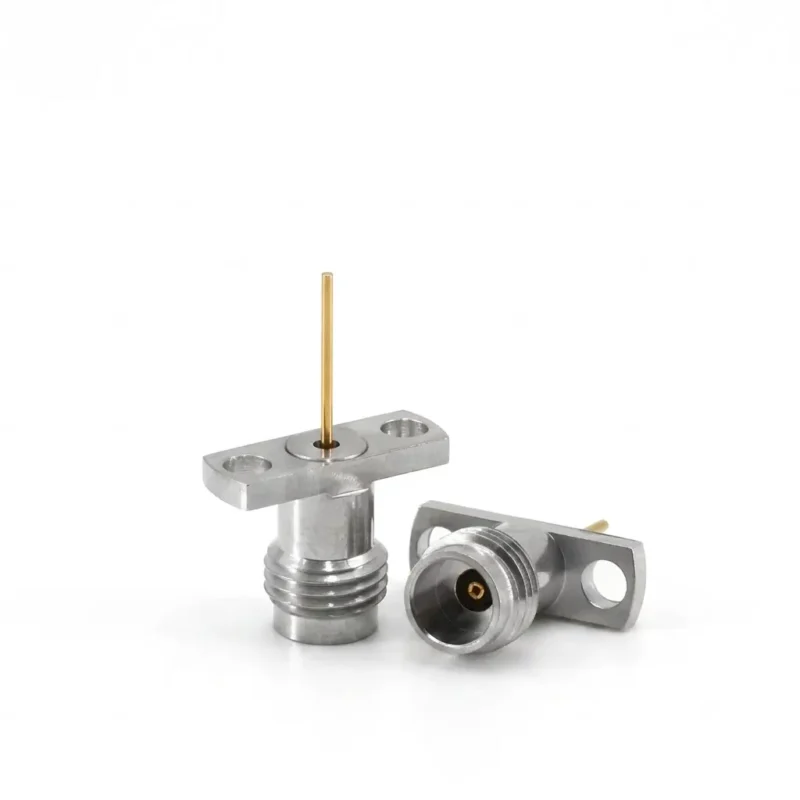
2.4 MM Connectors
Features
- Extends usable bandwidth to 50 GHz, covering full Ka-band and advanced mmWave applications
- Consistent impedance matching maintained to 50 GHz, minimizing reflections throughout the signal chain
- Air-filled signal path eliminates dielectric absorption and keeps performance stable across temperatures
- Thicker outer conductor walls strengthen female socket fingers, resisting wear over repeated mating cycles
- Protective mating sequence shields the center contact from damage during every connection
- Mechanically mates with 1.85mm connectors, giving your system a clear upgrade path to 65 GHz
- Non-intermateable with SMA, 3.5mm, and 2.92mm connectors, preventing accidental damage to precision ports
- Beryllium copper contacts with gold plating deliver low contact resistance and long-term durability
- Manufactured to precision connector standards with full compliance documentation available per part number
- sales@connector-sensor.com
- +86 15120067961
- Connectors121 products
- Sensors121 products
- Optoelectronic Modules1 product
2.4mm RF Connectors – Precision Coaxial Connectivity up to 50 GHz
Our 2.4mm RF coaxial connectors deliver precision performance for millimeter-wave applications where standard connectors begin to fail. Operating from DC to 50 GHz, they extend usable bandwidth 10 GHz beyond 2.92mm (K) connectors and far beyond SMA.
As a result, engineers can maintain signal integrity across higher frequencies without compromising mechanical durability. These connectors combine rugged construction, air dielectric design, and compatibility with 1.85mm interfaces—placing them at the top tier of precision RF interconnect solutions.
Product Advantages of 2.4mm RF Connectors
Rated to 50 GHz — Extending Beyond 2.92mm Limits
While 2.92mm connectors typically stop at 40 GHz, 2.4mm connectors continue to 50 GHz with mode-free transmission. This extended range supports Ka-band systems, emerging V-band applications, and next-generation mmWave testing.
Rugged Outer Conductor Enhances Durability
A thicker outer conductor wall strengthens the interface compared to SMA, 3.5mm, and 2.92mm designs. Consequently, the connector resists wear from repeated mating, side loads, and handling in demanding environments.
Outer Conductor Engages First for Protection
During mating, the outer conductor makes contact before the center pin. This design reduces alignment risk and protects the center contact from damage. Therefore, users achieve more consistent and reliable connections over time.
Designed to Prevent Misuse
Unlike 3.5mm and 2.92mm connectors, the 2.4mm interface does not mate with SMA or similar types. This intentional incompatibility prevents accidental misuse and protects high-value test equipment from damage.
Compatible with 1.85mm Connectors
At the same time, 2.4mm connectors mate directly with 1.85mm connectors (rated to 65 GHz). This compatibility allows engineers to scale systems toward higher frequencies without replacing existing infrastructure.
Air Dielectric Minimizes Signal Loss
Instead of using solid dielectric materials, the connector uses an air dielectric. As a result, it minimizes signal loss, eliminates dielectric drift, and improves phase stability—critical for precision measurements.
Low VSWR and Insertion Loss Across Full Range
Precision machining and gold-plated beryllium copper contacts ensure stable performance. Consequently, VSWR remains below 1.3:1 across the full 50 GHz range, supporting accurate and repeatable measurements.
Built for Harsh Environments
These connectors support at least 500 mating cycles and operate from −65°C to +165°C. Therefore, they perform reliably in aerospace, defense, and outdoor deployments.
Standards Compliance Ensures Consistency
All connectors meet IEC 61169-40 and IEEE 287-2007 standards. In addition, full traceability and compliance documentation are available for quality assurance.
Key Specifications
| Parameter | Value |
|---|---|
| Frequency Range | DC – 50 GHz |
| Impedance | 50 Ω |
| Max VSWR | ≤ 1.3:1 |
| Dielectric | Air (with short bead support) |
| Operating Temperature | −65°C to +165°C |
| Mating Cycles | ≥ 500 |
| Coupling Mechanism | Screw-on (threaded) |
| Mechanical Compatibility | 1.85mm connector series |
| Body Material | Stainless steel, passivated |
| Center Contact | Beryllium copper (BeCu), gold plated |
| Standards | IEC 61169-40, IEEE 287-2007 |
Product Configurations
- 2.4mm Male Connectors
Center pin interface for cable-end termination, cable assembly construction, and module output ports.
- 2.4mm Female Connectors
Center socket interface for panel mounting, PCB installation, instrument front panels, and DUT (device under test) access ports.
- 2.4mm Bulkhead Connectors
Panel-mount feedthrough connectors for chassis and enclosure walls. Provides a robust, secured RF passthrough between internal circuitry and external test or system connections.
- 2.4mm PCB Connectors
Board-mount versions including edge-launch (end launch) and surface-mount configurations for direct integration onto high-frequency PCBs, MMIC evaluation boards, and mmWave circuit substrates.
- 2.4mm Adapters
Between-series and within-series adapters: 2.4mm to 2.4mm, 2.4mm to 1.85mm, 2.4mm to 2.92mm (with adapter), and 2.4mm to 3.5mm (with adapter). Precision-grade, minimal added loss.
Applications
Test & Measurement
Engineers rely on 2.4mm connectors for VNAs and signal generators above 40 GHz. Because of their repeatability, they are ideal for calibration and precision measurement setups.
5G mmWave Systems
As 5G expands into higher frequency bands, these connectors provide stable performance across the entire FR2 range and beyond.
Aerospace & Defense
They maintain electrical stability under vibration, shock, and extreme temperatures, making them suitable for radar, EW, and satellite systems.
SATCOM
Low VSWR and consistent phase performance support high-frequency communication payloads and phased arrays.
Automotive Radar Development
Engineers use PCB-mounted 2.4mm connectors to evaluate 77 GHz and 79 GHz radar front ends with minimal signal distortion.
Semiconductor & mmWave Research
They enable accurate S-parameter measurements and device characterization up to 50 GHz.
2.4mm vs. 2.92mm vs. SMA
| SMA | 2.92mm (K) | 2.4mm | |
|---|---|---|---|
| Max Frequency | 18 GHz | 40 GHz | 50 GHz |
| Dielectric | Solid PTFE | Air | Air |
| Outer Conductor | Standard wall | Standard wall | Thicker / ruggedized |
| Mating Sequence | Simultaneous | Simultaneous | Outer first — center protected |
| Mates with SMA? | Yes | Yes | No (by design) |
| Mates with 1.85mm? | No | No | Yes |
| Typical Use | Sub-18 GHz general RF | mmWave to 40 GHz | Precision mmWave to 50 GHz |
Choose 2.4mm when your application runs above 40 GHz, when connector longevity and repeatability are critical, or when you need a path forward to 65 GHz via 1.85mm compatibility.
FAQ
- What is the frequency range of a 2.4mm RF connector?
Our 2.4mm connectors operate from DC to 50 GHz with mode-free transmission — 10 GHz higher than 2.92mm K connectors and nearly three times the upper limit of SMA.
2. What is a 2.4mm coaxial connector?
The 2.4mm connector is a 50-ohm precision RF coaxial connector defined by its 2.4mm outer conductor inner diameter, air dielectric construction, and screw-on coupling mechanism. It is standardized under IEC 61169-40 and IEEE 287-2007, and is used where reliable, low-loss performance above 40 GHz is required.
3. Can a 2.4mm connector mate with SMA, 3.5mm, or 2.92mm connectors?
No — and intentionally so. The thread dimensions differ from SMA, 3.5mm, and 2.92mm to prevent accidental mating. Forcing incompatible connectors together can permanently damage the precision interface. Use between-series adapters when a connection between these families is needed.
3. What connectors are compatible with 2.4mm?
2.4mm connectors are directly mechanically compatible with 1.85mm connectors (rated to 65 GHz). For connections to other families (2.92mm, 3.5mm, SMA), precision between-series adapters are available.
4. What is a 2.4mm PCB connector?
A 2.4mm PCB connector mounts directly onto a circuit board — either at the board edge (end launch) or on the surface — providing a coaxial-to-PCB transmission line transition with minimal added reflection. It is the standard access point for characterizing mmWave circuits and components in the lab.
5. What is the 2.4mm connector frequency range vs 2.92mm?
The 2.4mm connector is rated to 50 GHz; the 2.92mm K connector is rated to 40 GHz (or 46 GHz in KAPTON variants). If your system operates above 40 GHz, the 2.4mm is the correct choice.
Send Message to get Datasheet.
Strict Production Process
Engineers develop optimized electronic circuits and structural designs based on real application needs.
High-quality components and materials are carefully selected from trusted suppliers to ensure long-term reliability.
Automated SMT and precision soldering technologies are used to build stable and high-performance circuit boards.
Sensor elements or connector terminals are assembled with the PCB and housing to ensure accurate operation and strong mechanical stability.
Each product undergoes strict calibration and functional testing to guarantee accuracy and stable performance.
Every unit is carefully inspected, labeled, and securely packaged to ensure it arrives safely and performs reliably for your applications.
Strict Production Process of Yafeite