


Semi-Flexible Cable Assemblies
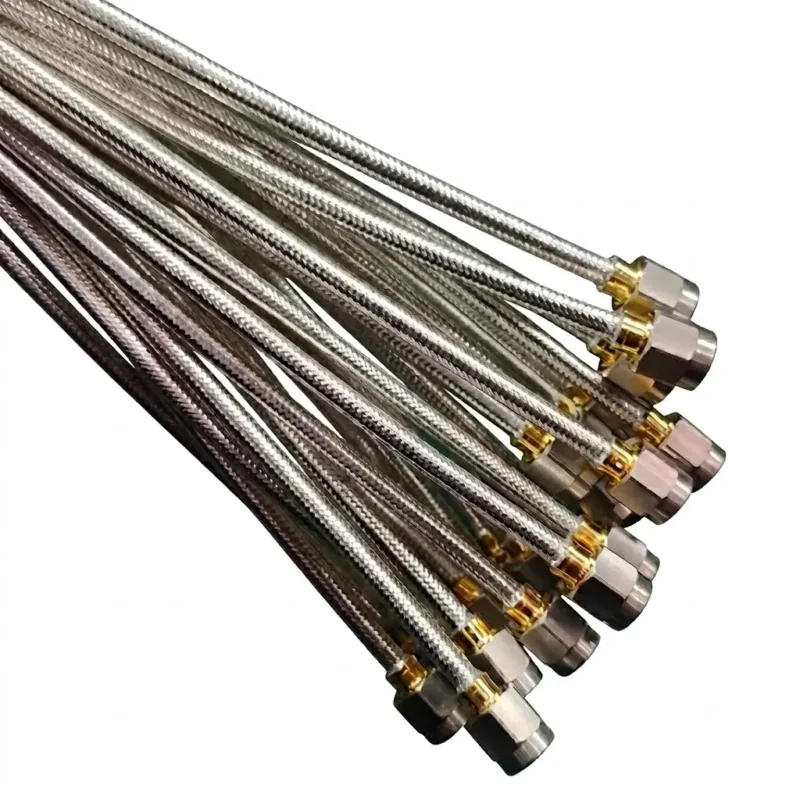
Semi-Flexible Cable Assemblies
Features
- Hand-formable outer conductor enables easy routing and re-routing without custom tooling
- Tin-plated spiral-wrap and braid shield provides over 130 dB shielding effectiveness with minimal crosstalk
- Solid center conductor and PTFE dielectric deliver low insertion loss and stable attenuation
- Retains its formed shape after bending, unlike fully flexible coax
- Supports standard RF connectors such as SMA, N-Type, TNC, and BNC with reliable soldered termination
- Reduces total assembly costs by eliminating precision bending tools and fixtures
- Maintains low VSWR and stable phase performance after bending or rework
- Supports moderate RF power handling with a low-resistance solid center conductor
- Operates from -55°C to +200°C with custom lengths and matched-phase options available
- Proven in aerospace, defense, telecom, and test systems from DC to tens of GHz
- sales@connector-sensor.com
- +86 15120067961
- Cable Assemblies9 products
- Connectors124 products
- Sensors121 products
- Automotive Sensors11 products
- Position Sensors1 product
- Proximity Sensors1 product
- Flow Sensors9 products
- Force Sensors21 products
- Gas Sensors18 products
- Photoelectric Sensors14 products
- Pressure Sensors19 products
- Temperature and Humidity Sensors3 products
- Temperature Sensors24 products
- Vision Sensors10 products
- IMU Sensor1 product
- Optoelectronic Modules1 product
Semi-Flexible Cable Assemblies
Semi-flexible cable assemblies are a specialized type of RF cable assembly that combines the electrical stability of solid-shield coax with the installation flexibility that semi-rigid cable cannot provide. They feature a solid center conductor—available in bare copper, silver-plated copper, or copper-clad steel—a PTFE dielectric, and a two-layer outer conductor consisting of a helically wrapped metal tape covered by a tin-plated braided shield.
This construction allows technicians to bend and route the cable by hand while enabling it to retain its shape after installation. Compared with fully flexible coax, it offers greater dimensional stability. Compared with semi-rigid cable, it is easier to install and rework.
As a result, semi-flexible cable assemblies are widely used in radar, satellite communications, telecommunications, and test systems, delivering near semi-rigid performance without the tooling and handling challenges of semi-rigid cable assemblies.
What Is Semi-Flexible Cable Assembly
A semi-flexible cable assembly is a coaxial RF interconnect built around three main components: a solid or stranded center conductor, a solid PTFE (Teflon) dielectric, and a two-layer outer conductor. The outer conductor consists of a helically wrapped metal tape covered by a tin-plated braided shield, providing both electrical performance and mechanical protection.
This construction distinguishes semi-flexible cable from other coaxial cable types.
- Semi-rigid cable uses a seamless metal tube as its outer conductor, providing excellent shielding and phase stability. However, once formed, it is difficult to reshape without risking damage.
- Fully flexible cable uses a braided outer conductor over a stranded center conductor, offering excellent flexibility but typically higher insertion loss, lower shielding effectiveness, and greater phase variation.
- Semi-flexible cable bridges the gap between the two. It can be hand-formed during installation and reshaped if routing changes, without requiring specialized bending tools.
Because it combines a solid center conductor with a highly metallic outer shield, semi-flexible cable delivers low insertion loss, excellent EMI shielding, and high signal stability while simplifying installation and reducing manufacturing costs.
Advantages of Semi-Flexible Cable Assemblies
Hand-Formable Without Custom Tooling
The spiral-wrapped outer conductor allows technicians to bend and route the cable by hand, eliminating the need for specialized forming tools, mandrels, and fixtures.
Low Insertion Loss and Excellent Shielding
The solid center conductor and metallic outer shield provide low signal loss, high isolation, and excellent EMI protection for demanding RF applications.
Stable Phase and VSWR Performance
Semi-flexible cable assemblies maintain consistent phase, insertion loss, and VSWR performance even after bending or rerouting.
Standard RF Connector Compatibility
Available with common RF connectors such as SMA, N-Type, TNC, BNC, 2.92mm, and 2.4mm, enabling easy integration into existing systems.
Lower Assembly Cost
By reducing tooling requirements and minimizing forming-related scrap, semi-flexible cable assemblies help lower overall production costs.
Moderate Power Handling Capability
The low-resistance center conductor reduces heat generation, making these assemblies suitable for moderate RF power transmission and signal applications
Typical Applications
Semi-flexible cable assemblies are ideal for applications that require near semi-rigid electrical performance with greater installation flexibility.
- Aerospace and satellite communications — Antenna feed lines, avionics interconnects, and SATCOM modules where compact routing, vibration resistance, and reliability are essential.
- Defense and military systems — Radar, electronic warfare (EW), and communication platforms requiring MIL-DTL-17-compliant construction and easy field maintenance.
- Telecommunications infrastructure — Base stations and equipment racks where cables must be routed through confined spaces without the limitations of rigid metal tubing.
- Test and measurement — Instrumentation and calibration systems requiring repeatable, low-loss, and phase-stable performance.
- Broadcast and RF/microwave systems — Antenna, transceiver, and signal distribution applications operating from DC to the low tens of GHz.
Construction & Technical Options
| Specification | Details |
|---|---|
| Cable Size | Common outer diameters follow semi-rigid-equivalent sizes such as .047″, .086″, .141″, and .250″, which determine insertion loss, power handling, and minimum bend radius. |
| Center Conductor | Bare copper, silver-plated copper, or copper-clad steel for an optimal balance of conductivity and strength. |
| Dielectric | Solid PTFE (Teflon) for stable electrical performance and consistent 50 Ω impedance. |
| Outer Conductor | Helically wrapped metal tape with a tin-plated braided shield for excellent shielding, flexibility, and mechanical protection. |
| Shielding Effectiveness | Typically exceeds 130 dB, minimizing EMI and crosstalk. |
| Operating Temperature | -55°C to +200°C |
| Jacket | FEP or PTFE for chemical and temperature resistance, with flame-retardant options available. |
| Connector Interface | Available with SMA, N-Type, TNC, BNC, 2.92mm, 2.4mm, MCX, MMCX, and other standard RF connectors in straight, right-angle, and bulkhead configurations. |
| Frequency Range | DC to the low tens of GHz, depending on cable size and connector selection. |
| Length & Tolerance | Custom lengths with tight electrical length and phase-matching tolerances for multi-channel and test applications. |
| Testing | 100% insertion loss, VSWR/return loss, and continuity testing, with traceability and test reports available upon request. |
Why Choose Our Semi-Flexible Cable Assemblies
We design and manufacture semi-flexible cable assemblies based on customer drawings or performance requirements, including standard RF connector interfaces, custom lengths, and matched-phase assemblies.
Our production capabilities support both prototype development and volume manufacturing, with electrical testing and documentation available for every production batch. Whether you need MIL-DTL-17-aligned construction, RoHS-compliant materials, or a custom connector configuration, our engineering team can provide a solution tailored to your application.
We also offer cross-reference support to help replace existing supplier part numbers and simplify product transitions.
FAQ
1.Is a semi-flexible cable assembly the same as a semi-rigid cable assembly?
No. Both use a solid center conductor and PTFE dielectric, but their outer conductor designs are different. Semi-rigid cable uses a solid metal tube, while semi-flexible cable uses a spiral-wrapped metal tape with a tin-plated braid. This allows semi-flexible cable to be hand-formed and adjusted after installation.
2. Can a semi-flexible cable assembly be re-routed after installation?
Yes. One of the main benefits of semi-flexible cable is that it can be reshaped during installation changes or field maintenance without the risk of damaging the outer conductor.
3. What frequency range do semi-flexible cable assemblies support?
Depending on cable size and connector selection, semi-flexible cable assemblies typically operate from DC to the low tens of GHz. They are widely used in RF, microwave, radar, and satellite communication systems.
4. Which connectors are available for semi-flexible cable assemblies?
Common RF connectors, including SMA, N-Type, TNC, BNC, 2.92mm, 2.4mm, MCX, and MMCX, are available in straight, right-angle, and bulkhead configurations.
5. Are semi-flexible cable assemblies more expensive than semi-rigid cable assemblies?
The material cost is generally comparable. However, semi-flexible cable assemblies often reduce total installation costs because they require fewer forming tools, fixtures, and specialized labor compared with semi-rigid cable.
6. Are matched semi-flexible cable assemblies available for multi-channel systems?
Yes. For applications requiring phase or amplitude consistency, such as phased-array antennas and multi-channel test systems, semi-flexible cable assemblies can be manufactured, tested, and supplied as matched sets with specified tolerances.
7. What operating temperature can semi-flexible cable assemblies withstand?
With a PTFE dielectric, semi-flexible cable assemblies typically operate from -55°C to +200°C, making them suitable for demanding environments such as aerospace, avionics, and high-temperature RF systems.
Ready to Find the Right Semi-Flexible Cable Assembly?
Tell us your frequency range, connector preferences, cable length, and application requirements. Our engineering team will recommend the right configuration and provide a fast, competitive quote.
Send Message to get Datasheet.
Strict Production Process
Engineers develop optimized electronic circuits and structural designs based on real application needs.
High-quality components and materials are carefully selected from trusted suppliers to ensure long-term reliability.
Automated SMT and precision soldering technologies are used to build stable and high-performance circuit boards.
Sensor elements or connector terminals are assembled with the PCB and housing to ensure accurate operation and strong mechanical stability.
Each product undergoes strict calibration and functional testing to guarantee accuracy and stable performance.
Every unit is carefully inspected, labeled, and securely packaged to ensure it arrives safely and performs reliably for your applications.
Strict Production Process of Yafeite