



UQDB Couplings
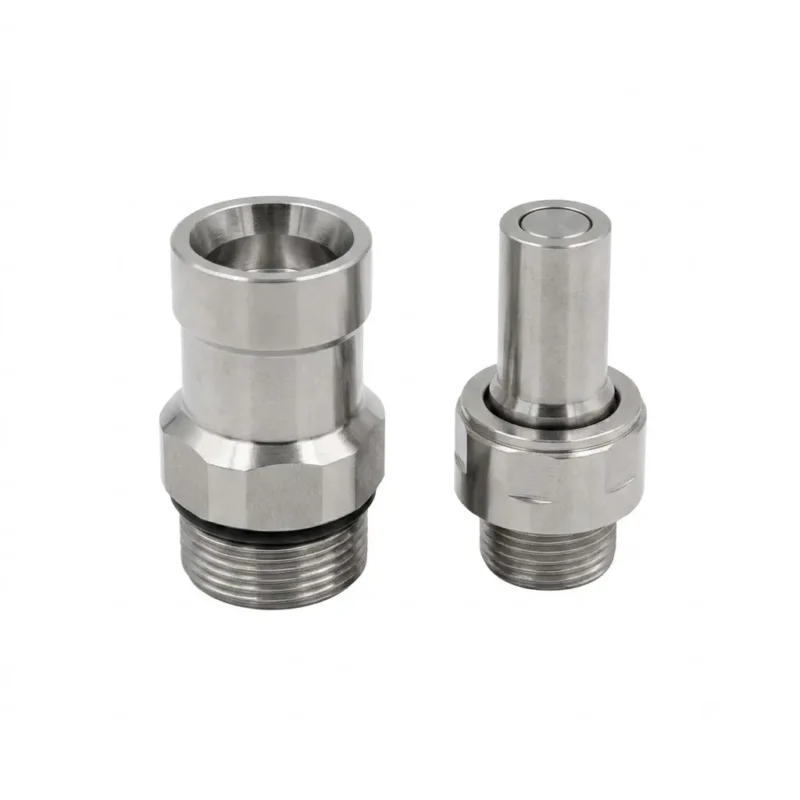
UQDB Couplings
Features
- Blind-mate design self-aligns as servers slide into the rack
- One-hand push-to-connect locking speeds up rack installation and service
- Flat-face seal keeps both sides leak-free, connected or disconnected
- Color-coded red and blue ports prevent supply-return wiring mistakes
- Four bore sizes match connectors precisely to your flow-rate needs
- Customizable tail interface adapts to your existing manifold or hose
- Rated for -55°C to +125°C across demanding data center environments
- Handles working pressure up to 1.6 MPa without compromising the seal
- Stainless steel body withstands years of coolant exposure and cycling
- EPDM seals handle glycol coolants and deionized water for 5,000 cycles
- sales@connector-sensor.com
- +86 15120067961
- Cable Assemblies9 products
- Connectors124 products
- Sensors121 products
- Automotive Sensors11 products
- Position Sensors1 product
- Proximity Sensors1 product
- Flow Sensors9 products
- Force Sensors21 products
- Gas Sensors18 products
- Photoelectric Sensors14 products
- Pressure Sensors19 products
- Temperature and Humidity Sensors3 products
- Temperature Sensors24 products
- Vision Sensors10 products
- IMU Sensor1 product
- Optoelectronic Modules1 product
Universal Quick Disconnect Blind-Mate (UQDB) Connectors
Liquid cooling is driving a fundamental shift in how data centers handle heat, and every cooling loop is only as reliable as its weakest connection point. That’s where UQDB connectors — sometimes called UQDB couplings — come in.
What Is UQDB Connector?
UQDB stands for Universal Quick Disconnect Blind-Mate. It’s a class of fluid connector built for one job: linking coolant lines inside a data center rack without spilling a drop, and without needing a technician to line anything up by hand.
The “blind-mate” part matters most. Unlike a standard hand-mate quick disconnect, a UQDB connector self-aligns as a server or tray slides into place. There’s no visual contact needed, and no fumbling behind a rack. Push the server home, and the connection locks itself.
This design grew out of the Open Compute Project (OCP), where server makers, coolant distribution unit (CDU) manufacturers, and connector suppliers worked together to standardize dimensions and performance. That collaboration is why UQDB has become the common term across the liquid cooling industry, from hyperscale data centers to HPC clusters.
Our UQDB Series: How It Works
Our UQDB Connectors follow this same push-to-connect, blind-mate principle, refined for daily use in production environments.
Slide the plug and socket together, and a direct-push locking mechanism engages automatically. One hand is all you need — no tools, no second person holding a bracket steady. Pull back on the sleeve, and the connector releases just as easily.
Sealing is where a lot of connectors fall short. Ours uses a flat-face seal design, so both sides stay sealed whether they’re connected or sitting apart. There’s no drip when you disconnect, and reconnecting won’t pull air into the loop. That matters in a live rack, where even a small leak near powered electronics is a real risk.
To cut down on installation mistakes, every connector carries a color code. Red marks the supply (warm) side, and blue marks the return (cold) side. Technicians can identify the right port at a glance, even in a crowded, poorly lit rack aisle.
Key Features
- One-hand push-to-connect and release — lock and unlock without tools, even in tight spaces
- Flat-face, zero-leak sealing — no drip when disconnected, no leak when mated
- Color-coded ports — red for supply, blue for return, so wiring mistakes drop to near zero
- Four bore sizes — match the connector to your actual flow-rate needs, from single-node to full-rack loops
- Customizable tail interface — we adapt the stem connection to fit your manifold or hose, so you don’t have to redesign your loop around our part
Technical Specifications
| Parameter | Value |
|---|---|
| Operating temperature | -55°C to +125°C (-67°F to +257°F) |
| Working pressure | 0 to 1.6 MPa (0 to approx. 232 psi) |
| Compatible media | Ethylene glycol coolant, propylene glycol coolant, deionized water, and similar fluids |
| Body material | Stainless steel |
| Seal material | EPDM (ethylene propylene diene monomer) rubber |
| Mechanical life | 5,000 mating cycles |
Where UQDB Connectors Are Used
UQDB connectors sit at two key points in a liquid cooling loop:
- Server-to-manifold connections — linking individual servers, sleds, or cold plates to the rack’s coolant manifold, so one unit can be pulled for service without draining the whole rack
- Manifold-to-piping connections — joining the rack manifold to the facility’s distribution piping or CDU
You’ll find this connector type across:
- Hyperscale and colocation data centers
- High-performance computing (HPC) clusters
- AI training and inference server racks
- Supercomputing facilities
- Any direct-to-chip or cold-plate liquid cooling deployment where uptime and serviceability both matter
Why Choose Our UQDB Connectors
Data center operators don’t get a second chance when a connector fails mid-swap. A dripping coupling near a live server tray isn’t just an inconvenience — it can mean downtime, or damaged hardware.
We build our UQDB Series around that reality. The stainless steel body holds up over years of cycling and exposure to glycol-based coolants. We chose the EPDM seal specifically for compatibility with the fluids data centers actually run, not just water. And because every deployment looks a little different, we customize the tail interface instead of asking you to redesign your manifold around our connector.
If your current connector is due for review, or you’re specifying parts for a new liquid-cooled rack, we’re glad to walk through sizing, materials, and integration with your existing CDU or manifold setup.
FAQ
1. What’s the difference between UQD and UQDB connectors?
UQD is the hand-mate version — you connect it manually, aligning the plug and socket yourself. UQDB adds blind-mate self-alignment, so the connector seats itself as a server slides into a rack. Think of UQDB as the rack-scale, automated evolution of UQD.
2. Will your UQDB connectors work with other manufacturers’ UQDB parts?
The UQDB category follows dimensional and performance guidelines set through the Open Compute Project, which is why parts from different suppliers are often interchangeable. That said, tolerances and materials vary by manufacturer. Send us your existing part number or drawing, and we’ll confirm compatibility before you order.
3. What coolants can I run through a UQDB connector?
Our UQDB Series is rated for ethylene glycol and propylene glycol coolant blends, deionized water, and similar fluids common in data center cooling loops. Running something less common? Let us know, and we’ll check seal compatibility first.
4. How long do UQDB connectors actually last?
Our connectors are rated for 5,000 mating cycles. In practice, that covers years of routine maintenance and server swaps before a connector needs replacing.
5. Can I get a custom tail or port configuration?
Yes. The bore size and sealing design stay standard, but we adapt the tail connection to match your current hose or manifold fitting, so you don’t have to change your existing piping layout.
6. What sizes are available?
We offer four bore sizes, each suited to a different flow rate:
UQDB-02 (3.2 mm / 1/8″): For small blade servers and micro-nodes.
UQDB-04 (6.4 mm / 1/4″): For standard rack server nodes (CPU/GPU loops).
UQDB-06 (9.5 mm / 3/8″): For high-power multi-node servers and branch manifolds.
UQDB-08 (12.7 mm / 1/2″): For main rack manifolds and high-flow total loops.
Tell us your target flow rate and rack density, and we’ll recommend the right size for your loop.
Have a spec sheet to match, or a system to retrofit? Contact our engineering team for a datasheet, sample, or a compatibility check.
Send Message to get Datasheet.
Strict Production Process
Engineers develop optimized electronic circuits and structural designs based on real application needs.
High-quality components and materials are carefully selected from trusted suppliers to ensure long-term reliability.
Automated SMT and precision soldering technologies are used to build stable and high-performance circuit boards.
Sensor elements or connector terminals are assembled with the PCB and housing to ensure accurate operation and strong mechanical stability.
Each product undergoes strict calibration and functional testing to guarantee accuracy and stable performance.
Every unit is carefully inspected, labeled, and securely packaged to ensure it arrives safely and performs reliably for your applications.
Strict Production Process of Yafeite