



MQD Couplings
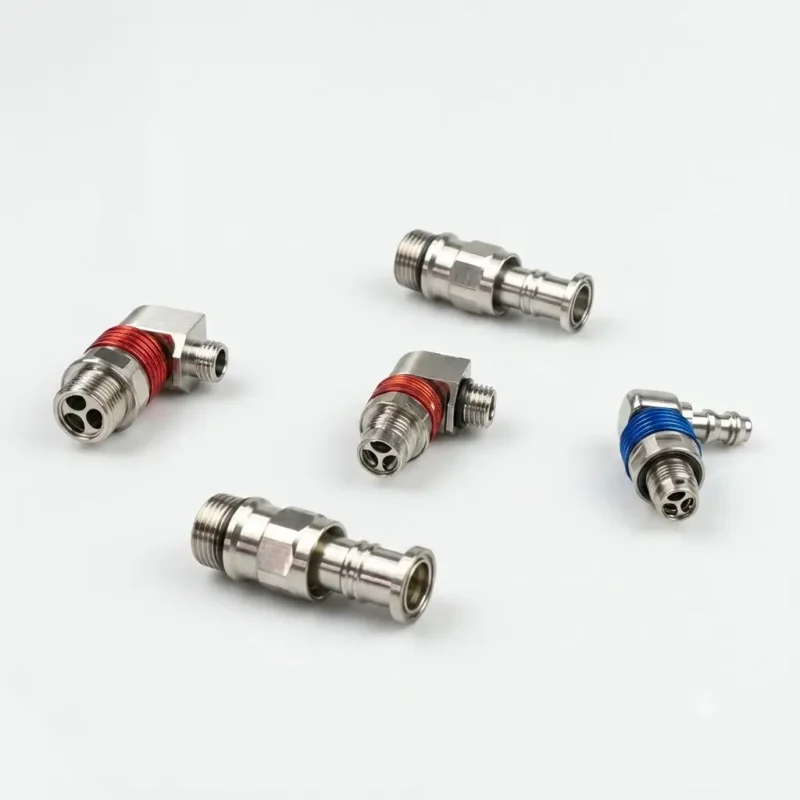
MQD Couplings
Features
- Compact multi-circuit design connects several coolant lines in one motion
- Dry-break, dual-poppet seal keeps every disconnect spill-free and drip-free
- High flow rate with low pressure drop, even in tight trays
- Available in sizes 02, 03, and 04 for flexible flow needs
- Hand-mate MQD or self-aligning blind-mate MQDB, your choice
- Straight or 90° right-angle configurations fit any tray layout
- 304/316L stainless steel body resists corrosion in demanding environments
- Rated for thousands of connect/disconnect cycles under vibration and thermal stress
- Interchangeable across qualified suppliers, giving you sourcing flexibility
- Fully customizable channel count, seals, and ports to match your design
- sales@connector-sensor.com
- +86 15120067961
- Cable Assemblies9 products
- Connectors126 products
- Sensors121 products
- Automotive Sensors11 products
- Position Sensors1 product
- Proximity Sensors1 product
- Flow Sensors9 products
- Force Sensors21 products
- Gas Sensors18 products
- Photoelectric Sensors14 products
- Pressure Sensors19 products
- Temperature and Humidity Sensors3 products
- Temperature Sensors24 products
- Vision Sensors10 products
- IMU Sensor1 product
- Optoelectronic Modules1 product
Multi Quick Disconnect Couplings for AI & Data Center Liquid Cooling
Liquid cooling is no longer optional for AI servers. That’s because GPU racks now run hotter and denser than ever, and every fluid connection inside that rack has to keep up. That’s where MQD connectors come in.
MQD stands for Multi Quick Disconnect. In short, it’s a compact, multi-circuit coupling that connects and disconnects several coolant lines at once, in the tight space of a compute tray. Below, we’ll walk through what MQD connectors are, how they work, which type fits your application, and what to check before you order.
What Is an MQD Connector?
MQD connector is a quick-disconnect coupling for single-phase water/glycol cooling loops inside AI and HPC infrastructure. Unlike a standard single-line coupling, MQD combines multiple fluid channels — supply and return, or several parallel circuits — into one interface. In practice, one plug-and-pull action connects (or disconnects) every channel at the same time.
The design grew out of the shift toward direct-to-chip liquid cooling for high-density AI racks. As GPU trays got more crowded, engineers needed a connector that could deliver high flow without eating up the millimeters left for tubing, power, and signal paths. MQD answers that need with a small footprint and a multi-channel body. Today, several major connector manufacturers produce it, with cross-vendor interchangeability in mind.
How Does an MQD Coupling Work?
The mechanism is simple to use, even though the engineering behind it isn’t. Every connection follows the same three-step sequence:
- Align and guide. Guide features on the multi-port interface steer the plug toward its matching socket, so every channel lines up at once.
- Insert and seal. As the connector seats, each channel’s seal engages, and the internal valves open together.
- Lock and flow. A positive latch clicks into place. All channels are now open and leak-tight under system pressure.
Naturally, disconnection simply reverses that sequence. When you release the latch, every valve closes at the same moment, and a dual-poppet, dry-break design traps the coolant inside both halves. That’s what keeps MQD connectors dripless: no puddle on the tray, no air pulled into the loop, and no need to drain the system first.
Our MQD Connector Types and Sizes
Not every MQD connector looks the same, though. Here’s how the family breaks down.
Hand-mate (MQD) vs. blind-mate (MQDB)
Hand-mate MQD connectors let a technician plug them in by hand — typical for service points they can see and reach. In contrast, blind-mate MQDB versions add self-alignment, so the connection completes correctly even when the port is out of sight, such as behind a sliding tray or inside a dense chassis.
Straight vs. Right-angle
A straight (inline) MQD has the lowest pressure drop, since the fluid path never bends. A 90° right-angle version costs a little more pressure drop, but it’s the better choice when tray height is tight and the tubing needs to exit sideways.
Size 02, 03, and 04
Our MQD couplings come in three sizes — roughly MQD02 (3.3 mm), MQD03 (4.9 mm), and MQD04 (6.4 mm) in nominal flow diameter. Larger sizes carry more flow but need more space, so the right size depends on your target flow rate and available envelope.
Multi-channel Layouts
Because MQD is a multi-circuit design by nature, it’s available in 2-channel, 4-channel, and higher configurations. Our team can build channel count, pitch, and port arrangement around your specific tray interface.
Key Technical Specifications
| Parameter | Typical Range |
|---|---|
| Nominal sizes | 02 / 03 / 04 (≈3.3–6.4 mm flow diameter) |
| Flow rate | Roughly 2–7 L/min per channel, size-dependent |
| Body material | 304 / 316L stainless steel (aluminum or engineering plastic on request) |
| Seal material | EPDM, FKM, or NBR, selected for coolant compatibility |
| Operating temperature | Commonly -40°C to 150°C, depending on seal material |
| Mating style | Hand-mate (MQD) or blind-mate (MQDB) |
| Configuration | Straight or 90° right-angle |
| Connect/disconnect cycles | Rated for thousands of cycles; exact figure depends on design |
| Leak testing | Helium leak testing |
Advantages of MQD Couplings
- Space-Saving
In a compute tray, you’ve already used up every millimeter you have. That’s why MQD’s compact envelope matters: it frees up room for denser tubing runs and shorter, straighter bends, which also helps lower pressure drop elsewhere in the loop.
- High Flow
Optimized internal flow paths keep pressure drop low, so pumps don’t have to work harder to hit the flow rate a GPU tray needs.
- Zero Spillage
The dry-break, dual-poppet design closes every channel the instant it disconnects. That means safer maintenance, less cleanup, and no risk of coolant reaching live electronics nearby.
- Fast Connections
A technician can seat or release a full multi-channel connection in one motion. For hyperscale operators swapping thousands of trays a year, that time adds up quickly.
- Reliable Durability
Vibration, thermal cycling, and repeated connect/disconnect events are part of daily life in a data center. That’s why we engineer and test every MQD coupling to keep sealing reliably through all of it.
- Cross-Vendor Compatible
Because the interface follows a shared industry design intent, MQD connectors from different qualified suppliers generally mate with each other. As a result, buyers gain flexibility in sourcing and avoid getting locked into a single vendor.
Where MQD Connectors Are Used
- AI and GPU server compute trays — the primary use case, where direct-to-chip cooling demands maximum flow in minimal space.
- Tray-to-manifold connections — linking individual server trays to the rack’s coolant distribution manifold.
- CDU supply and return lines — connecting Coolant Distribution Units to the rack loop.
- Cold plate connections — delivering coolant directly to the cold plates mounted on GPUs and CPUs.
- Other space-constrained thermal systems — power electronics, medical devices, and laser systems that face the same space-versus-flow trade-off as compute trays.
MQD vs. UQD vs. BMQC vs. LQC: What’s the Difference?
MQD isn’t the only quick-disconnect coupling in a liquid cooling loop. Instead, each type serves a different point in the system.
| Type | Best Suited For | Mating Style | Typical Flow Focus |
|---|---|---|---|
| MQD | Compute trays, multi-circuit connections | Hand-mate or blind-mate (MQDB) | Compact, moderate flow |
| UQD | General rack-level service points | Hand-mate | Standard flow, OCP-aligned |
| BMQC | OCP Open Rack V3 chassis-to-manifold | Blind-mate | Standard flow |
| LQC | Cold plate and manifold interfaces needing high flow | Screw-to-connect | High flow, larger bore |
In short: if the connection needs to carry several fluid circuits through one compact interface — the way a compute tray does — MQD is usually the right fit. If you just need a single high-flow line with more room to work in, UQD or LQC may serve better.
How to Choose the Right MQD Connector
A few questions will narrow the decision quickly:
- How much flow do you need per channel? Match your target flow rate and acceptable pressure drop to a nominal size (02/03/04).
- Can a technician see and reach the port, or not? Visible, hand-accessible points call for standard MQD. Otherwise, hidden or hard-to-reach points call for blind-mate MQDB.
- How much vertical clearance do you have? Straight configurations give the lowest pressure drop; right-angle configurations solve height-constrained layouts.
- What coolant are you running? Confirm seal material (EPDM, FKM, NBR) is compatible with your fluid chemistry and additive package.
- How many circuits does the tray need? Decide on channel count and pitch early, since this drives the whole interface layout.
Still unsure which configuration fits? Send us your tray drawing and flow target, and our engineering team will recommend a spec.
Why Choose HUADA GROUP MQD Connectors
Complete Cooling Solutions
More than just MQD connectors. We also supply liquid cooling quick disconnects, flow sensors, pressure sensors, and temperature sensors, giving you a single source for both fluid connections and cooling system monitoring.
20+ Years of Connector Expertise
Since 2002, HUADA has specialized in high-performance connector solutions. Our liquid cooling products build on decades of engineering experience to support today’s AI servers, HPC systems, data centers, energy storage, and industrial cooling applications.
Quality You Can Depend On
Every product is manufactured under certified quality management systems, such as ISO 9001, AS9100, and IATF 16949. Rigorous inspection and reliability testing help ensure stable performance in demanding environments.
Fast Delivery & Responsive Support
Standard production lead times can be as short as two weeks. Our engineering and sales teams provide prompt technical support throughout product selection, customization, and after-sales service.
Custom Solutions for Your System
We offer OEM and custom configurations, including channel count, port layout, straight or right-angle designs, body materials, sealing materials, and interface options to match your cooling architecture and OCP-compatible requirements.
Built for Long-Term Partnerships
From prototype development to volume production, we work closely with OEMs, system integrators, and data center equipment manufacturers to deliver reliable products, consistent quality, and dependable supply.
FAQ
1.What does MQD stand for?
MQD stands for Multi Quick Disconnect, a multi-circuit fluid coupling for liquid cooling systems. You’ll find it most often in AI server compute trays.
2. What’s the difference between MQD and MQDB?
MQD is the hand-mate version, which a technician connects manually. MQDB, on the other hand, is the blind-mate version: it includes self-alignment features for ports that are hard to see or reach.
3. Are MQD connectors interchangeable between brands?
Generally, yes. MQD couplings from qualified suppliers follow a shared design intent, so a plug from one vendor typically mates with a socket from another. That said, always confirm compatibility for your specific model before mixing suppliers.
4. Do MQD connectors leak when you disconnect them?
No. They use a dry-break, dual-poppet design, which closes both halves at the moment of disconnection. At most, a small trace of fluid remains — not a spill.
5. Can MQD connectors be customized?
Yes. You can configure channel count, pitch, port diameter, straight vs. right-angle routing, seal material, and mounting interface around your tray design.
6. What coolant works with MQD connectors?
Most MQD connectors work with single-phase water/glycol coolant loops, common in AI and data center liquid cooling. If you’re running a different fluid or additive package, confirm seal compatibility first.
Get a Quote or Technical Consultation
Tell us your flow rate, available space, and channel count, and we’ll help you find the right MQD configuration for your project.
Send Message to get Datasheet.
Strict Production Process
Engineers develop optimized electronic circuits and structural designs based on real application needs.
High-quality components and materials are carefully selected from trusted suppliers to ensure long-term reliability.
Automated SMT and precision soldering technologies are used to build stable and high-performance circuit boards.
Sensor elements or connector terminals are assembled with the PCB and housing to ensure accurate operation and strong mechanical stability.
Each product undergoes strict calibration and functional testing to guarantee accuracy and stable performance.
Every unit is carefully inspected, labeled, and securely packaged to ensure it arrives safely and performs reliably for your applications.
Strict Production Process of Yafeite