



2.92 MM Connectors
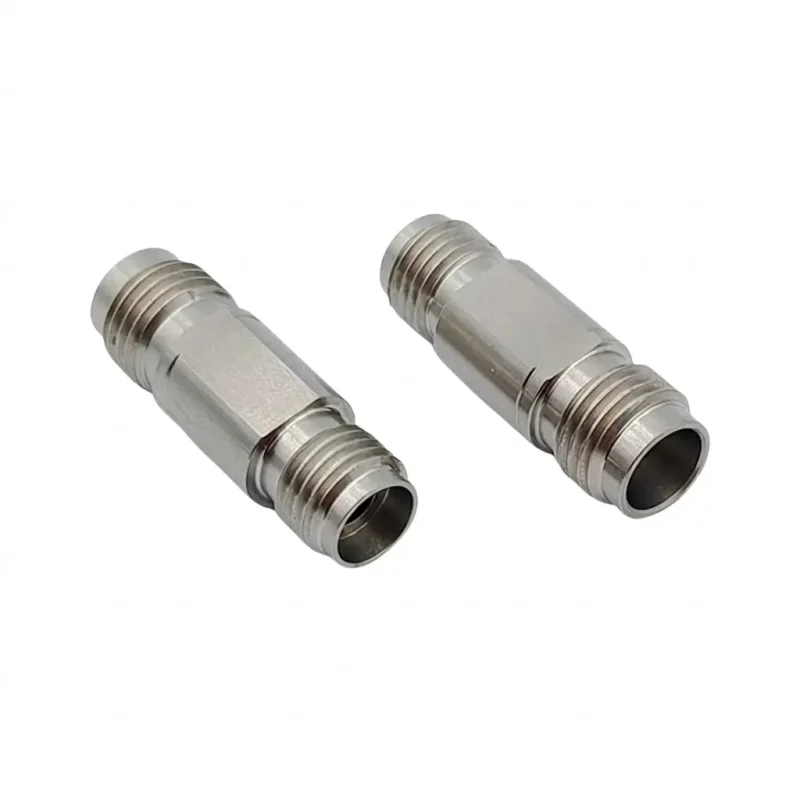
2.92 MM Connectors
Features
- Clean, interference-free signal transmission from DC to 40 GHz — no higher-order modes
- Less than 0.5 dB insertion loss at 40 GHz keeps every measurement accurate and on spec
- Stable impedance matching maintained across the entire rated range, minimizing signal reflections
- Air dielectric construction eliminates dielectric loss and resists performance drift over temperature
- Mechanically compatible with SMA and 3.5mm connectors — no adapters, no extra hardware
- BeCu center contacts with gold plating deliver low contact resistance and lasting conductivity
- Passivated stainless steel housing rated for 500+ mating cycles in lab and field use
- Engineered to perform reliably from −65°C to +165°C across aerospace and defense environments
- Male, female, bulkhead, end launch, and adapters — one series covering every application
- Compliant with IEC 61169-35, MIL-PRF-39012, and MIL-STD-348. Full documentation available
- sales@connector-sensor.com
- +86 15120067961
- Connectors121 products
- Sensors121 products
- Optoelectronic Modules1 product
2.92mm RF Connectors (K Connectors) – Push Your System Beyond 40 GHz
Our 2.92mm RF connectors—also known as K connectors or SMK connectors—are built for engineers who need clean, reliable signal transmission well into the millimeter-wave range. With a mode-free frequency range of DC to 40 GHz (standard ULTEM) or DC to 46 GHz (high-frequency KAPTON), they deliver more than double the bandwidth of standard SMA connectors. As a result, you can extend system performance without the compromises that occur when pushing SMA beyond its limits.
Whether you’re specifying a VNA test port, designing a 5G mmWave front end, or qualifying aerospace hardware, this connector series provides both the electrical precision and mechanical durability required in demanding applications.
Why Choose Our 2.92mm Connectors?
Mode-Free Performance to 40 GHz — or 46 GHz
Our standard 2.92mm connectors (ULTEM insulator) operate cleanly from DC to 40 GHz with no higher-order mode interference. In addition, the KAPTON-insulator variant extends performance to 46 GHz. Therefore, it becomes the preferred option for advanced lab measurements and high-frequency mmWave development.
Insertion Loss Below 0.5 dB at 40 GHz
Signal attenuation remains extremely low—under 0.5 dB at 40 GHz for the standard type, and under 0.6 dB at 46 GHz for the high-frequency version. Consequently, engineers achieve tighter calibration and more reliable measurement data, especially in long or complex signal chains.
VSWR ≤ 1.3:1 Across the Full Frequency Range
Our connectors maintain a VSWR below 1.3:1 across the entire operating bandwidth. As a result, reflections stay minimal and impedance remains stable. This is particularly important at higher frequencies, where even small mismatches can significantly impact performance.
Air Dielectric for Stable, Low-Loss Transmission
Unlike SMA connectors that rely on solid PTFE, our 2.92mm connectors use an air dielectric. Because air introduces virtually no dielectric loss, signal integrity remains consistent across temperature changes and environmental conditions. In other words, your measurements stay stable even in less controlled environments.
Durable Materials for Long-Term Use
We machine center contacts from beryllium copper and apply gold plating to ensure excellent conductivity and corrosion resistance. Meanwhile, the stainless steel housing withstands harsh environments, including vibration, thermal cycling, and humidity. As a result, the connectors support over 500 mating cycles in both lab and field conditions.
Certified to Industry Standards
All connectors comply with IEC 61169-35, MIL-PRF-39012, and MIL-STD-348 standards. In addition, they pass MIL-STD-202 environmental testing. Therefore, you can rely on consistent performance in regulated and mission-critical applications.
Key Specifications of 2.92mm Connectors
| Parameter | Standard (ULTEM) | High-Frequency (KAPTON) |
|---|---|---|
| Frequency Range | DC – 40 GHz | DC – 46 GHz |
| Impedance | 50 Ω | 50 Ω |
| Max VSWR | ≤ 1.3:1 | ≤ 1.3:1 |
| Max Insertion Loss | < 0.5 dB @ 40 GHz | < 0.6 dB @ 46 GHz |
| RF Leakage | ≤ −90 dB | ≤ −90 dB |
| Operating Temperature | −65°C to +165°C | −65°C to +200°C |
| Mating Cycles | ≥ 500 | ≥ 500 |
| Tightening Torque | 80–115 N·cm (7–10 in·lbs) | 80–115 N·cm (7–10 in·lbs) |
| Compatible Interfaces | SMA, 3.5mm | SMA, 3.5mm |
| Body Material | Stainless steel, passivated | Stainless steel, passivated |
| Center Contact | BeCu, gold plated | BeCu, gold plated |
| Standards | IEC 61169-35, MIL-PRF-39012, MIL-STD-348 | Same |
2.92mm Connectors Product Configurations
We offer a complete range of 2.92mm connector types to match different installation and design needs.
- 2.92mm Male Connectors
Center pin (plug) interface. Standard cable-mount termination for coaxial cable assemblies and module output ports.
- 2.92mm Female Connectors
Center socket (jack) interface. Used on instrument front panels, PCB mounting, and device under test (DUT) interfaces.
- 2.92mm Bulkhead Connectors
Panel-mount design for chassis feedthrough. Nut or flange retention secures the connector to the panel, providing a sealed RF passthrough between the inside and outside of an enclosure. Standard on test instrument front panels, radar housings, and satellite payloads.
- 2.92mm End Launch Connectors
Edge-mount directly to PCB, providing a low-reflection coaxial-to-microstrip or coaxial-to-CPW transition. The standard access point for characterizing mmWave PCB circuits, MMIC evaluation boards, and 77 GHz radar front ends.
- 2.92mm Adapters
Between-series and within-series adapters including 2.92mm to SMA, 2.92mm to 3.5mm, 2.92mm to 2.4mm, and 2.92mm female-to-female barrel types. Minimal additional insertion loss, full frequency rating maintained.
Applications of 2.92mm Connectors
Test & Measurement
2.92mm connectors are widely used in VNAs and signal generators up to 40 GHz. Because of their stable VSWR and insertion loss, they ensure repeatable and accurate measurements.
Aerospace & Defense
These connectors perform reliably under extreme conditions. Therefore, they are suitable for radar, SATCOM, and electronic warfare systems.
5G mmWave
Since 5G FR2 operates up to 40 GHz, 2.92mm connectors fit perfectly within this range. As a result, they support both R&D and production testing environments.
Satellite Communications (SATCOM)
They provide low reflection and stable phase performance, which is essential for phased arrays and RF payload systems.
Automotive Radar
In addition, engineers use end-launch connectors to evaluate 77 GHz radar front-end PCBs, ensuring accurate DUT characterization.
FAQ
1. What is the frequency range of a 2.92mm connector?
Our standard 2.92mm connectors with ULTEM insulators operate from DC to 40 GHz without higher-order modes. Additionally, for applications requiring extended high-frequency performance, the KAPTON variant supports a wider frequency range from DC to 46 GHz.
2. What is a 2.92mm K connector?
The term “K connector” is the trade name originally introduced by Wiltron (now Anritsu) for the 2.92mm coaxial interface. Therefore, the terms 2.92mm connector, K connector, and SMK connector all refer to the same connector type and describe the same RF interface.
3. Can a 2.92mm connector mate with an SMA connector?
Yes, a 2.92mm connector is mechanically compatible with SMA connectors and can mate directly. However, when these connectors are used together, the overall system frequency performance will be limited by the SMA connector’s maximum frequency rating of 18 GHz. Therefore, for applications requiring full 40 GHz performance, it is recommended to use 2.92mm-to-2.92mm connections throughout the RF system.
4. What is a 2.92mm bulkhead connector?
A 2.92mm bulkhead connector is a panel-mount RF connector designed to pass signals through a chassis wall or instrument panel. In addition, it is typically secured with a hex nut or flange to provide a stable and reliable feedthrough connection. As a result, these connectors are widely used in RF test equipment, microwave instruments, and enclosed electronic systems where secure signal transmission is required.
5. What is a 2.92mm end launch connector?
A 2.92mm end launch connector is designed to mount directly onto the edge of a PCB, allowing a coaxial cable or test port to connect with a microstrip or coplanar waveguide (CPW) trace. In particular, this configuration minimizes signal discontinuity and is widely used for high-frequency PCB testing and mmWave circuit characterization. For this reason, end launch connectors are commonly selected for laboratory measurement systems and RF integrated circuit evaluation.
6. What are the dimensions of a 2.92mm connector?
The outer conductor inner diameter of a 2.92mm connector is 2.92 mm. Moreover, the interface complies with MIL-STD-348 Figures 323-1 (male) and 323-2 (female). Additionally, the coupling nut uses a 5/16-36 UN thread, which is the same thread size used by SMA and 3.5mm connectors. Therefore, these three connector types can achieve direct mechanical mating while maintaining compatibility across different RF systems.
Send Message to get Datasheet.
Strict Production Process
Engineers develop optimized electronic circuits and structural designs based on real application needs.
High-quality components and materials are carefully selected from trusted suppliers to ensure long-term reliability.
Automated SMT and precision soldering technologies are used to build stable and high-performance circuit boards.
Sensor elements or connector terminals are assembled with the PCB and housing to ensure accurate operation and strong mechanical stability.
Each product undergoes strict calibration and functional testing to guarantee accuracy and stable performance.
Every unit is carefully inspected, labeled, and securely packaged to ensure it arrives safely and performs reliably for your applications.
Strict Production Process of Yafeite