


6 Axis Force Torque Sensors
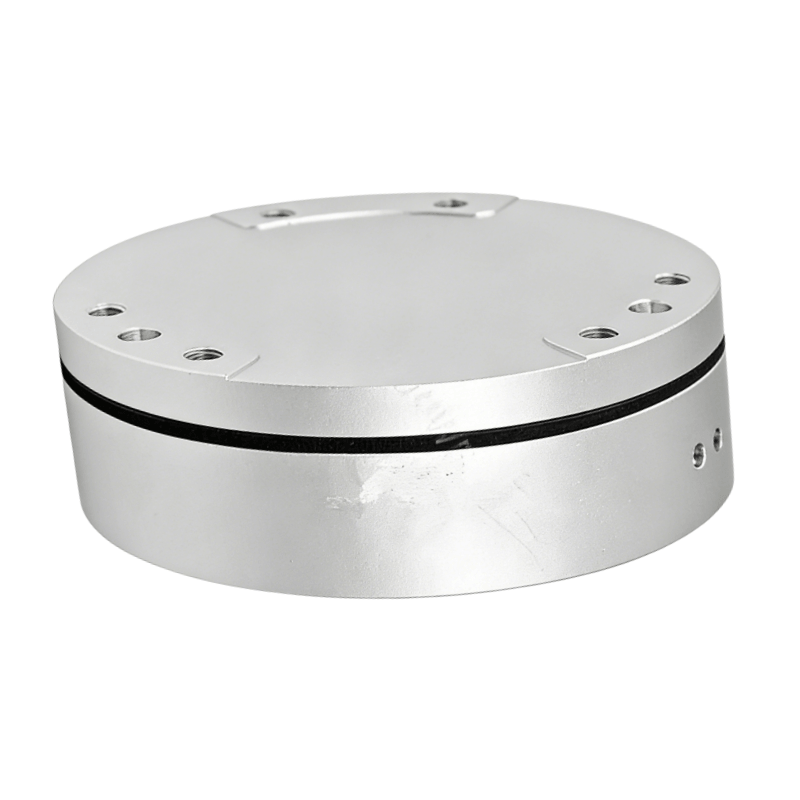
6 Axis Force Torque Sensors
Overview
- Measures 3 forces (Fx, Fy, Fz) and 3 torques (Mx, My, Mz) simultaneously in real time
- Offers scalable capacities from low-load micro models (±10 N) up to heavy-duty testing (50 KN)
- Built with monolithic stainless steel or aluminum to minimize center-of-gravity shifts on robot flanges
- Limits inter-axis interference to ≤ 1.0% FS using embedded 6×6 factory decoupling matrices
- Supports high sampling rates up to 1 kHz – 4 kHz for zero-delay, real-time force feedback
- Integrated hardware compensation from -10°C to +85°C eliminates friction-induced zero drift
- Provides 200% to 500% safe overload capacity to survive sudden E-stops and impacts
- Features onboard EtherCAT, PROFINET, EtherNet/IP, CANopen, and RS485 without external boxes
- Matches ISO 9409-1 bolt patterns (Ø 30mm to Ø 80mm) for drop-in ATI replacement
- Rated at IP65 or IP67 to resist intense vibration, wet machining, and heavy dust
- Fully factory-calibrated with ready-to-use ROS/ROS2, SDKs, and URCap software plugins
- sales@connector-sensor.com
- +86 15120067961
- Cable Assemblies9 products
- Connectors126 products
- Sensors121 products
- Automotive Sensors11 products
- Position Sensors1 product
- Proximity Sensors1 product
- Flow Sensors9 products
- Force Sensors21 products
- Gas Sensors18 products
- Photoelectric Sensors14 products
- Pressure Sensors19 products
- Temperature and Humidity Sensors3 products
- Temperature Sensors24 products
- Vision Sensors10 products
- IMU Sensor1 product
- Optoelectronic Modules1 product
Industrial 6-Axis Force/Torque Sensors (Multi-Axis Load Cells)
High-Precision Force & Torque Sensing Solutions for Intelligent Automation and Robotics
Enhance robotic dexterity, adaptive force control, and intelligent automation with our high-performance 6-axis force torque sensors. Engineered for real-time measurement of static and dynamic loads across all six degrees of freedom (Fx, Fy, Fz and Mx, My, Mz), our multi-axis load cells deliver exceptional accuracy, ultra-low cross-talk, and rugged reliability for demanding industrial and research environments.
Our 6-axis force torque sensors are widely used in robotic assembly, polishing, grinding, deburring, collaborative robots, medical robotics, automated testing, and advanced research applications. Whether you are integrating a robotic wrist force sensor into a collaborative robot system or developing precision force-feedback automation equipment, we provide reliable multi-axis sensing solutions tailored to modern intelligent manufacturing.
Key Advantages of 6 Axis Force Torque Sensors
- Advanced Cross-Talk Decoupling
Under 1.0% FS inter-axis interference achieved via proprietary 6×6 calibration matrices, ensuring clean and highly accurate multi-axis force data.
- Plug-and-Play Robotic Integration
Seamless mechanical compliance with standard ISO 9409-1 bolt patterns for direct mounting to Universal Robots, KUKA, FANUC, ABB, and Yaskawa.
- High Dynamic Bandwidth
Sampling frequencies up to 2 kHz – 4 kHz via native digital interfaces, ensuring zero-delay tactile feedback for high-speed control loops.
6-Axis Force Torque Sensor Product Series
We offer multiple 6-axis force torque sensor models specifically engineered to balance payload demands, signal clearance, and architectural requirements across diverse automation environments.
Series 1: Miniature 6-Axis Force Torque Sensors (Low-Load & Micro Sensing)
Designed specifically for space-constrained applications, delicate micro-manipulation, and small collaborative robots, this series features ultra-compact outer diameters ranging from 30 mm to 50 mm and an exceptionally lightweight aircraft-grade aluminum housing weighing under 150g.
Offering standard force ranges up to 200 N and torques up to 5 Nm, these high-sensitivity sensors support SPI, I2C, RS485, or low-noise analog interfaces, making them the premier choice for medical surgical robotics, electronics peg-in-hole assembly, and laboratory biomechanics testing.
Series 2: Industrial Robot Wrist Force Sensors (Medium-Load & Automation Standard)
Serving as the benchmark for mainstream industrial automation and robotic material removal, this series offers rugged standard force capacities up to 1500 N and torques up to 100 Nm to ensure reliable tactile feedback under continuous operation.
These smart sensors integrate standard ISO 9409-1 flange patterns for direct mechanical mounting and feature native embedded bus protocols like EtherCAT, PROFINET, EtherNet/IP, or CANopen within the sensor body, eliminating the need for an external controller box while maintaining an IP65 dust- and water-jet resistant seal during intense robotic polishing, grinding, and deburring tasks.
Series 3: Heavy-Duty Multi-Axis Load Cells (High-Capacity Structural Testing)
Engineered with massive structural rigidity and huge safety margins for the most severe operating environments, this heavy-duty series provides maximum force measurements up to 50 KN and torques up to 2000 Nm.
Built from a monolithic elastic body of ultra-high-strength 17-4 PH stainless steel, these sensors deliver a 300% to 500% safe overload protection margin against catastrophic impacts while maintaining an IP67 submersible rating that is ideal for aerospace wind tunnel balances, automotive crash testing, and heavy industrial manipulator control.
Technical Specifications of 6 Axis Force Torque Sensors
The following matrix represents the standard engineering benchmarks across our 6-axis force/torque sensor lineup. All individual parameters can be optimized to meet specific OEM integration requirements.
| Engineering Parameter | Standard Reference Specifications |
| Force Measurement Axes | Three orthogonal components (Fx, Fy, Fz) |
| Torque Measurement Axes | Three orthogonal moments (Mx, My, Mz) |
| Rated Force Capacity Range | 50 N to 50 KN (Customizable based on product series) |
| Rated Torque Capacity Range | 1 Nm to 2000 Nm (Customizable based on product series) |
| Accuracy Class | 0.2% to 0.5% FS (Full Scale) |
| Repeatability | ≤0 .1 % FS (Excellent long-term stability under continuous loads) |
| Inter-Axis Cross-Talk | ≤ 1.0\% FS (Achieved after multi-axis factory matrix decoupling) |
| Safe Overload Capacity | 300% to 500% of rated capacity (Built-in mechanical overload protection) |
| Signal Output Options | Analog: mV/V, 0-10V, 4-20mA
Digital: EtherCAT, PROFINET, CANopen, RS485 (Modbus-RTU) |
| Operating Temperature Range | Industrial Grade: -10 ℃ to +60 ℃ (Thermal compensation included) |
| Ingress Protection Level | IP65 Standard / IP67 Submersible Optional |
| Mechanical Installation | Standard ISO 9409-1 Robot Flange or customizable adapter plates |
Industrial Applications of 6 Axis Force Torque Sensors
Adaptive Robotic Assembly
Integrating a 6-axis sensor at the robot wrist converts blind mechanical motion into intelligent touch. It enables force-guided search algorithms for precise peg-in-hole assembly, threaded fastening, and electronic connector mating, preventing jamming, cross-threading, and mechanical deformation.
Surface Finishing: Polishing, Grinding and Deburring
In material removal operations, the sensor continuously monitors normal forces (Fz) and tangential friction forces (Fx, Fy). This real-time data allows the robot controller to maintain a constant contact force against uneven part geometries, significantly increasing tool life and surface finish consistency.
Medical and Biomechanical Testing
For surgical robot end-effectors, haptic feedback devices, and prosthetic validation, our sensors offer the high linearity and low signal drift required to safely measure human-machine interaction forces down to the milli-Newton range.
Automated Quality Inspection
Measure multi-directional forces during automated testing, verification, and product quality validation processes. It ensures real-time quality control data for safety-critical industrial components.
Core Technical Advantages
Monolithic Silicon Strain Gauge / Foil Gauge Technology: Employs advanced strain gauge configurations bonded to a single piece of metal. This eliminates mechanical joints, reducing hysteresis to under 0.1% FS.
Real-Time Temperature Compensation: Every sensor features integrated hardware thermal compensation circuits operating from -10°C to +60°C, mitigating zero-point drift caused by industrial friction heating.
Pre-Written Software Drivers: We provide ready-made SDKs, ROS/ROS2 drivers, and URCap plugins to minimize software integration time from days to minutes.
Technical Comparison and Selection Guide
Use this engineering Matrix to quickly cross-reference your robotic payload, required force capacities, and communication protocols to select the ideal 6-axis sensing configuration for your project:
| Target Application | Typical Robotic Payload | Recommended Vertical Force (Fz) | Required Bus Protocol | Core Technical Focus & Buyer Guide |
| Precision Electronics Insertion | 1 kg – 3 kg | 50 N – 100 N | Analog / RS485 | High Sensitivity: Features a resolution under 0.05% FS to detect subtle resistance and prevent delicate component damage during micro-assembly. |
| Cobot Force-Sensing Workspace | 5 kg – 12 kg | 200 N – 500 N | CAN Bus / EtherCAT | Lightweight Design: Focuses on minimizing the center-of-gravity shift on the robot tool flange to protect the cobot’s native payload margins. |
| Robotic Grinding and Sanding | 10 kg – 50 kg | 500 N – 1500 N | EtherCAT / PROFINET | High Bandwidth: Delivers 1 kHz or higher sampling rates to effectively filter out industrial tool vibrations and ensure a smooth surface finish. |
| Aerospace & Automotive Structural Test | Heavy Duty Payload | 5 KN – 50 KN | EtherNet/IP / Ethernet | High Structural Rigidity: Engineered for extremely low deflection even under maximum multi-axis bending moments during severe fatigue testing. |
Custom 6-Axis Force Torque Sensor Solutions
In addition to standard models, we provide custom multi-axis force sensing solutions for robotics manufacturers, automation integrators, research laboratories, and OEM equipment developers. Customization options include custom force and torque ranges, special mechanical mounting interfaces, integrated electronics, custom communication protocols, waterproof and sealed designs, compact lightweight structures, and high overload configurations. Our engineering team can assist with sensor selection, integration support, and application optimization for your specific robotic or automation project.
FAQ
1. Can your sensors act as a drop-in alternative to ATI 6 axis force and torque sensors?
A: Yes. Our industrial robot series is designed with identical bolt circles (such as 50mm, 63mm, 80mm diameter) matching standard ISO 9409-1 dimensions. This allows them to serve as drop-in mechanical replacements for market standards like the ATI Gamma, Delta, or Axia series. We also provide compatible communication matrices to simplify software adaptation.
2. How do you calibrate the sensor to manage cross-talk between axes?
A: Multi-axis cross-talk occurs when a pure force in one axis (such as Fz) registers false readings in another axis (such as Mx). To eliminate this, each sensor undergoes an automated multi-axis loading sequence in our factory. The resulting empirical data generates a unique 6×6 decoupling matrix loaded directly onto the sensor’s microprocessor, keeping cross-talk within 1.0% of Full Scale.
3.What is the lead time for custom mechanical interfaces or load ranges?
A: While standard ISO-flange models are typically stocked for immediate delivery, custom OEM modifications—such as hollow-shaft configurations for cable routing, subsea waterproofing, or custom mounting plates—generally require a 4 to 6-week engineering and calibration lead time.
4. Can your sensors be used directly with collaborative robots?
A: Yes. Our compact and lightweight sensor designs are suitable for collaborative robots, robotic wrists, and force-feedback automation systems. We support mainstream robot software platforms to ensure rapid setup.
Request a Quote and Engineering Consultation?
Whether you need a single unit for academic research or a highly optimized OEM solution for high-volume machine building, contact our application engineering team. Please prepare your required measurement ranges for Fx/Fy/Fz, Mx/My/Mz, and your preferred communication interface (EtherCAT, PROFINET, CAN Bus, RS485, or Analog). Our team will reply with technical drawings and formal commercial pricing within 12 business hours.
Send Message to get Datasheet.
Strict Production Process
Engineers develop optimized electronic circuits and structural designs based on real application needs.
High-quality components and materials are carefully selected from trusted suppliers to ensure long-term reliability.
Automated SMT and precision soldering technologies are used to build stable and high-performance circuit boards.
Sensor elements or connector terminals are assembled with the PCB and housing to ensure accurate operation and strong mechanical stability.
Each product undergoes strict calibration and functional testing to guarantee accuracy and stable performance.
Every unit is carefully inspected, labeled, and securely packaged to ensure it arrives safely and performs reliably for your applications.
Strict Production Process of Yafeite