


Corrugated Coaxial Cables
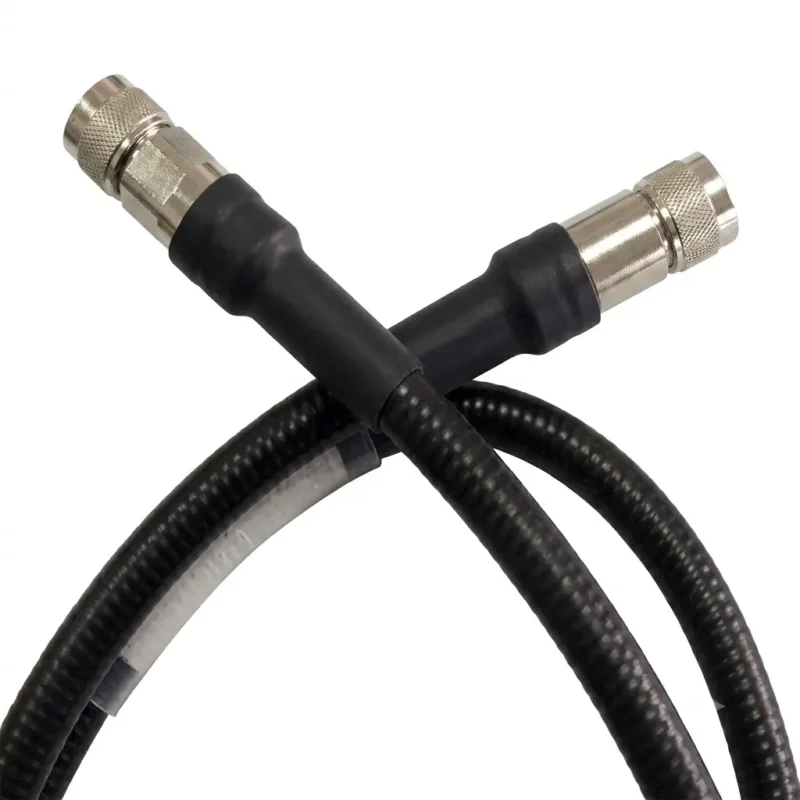
Corrugated Coaxial Cables
Features
- Corrugated copper outer conductor bends easily around tight corners without kinking or losing shielding
- Shielding effectiveness above 120 dB blocks interference and keeps signal transmission clean
- Foamed PTFE dielectric and bare copper inner conductor deliver stable, ultra-low-loss performance
- Very low intermodulation keeps signal clean even under high-power, multi-carrier operation
- High power handling capability makes it ideal for demanding RF feeder applications
- High tensile strength and crush resistance withstand rough handling and installation stress
- Lightweight construction simplifies installation and reduces load on towers and structures
- Operates reliably across a wide temperature range, from -55°C to +85°C
- sales@connector-sensor.com
- +86 15120067961
- Cable Assemblies9 products
- Connectors126 products
- Sensors121 products
- Automotive Sensors11 products
- Position Sensors1 product
- Proximity Sensors1 product
- Flow Sensors9 products
- Force Sensors21 products
- Gas Sensors18 products
- Photoelectric Sensors14 products
- Pressure Sensors19 products
- Temperature and Humidity Sensors3 products
- Temperature Sensors24 products
- Vision Sensors10 products
- IMU Sensor1 product
- Optoelectronic Modules1 product
High Power, Low Loss Corrugated Coaxial Cables for Reliable RF Transmission
RF systems rely on a strong, stable link between the antenna and the equipment. However, when a cable loses signal, distorts under power, or cracks in harsh weather, that link — and overall system performance — can suffer.
Our corrugated coaxial cable assemblies are built to handle that demand. A corrugated copper outer conductor gives the cable the flexibility to bend around tight corners without kinking, while a foamed PTFE dielectric and multi-strand bare copper inner conductor help keep loss low and signal quality high.
In addition, shielding effectiveness above 120 dB, minimal intermodulation, and high power handling make these cables a dependable choice for demanding RF feeder applications. They also operate from -55°C to +85°C and withstand harsh outdoor weather, so they deliver long service life wherever reliable RF transmission matters most.
Why Choose Our Corrugated Coaxial Cables
Flexible without Giving Up Shielding
The corrugated copper outer conductor bends easily around obstacles and tight corners. As a result, it resists kinking and helps preserve shield integrity, something solid-wall coax struggles to do.
Built for High Power
These cables handle heavy power loads while keeping intermodulation to a minimum. That means the signal stays clean even under sustained load.
Rated for the Outdoors
Harsh weather, temperature swings, and years of continuous outdoor exposure do not compromise performance. Therefore, these cables suit demanding outdoor installations.
Engineered to Last
High tensile strength and strong crush resistance combine to deliver a long service life. This makes the cable a reliable choice for challenging installation conditions.
Technical Specifications of Corrugated Coaxial Cables
| Parameter | Value |
|---|---|
| Inner conductor | Multi-strand bare copper wire |
| Dielectric | Foamed PTFE |
| Outer conductor | Corrugated copper tube |
| Shielding effectiveness | > 120 dB |
| Intermodulation (PIM) | Very low |
| Power handling | High |
| Attenuation | Ultra-low loss |
| Tensile strength | High |
| Crush resistance | High |
| Weight | Lightweight |
| Operating temperature | -55°C to +85°C |
| Typical role | RF power feeder cable |
Applications of Corrugated Coaxial Cables
Base stations and wireless communication
Corrugated coaxial cable serves as the feeder line connecting antennas to base station equipment. In this way, it carries RF power efficiently across cellular, PCS, and wireless networks.
Broadcast and terrestrial microwave
Broadcast towers and terrestrial microwave links rely on low-loss, high-power feeder cable. This allows the signal to move from the equipment room to the antenna with minimal degradation.
In-building and DAS systems
Distributed antenna systems and repeater installations need cable that bends around building structures while still handling meaningful power. Corrugated construction meets that need well.
Customization
Every installation has its own run length, bend requirements, and power demands. Therefore, corrugated coaxial cable assemblies can be tailored to fit your project, including cable diameter, length, connector interface, and jacket type.
Send us your frequency, power level, run length, and environmental conditions, and we will help you configure the right cable for your project.
FAQ
1. What makes corrugated coaxial cable different from standard coax?
The outer conductor uses a corrugated copper tube instead of a smooth solid wall. Because of this design, the cable can bend and flex without cracking or losing shielding effectiveness, unlike solid-wall coax that needs a much larger bend radius.
2. Why does intermodulation (PIM) matter?
Intermodulation distortion creates unwanted signals inside the cable itself. As a result, it can degrade network performance, especially in multi-carrier systems. Low-PIM construction helps keep the transmitted signal clean.
3. What temperature range can this cable handle?
Our corrugated coaxial cables operate from -55°C to +85°C, so they cover both cold climates and the heat buildup common on towers and rooftops.
4. Is corrugated coaxial cable suitable for high-power applications?
Yes. The construction supports high power handling with low loss, which is why it is widely used as feeder cable for base stations and broadcast antennas.
5. Can these cables be customized for my project?
Yes. We can adjust the diameter, length, connector type, and jacket material to match your frequency, power level, and installation environment. Share your requirements, and we will recommend the right configuration.
Send Message to get Datasheet.
Strict Production Process
Engineers develop optimized electronic circuits and structural designs based on real application needs.
High-quality components and materials are carefully selected from trusted suppliers to ensure long-term reliability.
Automated SMT and precision soldering technologies are used to build stable and high-performance circuit boards.
Sensor elements or connector terminals are assembled with the PCB and housing to ensure accurate operation and strong mechanical stability.
Each product undergoes strict calibration and functional testing to guarantee accuracy and stable performance.
Every unit is carefully inspected, labeled, and securely packaged to ensure it arrives safely and performs reliably for your applications.
Strict Production Process of Yafeite