



Microwave Cable Assemblies
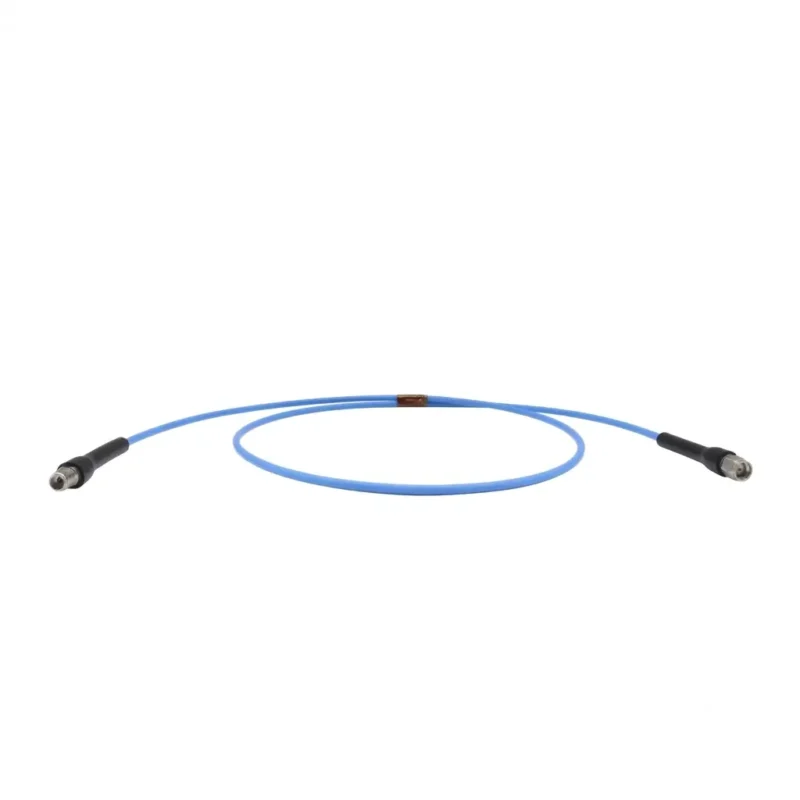
Microwave Cable Assemblies
Features
- Precision-engineered RF interconnect covering DC to 110 GHz for microwave and mmWave systems
- Tested VSWR, insertion loss, and shielding data supplied with every assembly, not just a datasheet
- Available in semi-rigid, hand-formable, and fully flexible constructions to match your routing needs
- Low-loss PTFE dielectric and silver-plated copper conductors minimize attenuation across the operating band
- Phase- and amplitude-matched sets keep multiple channels tracking precisely in radar and phased-array systems
- Standard and precision mmWave connectors — SMA to N-Type through 2.92mm, 2.4mm, and 1.85mm
- Rugged construction withstands vibration, thermal extremes, salt fog, and fuel or hydraulic fluid exposure
- Custom lengths, connector configurations, and cross-reference support for replacing incumbent supplier part numbers
- Proven across aerospace, defense, satcom, telecom, radar, and lab-grade test & measurement applications
- Optional MIL-DTL-17-aligned construction with full material traceability for defense and aerospace programs
- sales@connector-sensor.com
- +86 15120067961
- Cable Assemblies9 products
- Connectors126 products
- Sensors121 products
- Automotive Sensors11 products
- Position Sensors1 product
- Proximity Sensors1 product
- Flow Sensors9 products
- Force Sensors21 products
- Gas Sensors18 products
- Photoelectric Sensors14 products
- Pressure Sensors19 products
- Temperature and Humidity Sensors3 products
- Temperature Sensors24 products
- Vision Sensors10 products
- IMU Sensor1 product
- Optoelectronic Modules1 product
Microwave Cable Assemblies
Microwave cable assemblies transmit signals from DC to the millimeter-wave range with the precision required by radar, satcom, 5G infrastructure, and test & measurement systems. A microwave cable assembly is more than just a cable. It is a passive TEM-mode transmission line designed to maintain electrical performance under vibration, thermal cycling, and long-term field operation.
These assemblies must meet strict requirements for VSWR, insertion loss, and phase stability. We manufacture microwave cable assemblies from DC up to 40 GHz, with semi-rigid, hand-formable, and fully flexible constructions available. Each assembly comes with standard or custom connector interfaces and complete electrical test data, giving you full confidence in the performance of every component you install.
What Is Microwave Cable Assembly?
A microwave cable assembly is a precision coaxial interconnect designed to transmit RF and microwave signals between a source and a load. It connects systems such as transmitters and antennas, RF modules and test instruments, or individual RF circuit boards.
Throughout the signal path, the assembly must maintain stable amplitude, phase, and impedance across the operating frequency range. Its structure includes a center conductor, dielectric, outer conductor or shield, protective jacket, and connectors on one or both ends. At microwave frequencies, however, every element becomes a carefully engineered component rather than a standard cable part.
This difference is critical because a microwave cable assembly performs two functions simultaneously. It provides mechanical routing within a system while also acting as a controlled transmission line for signal propagation. Any variation in geometry, material properties, or connector termination can directly affect measured electrical performance.
Advantages of Our RF Microwave Cable Assemblies
- VSWR / Return Loss
Our RF microwave cable assemblies provide excellent impedance matching across the operating frequency range, helping reduce signal reflection and maintain reliable signal integrity.
- Low Insertion Loss
Designed with low-loss dielectric materials and optimized conductors, our assemblies minimize attenuation and support stable signal transmission in broadband RF systems.
- Phase Stability
Our cable assemblies maintain consistent electrical length under temperature changes and mechanical stress, making them ideal for radar, phased-array antennas, and multi-channel systems.
- Frequency Range
Our microwave cable assemblies support frequencies from DC to 40 GHz, providing reliable performance for broadband RF and millimeter-wave interconnect applications.
- Power Handling
High-quality conductors and PTFE dielectric materials help our assemblies handle demanding RF power requirements while maintaining stable electrical performance.
- Environmental Durability
With PTFE dielectric construction, our cable assemblies operate reliably from -55°C to +200°C and withstand vibration, humidity, temperature changes, and harsh environments.
- Lightweight & Mechanical Reliability
Our lightweight cable designs reduce system weight while maintaining mechanical strength and long-term reliability for aerospace, defense, industrial, and portable applications.
Key Specifications of Microwave Cable Assemblies
| Parameter | Specification |
|---|---|
| Frequency Range | DC to 40 GHz |
| Operating Temperature | -55°C to +200°C (PTFE dielectric construction) |
| Impedance | 50Ω |
| Cable Types | Semi-rigid, semi-flexible, hand-formable, and flexible |
| Dielectric Material | PTFE and low-loss dielectric options |
| Connector Options | SMA, N-Type, TNC, BNC, 2.92mm, 2.4mm, 1.85mm |
| Customization | Custom lengths, connector configurations, phase-matched sets, and application-specific designs |
| Testing | VSWR / return loss, insertion loss, continuity, and electrical performance testing |
Applications of Microwave Cable Assemblies
Test & Measurement
Microwave cable assemblies support VNA test systems and laboratory equipment where repeatable measurements and stable electrical performance are required. Precision designs support high-frequency testing, calibration, and research applications.
Aerospace, Defense & Avionics
Lightweight and vibration-resistant cable assemblies connect radar systems, electronic warfare equipment, avionics, and UAV platforms. These applications require stable phase performance under temperature changes and mechanical stress.
Satellite & Spaceflight
Space-grade cable assemblies combine lightweight construction, low outgassing materials, and high reliability to withstand launch vibration and vacuum environments.
Telecommunications & 5G Infrastructure
Microwave cable assemblies provide reliable RF connections between radios, antennas, and baseband equipment. They support broadband communication systems that require low loss and stable signal transmission.
Radar & Phased-Array Systems
Phase- and amplitude-matched cable assemblies help maintain precise channel alignment in radar and phased-array antenna systems. They provide consistent performance across temperature variations and mechanical movement.
Automotive, Medical & Industrial Electronics
Precision RF interconnects support sensor systems, diagnostic equipment, industrial measurement devices, and other applications that require stable and repeatable signal transmission.
Connector Options
Microwave cable assemblies use standard connector families widely adopted across the RF and microwave industry.
For general-purpose and lower-frequency applications, common options include SMA, N-Type, TNC, and BNC connectors. As operating frequencies increase into the GHz range, precision mmWave interfaces such as 2.92mm (K), 2.4mm, and 1.85mm connectors provide the performance required for high-frequency systems.
We offer straight, right-angle, and bulkhead configurations with plug or jack designs and male or female interfaces. For multi-channel applications, we can provide phase-matched connector assemblies to maintain consistent signal performance across channels.
If your design uses a specific supplier part number or a less common connector interface, our engineering team can help cross-reference existing solutions or develop a compatible replacement.
Why Choose Our Microwave Cable Assemblies
We design and manufacture microwave cable assemblies according to customer specifications, from flexible RF cable solutions to precision semi-rigid and hand-formable constructions.
Our standard product lines support applications from DC to 40 GHz, with designs optimized for low loss, stable electrical performance, and reliable operation in demanding environments.
Each assembly uses quality-controlled conductors, dielectric materials, and shielding structures. We provide standard or custom connector configurations along with electrical test data, including return loss and insertion loss results, so you can verify actual performance before installation.
We support both prototype development and volume production. Our capabilities include custom lengths, phase-matched cable sets, connector customization, and cross-reference solutions for replacing existing supplier part numbers.
Quality & Testing
We test every microwave cable assembly before shipment to verify electrical performance and reliability. Each assembly undergoes VSWR/return loss and insertion loss testing across the specified frequency range. We also verify continuity and shielding effectiveness to ensure consistent signal integrity.
You receive complete test data with your assembly, not just a datasheet specification. For phase-sensitive applications, we perform testing under controlled temperature and humidity conditions to provide stable and repeatable phase measurements instead of a single ambient-condition result.
When required, we can manufacture and qualify assemblies according to MIL-DTL-17 and related military transmission-line specifications. We also provide full material traceability and documentation to support defense, aerospace, and other regulated applications.
FAQ
1. What frequency range do microwave cable assemblies cover?
Microwave cable assemblies cover a wide range of RF and microwave applications depending on cable size, dielectric material, and connector design.
Our standard product lines support frequencies from DC to 40 GHz, covering most broadband RF interconnect requirements. Higher-frequency precision assemblies can extend beyond this range when specialized cable structures and mmWave connectors are required.
2. What is the difference between a microwave cable assembly and a general RF cable assembly?
The terms overlap, but microwave cable assemblies typically serve higher-frequency applications where electrical performance becomes more sensitive.
At microwave frequencies, factors such as cutoff frequency, mode resonance, connector transition design, and material tolerances have a greater impact on performance. As a result, microwave cable assemblies require more precise mechanical design and tighter manufacturing control than standard RF cables.
3. Why does VSWR matter if my system already tolerates some insertion loss?
VSWR and insertion loss affect signal performance in different ways.
High VSWR reflects part of the signal back toward the source and can create ripple across the insertion loss curve. Even when average insertion loss appears acceptable, poor VSWR can reduce signal accuracy and system reliability.
For this reason, engineers evaluate VSWR and insertion loss together across the complete operating frequency range.
4. Can microwave cable assemblies be supplied as phase-matched sets?
Yes. We provide phase- and amplitude-matched cable assemblies for applications such as phased-array antennas, radar systems, and multi-channel test equipment.
We manufacture, test, and supply matched sets according to specified phase and amplitude requirements.
5. Should I choose semi-rigid, hand-formable, or flexible microwave cable?
The best choice depends on installation requirements.
Semi-rigid cable assemblies provide the lowest loss and best phase stability for fixed installations where the cable will not require adjustment.
Hand-formable (semi-flexible) cable assemblies offer a balance between electrical performance and installation flexibility. They allow technicians to shape and adjust the cable without special tooling.
Flexible cable assemblies are ideal for jumper cables, test leads, and applications that require frequent movement or repeated connection cycles.
6. Can you build custom microwave cable assemblies to my specification?
Yes. Provide your frequency requirements, connector specifications, environmental conditions, and routing requirements. Our engineering team can recommend the appropriate construction and provide customized solutions, including cable lengths, connector configurations, and matched cable sets.
Ready to Find the Right Microwave Cable Assembly for Your Application?
Share your frequency range, connector requirements, and environmental conditions with our engineering team. We will help you select the right cable construction and provide a customized solution and quotation for your project.
Send Message to get Datasheet.
Strict Production Process
Engineers develop optimized electronic circuits and structural designs based on real application needs.
High-quality components and materials are carefully selected from trusted suppliers to ensure long-term reliability.
Automated SMT and precision soldering technologies are used to build stable and high-performance circuit boards.
Sensor elements or connector terminals are assembled with the PCB and housing to ensure accurate operation and strong mechanical stability.
Each product undergoes strict calibration and functional testing to guarantee accuracy and stable performance.
Every unit is carefully inspected, labeled, and securely packaged to ensure it arrives safely and performs reliably for your applications.
Strict Production Process of Yafeite