


MIL-DTL-26482 Series I Connectors
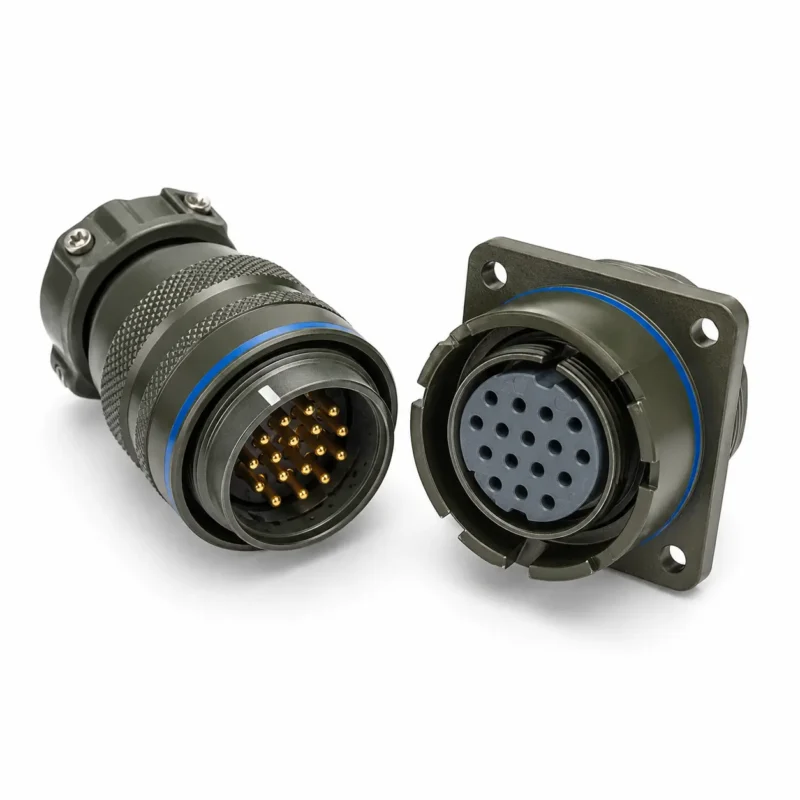
MIL-DTL-26482 Series I Connectors
Overview
3-Point Bayonet Coupling Ensures rapid mating with secure, vibration-resistant locking
High-Density Contact Layouts accommodates 2 to 61 channels in a compact circular shell
Operates reliably in extreme environments from -55°C to +125°C
Features resilient neoprene inserts to completely block moisture, dust, and contaminants
Available with solder contacts for field repairs or crimp for high-reliability assembly
Fully interchangeable with Amphenol PT, ITT Cannon KPT, and Souriau series
Choose classic olive drab cadmium or RoHS-compliant electroless nickel plating
Source directly from the manufacturer for lower costs and flexible MOQ
Complete solutions including matching backshells, dust caps, and custom wiring harnesses
Accelerate your design cycle with instant STEP files and 24-hour quotes
- sales@connector-sensor.com
- +86 15120067961
- Connectors121 products
- Sensors121 products
- Optoelectronic Modules1 product
MIL-DTL-26482 Series I Connectors: Environment-Resistant Miniature Circular Solutions
Our MIL-DTL-26482 Series I connectors deliver an environment-resistant, quick-disconnect miniature circular solution engineered for reliable signal and power transmission across tactical defense networks, commercial avionics, and rugged industrial automation platforms. Utilizing a robust 3-point bayonet coupling mechanism, this series balances high-density contact configurations with a lightweight, compact footprint.
Series Positioning Statement: MIL-DTL-26482 Series I is technically optimized for solder termination and legacy fixed factory-bonded installations, whereas MIL-DTL-26482 Series II caters to rear-release crimp, field-serviceable wiring harness systems.
As an integrated connector manufacturer, we supply standard configurations designed for intermateability and performance compatibility with prominent industry series, including Amphenol PT/PT-SE and ITT Cannon KPT/KPSE families, subject to configuration matching.
Technical Specifications & Performance
Designed to align with the core mechanical and environmental parameters of the MIL-DTL-26482 specification, these connectors provide proven reliability under high-vibration and diverse climatic loads.
| Technical Parameter | Specification & Operational Boundaries (Verify against exact part number) |
| Coupling Style | 3-point rapid bayonet locking with audible and tactile coupling confirmation |
| Termination Types | Predominantly fixed solder contacts (front-release crimp removable variants defined) |
| Operating Temperature | Typically categorized from -55 ℃ to +125 ℃ |
| Insulation Resistance | 5,000 Megohms minimum at 25 ℃ initial testing |
| Mating Durability | 500 mating cycles minimum when decoupled under specification rules |
| Shell Sizes & Circuits | Shell sizes from 8 through 24; accommodating 2 to 61 lines under MIL-STD-1669 |
| Wire Accommodation | Standard ranges accept 24 AWG to 12 AWG conductors |
| Environmental Protection | Qualified environmental sealing per MIL-DTL-26482 configurations (not directly rated to IEC IP system unless specified) |
Available Shell Styles (MS Cross-Reference)
We manufacture a comprehensive range of Series I shell styles to support versatile panel-mounting and cable-connecting architectural layouts:
MS3110 (Wall Mount Receptacle): Equipped with a 4-hole square flange for front or rear panel securing, integrated with rear accessory threads for backshell adaptation.
MS3112 (Box Mount Receptacle): Provides a low-profile flange design without rear accessory threads, optimized for tight interior enclosure routing.
MS3114 (Jam Nut Receptacle): Single-hole panel mounting featuring an interfacial O-ring, ideal for applications requiring robust panel environmental sealing.
MS3116 (Straight Plug): Cable-end connector housing the primary bayonet coupling ring to engage securely with matching receptacles.
MS3111 (Cable Connecting Receptacle): Designed for cable-to-cable extension lines and inline cable splices.
Technical Finishes & Chemical Protection Options
To withstand prolonged atmospheric moisture, chemical exposure, and industrial salt spray, our aluminum alloy shells are available with multiple high-durability surface treatment options, structurally categorized by configuration requirements:
Standard Shell Finishes (Plating Systems)
Olive Drab Cadmium over Nickel: The traditional military standard, delivering maximum corrosion resistance and verified up to 500-hour salt spray endurance.
Electroless Nickel: A bright silver, highly conductive finish, fully RoHS compliant for commercial aerospace, medical, and specialized electronic applications.
Optional Finishes (Surface Treatments)
Black Anodized Aluminum: A non-conductive, ruggedized surface finish optimized for tactical ground equipment and weight-sensitive configurations.
Black Zinc Cobalt Plating: A corrosion-resistant, conductive eco-friendly alternative tailored for industrial automation and harsh field instrumentation.
Target Industry Applications
Due to their miniature form factor and high contact density, MIL-DTL-26482 Series I connectors are frequently specified over bulkier MIL-DTL-5015 footprints in weight-sensitive configurations:
Industrial Automation & Robotics: Rapid bayonet engagement facilitates quick swaps on multi-axis robotic arms and remote proximity sensor arrays.
Commercial Aerospace & Avionics: Cockpit instrumentation panels, localized flight control sub-assemblies, and cabin power distribution boards.
Defense Communications & Radar: Tactical field radios, mobile telemetry enclosures, and naval electronic control racks.
Geophysical Exploration: Heavy-duty oil and gas extraction sensors, seismic monitoring equipment, and ruggedized outdoor power units.
Procurement & Engineering Selection Guide
Engineering Selection Checklist
To streamline drawing validation, eliminate assembly mismatches, and expedite technical quotes, ensure your bill of materials confirms the following six design parameters prior to submission:
Shell Style Designation: Select the standard MS prefix (MS3110, MS3112, MS3114, MS3116, or MS3111).
Service Class Suffix: Specify environmental requirements, such as Class E (environmental grommet), Class F (with strain relief), or Class P (potted application).
Shell Size & Insert Arrangement: Identify the exact layout designator under MIL-STD-1669 (e.g., 12-10, 14-19) to match your target circuit count.
Contact Gender: Specify Male Pins (P) or Female Sockets (S).
Alternate Insert Rotation: For adjacent identical connectors, specify alternate keying angles (W, X, Y, Z) to eliminate cross-mating risks.
Rear Accessory Interface: Confirm backshell grounding or environmental constraints to ensure proper thread matching.
Critical System Integration Reminders
Intermateability Constraints: Series I connectors can intermate with Series II variants when utilizing standard power contacts only. If your target insert arrangement incorporates shielded, coaxial, or triaxial positions, they do not intermate across series due to conflicting physical seating depths.
Accessory Thread Verification: Backshell thread configurations differ across the two series. While Series II typically supports standard AS85049 accessories, Series I interfaces require careful cross-checking against the manufacturer’s specific shell drawing to guarantee sealing integrity.
FAQ
Q1: What parameters should be confirmed first when cross-referencing an Amphenol PT part number to your series?
Verify the shell style, arrangement code under MIL-STD-1669, and the service class suffix. For example, an Amphenol PT06A straight plug cross-references directly to our MS3116 electrical equivalent, provided the plating finish matches your system’s galvanic compatibility profile.
Q2: Can we mix front-release crimp tooling and standard solder tools on the same Series I connector?
No. Standard Series I configurations feature factory-bonded fixed contacts (solder cups) or specific inserts engineered for front-release crimp removable variants. These internal retention matrices require completely different assembly workflows and tool profiles; always verify your contact type before ordering harness tools.
Q3: Are Series I hermetic configurations available for vacuum-sealed sensor deployments?
Yes. For applications requiring strict pressure containment or vacuum boundary retention, we provide Series I hermetic receptacles utilizing glass-to-metal seals. These configurations generally feature fixed, non-removable solder cups to ensure structural seal longevity.
Q4: Why does a mixed Series I and Series II connection alter environmental performance?
While the front bayonet footprint allows standard power contact shell halves to mate across series, their interfacial environmental profiles and internal seal compressions vary. Intermating a Series I plug with a Series II receptacle can alter elastomer degradation profiles under extreme thermal cycling.
Factory-Direct Sourcing Advantages
Interchangeable with Industry Baselines: Our components cross-reference with standard MIL-DTL-26482 Series I configurations, including Amphenol PT/PT-SE and ITT Cannon KPT/KPSE series, subject to insert arrangement and specification matching.
Turnkey Customization Capabilities: Beyond raw components, our engineering team provides custom wiring harnesses, protective dust caps, overmolded strain reliefs, and specialized PC Tail / PCB contacts.
Direct Supply Logistics: Operating as a factory-direct manufacturer enables us to offer scalable manufacturing runs, transparent lead times, and comprehensive quality documentation.
Engineering Resource Support: Contact us to download the full MIL-DTL-26482 Technical Catalog, request 3D CAD STEP files, or receive a cross-reference validation report within 24 hours.
Send Message to get Datasheet.
Strict Production Process
Engineers develop optimized electronic circuits and structural designs based on real application needs.
High-quality components and materials are carefully selected from trusted suppliers to ensure long-term reliability.
Automated SMT and precision soldering technologies are used to build stable and high-performance circuit boards.
Sensor elements or connector terminals are assembled with the PCB and housing to ensure accurate operation and strong mechanical stability.
Each product undergoes strict calibration and functional testing to guarantee accuracy and stable performance.
Every unit is carefully inspected, labeled, and securely packaged to ensure it arrives safely and performs reliably for your applications.
Strict Production Process of Yafeite