



MIL-DTL-26482 Series II Connectors
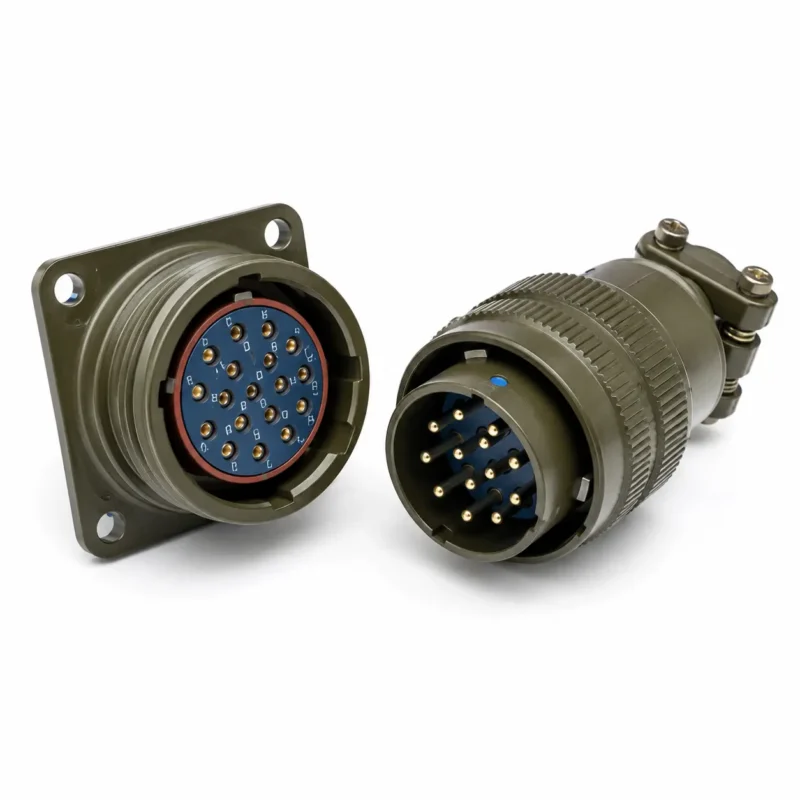
MIL-DTL-26482 Series II Connectors
Overview
- MIL-DTL-26482 Series II standard miniature circular connectors for harsh environments
- 3-point bayonet coupling system for fast, secure mating and unmating
- Rear insertable / rear releasable crimp contacts for easy wiring and maintenance
- Compact circular shell design ideal for space-limited equipment layouts
- Environmental sealing structure for protection against moisture, dust, and contamination
- High vibration and shock resistance for mobile and rugged applications
- Multiple shell sizes and insert arrangements for flexible system design
- Supports signal and power transmission in the same connector family
- Clear mating confirmation with locking feedback for installation reliability
- Designed for long service life in aerospace, defense, and industrial systems
- sales@connector-sensor.com
- +86 15120067961
- Connectors121 products
- Sensors121 products
- Optoelectronic Modules1 product
MIL-DTL-26482 Series II Connectors: Miniature Circular Interconnect Solutions
Our MIL-DTL-26482 Series II connectors deliver an environment-resisting, quick-disconnect interconnect solution developed for high-reliability military, aerospace, and harsh-environment industrial platforms. Engineered to maintain rigorous electrical continuity under severe vibration and mechanical shock, this miniature circular family balances space-saving enclosure geometries with high-density signal integration.
By pairing a defined 3-point bayonet coupling mechanism with a highly serviceable rear-release crimp contact architecture, these connectors streamline production line assembly and simplify field maintenance workflows without compromising structural sealing.
Benefits of Our MIL-DTL-26482 Series II Connectors
Efficient 3-Point Bayonet Mating
3-point bayonet locking with audible/tactile feedback enables fast, secure mating and prevents incomplete coupling or vibration-induced back-off.
Rear-Release Contact Architecture
Rear-insertable crimp contacts with beryllium copper retention allow tool-based insertion and removal without soldering or harness disruption.
Environmental Sealing System
Multi-lip elastomer seals and contact-level barriers provide reliable protection against moisture, dust, and industrial fluids in harsh environments.
Mismating Prevention Keying
Five-key/keyway polarization ensures correct alignment and prevents cross-mating and pin damage during blind-mating operations.
High-Density Miniature Layout
MIL-STD-1669 insert arrangements support up to 55 contacts in a compact shell for space- and weight-constrained systems.
Applications Of MIL-DTL-26482 Series II Connectors
The design maturity and structural durability of the MIL-DTL-26482 Series II footprint make it a common baseline across critical technology sectors:
Aerospace Avionics: Flight deck control networks, sensor telemetry interfaces, and cockpit instrumentation power lines.
Defense & Tactical Ground Infrastructure: C4ISR communication arrays, mobile radar control nodes, and armored vehicle power feeds.
Unmanned Systems & Telemetry: Unmanned aerial vehicle (UAV) distribution blocks, remote tracking pods, and marine robotic controls.
Rugged Industrial Instrumentation: Heavy manufacturing control systems, remote oil/gas monitoring hardware, and ruggedized power modules.
Key Specifications of MIL-DTL-26482 Series II Connectors
For rapid evaluation during the initial design phase, the baseline parameters of the MIL-DTL-26482 Series II family include:
| Parameter | Specification Boundary (Verify against exact part number) |
| Coupling Mechanism | 3-Point Bayonet Coupling with visual confirmation of complete lock |
| Termination Type | Rear insertable, rear releasable crimp contacts |
| Shell Sizes Available | Shell size 8 to shell size 24 options |
| Circuit Density | 3 to 55 circuits, governed by MIL-STD-1669 insert arrangements |
| Contact Sizes | Size 20, Size 16, and Size 12 options |
| Operating Voltage | Up to 600 VAC (RMS) for Service Rating I; Up to 1,000 VAC (RMS) for Service Rating II at sea level |
| Temperature Range | Class dependent; options rated for -55 ℃ to +175 ℃ or +200 ℃thresholds |
How to Choose MIL-DTL-26482 Series II Connectors
Because MIL-DTL-26482 is a broad standard family, final performance metrics change based on configuration choices. When preparing a bill of materials or submitting a quote request, please confirm these six core parameters:
Connector Series & Shell Style: Determine the mounting method—wall mount receptacle, jam nut receptacle, cable-connecting receptacle, or straight plug.
Shell Size: Select from size 8 through 24 based on spacing and contact count restrictions.
Insert Arrangement: Choose the specific pattern designation defined under MIL-STD-1669 (e.g., 14-19, 22-55) to match circuit counts.
Contact Style & Gender: Specify male pins or female sockets, and verify whether standard power contacts or specialized configurations apply.
Shell Finish & Plating Class: Select a finish based on environment, such as RoHS-compliant Electroless Nickel for commercial spaces or Olive Drab Cadmium for extreme corrosion defense.
Accessory Coupling Interface: Identify backshell grounding or environmental constraints to ensure proper thread matching.
Key Technical Verification Points
Review Intermateability Boundaries: Series II connectors can intermate with Series I versions when utilizing standard power contacts only. Shielded coaxial, triaxial, or high-frequency data contacts do not intermate across series generations due to conflicting internal dimensional depths.
Verify Accessory Compatibility: AS85049-style backshells are commonly specified for Series II rear accessory systems. However, because thread matching and moisture seals vary across manufacturers, you must verify the exact shell size, drawing, and manufacturer accessory data before finalized deployment.
Manage Blind-Mating Risks: To reduce the risk of contact damage during blind-mating sequences or rough handling, standard engineering practice suggests placing recessed female socket inserts on the stationary bulkhead side and male pins on the movable cable plug side.
FAQ
Q1: What parameters must be verified on our system drawings before selecting a Series II backshell?
You must confirm the exact shell size, the series type (Series II), and the rear accessory thread profile. Ensure you cross-check the housing plating class with the accessory plating to avoid galvanic corrosion in high-salinity or high-moisture environments.
Q2: When is a Series II Hermetic Receptacle preferred over a standard version?
Specify Hermetic configurations when your system enclosure must maintain strict pressure boundaries or true vacuum integrity (such as in sealed sensor boxes). While standard layouts utilize elastomer wire seals, our Series II Hermetic configurations leverage glass-to-metal seals and can accommodate nonremovable solder cups or crimp removable terminations depending on the qualified part number.
Q3: Can we utilize standard Series I insertion and extraction tooling for Series II wiring harnesses?
No. Series I and Series II employ completely distinct contact retention mechanisms. Standard Series II connectors require specialized rear-insertion and rear-extraction tools to safely engage the internal beryllium copper retention clips. Utilizing front-release or incorrect tool profiles will deform the internal clips and destroy the insert’s contact retention.
Q4: Do shielded contacts within a Series II housing follow standard power contact layout rules?
No. Shielded coaxial or triaxial contacts utilize unique physical dimensions and seating depths. Under MIL-STD-1669, insert arrangements featuring shielded positions are explicitly isolated and assigned dedicated arrangement designators to protect the assembly against physical interference during the bayonet locking phase.
Technical Support & Cross-Reference Validation
Validating an interconnect architecture requires cross-checking part numbers, insert arrangements, and environmental finishes against active military sheets and manufacturer drawings. If you are verifying an application-specific temperature class, cross-checking a replacement suffix, or validating a complex insert arrangement under MIL-STD-1669, our engineering team can help review the specific series, contact style, and interface requirements to ensure a reliable deployment.
Send Message to get Datasheet.
Strict Production Process
Engineers develop optimized electronic circuits and structural designs based on real application needs.
High-quality components and materials are carefully selected from trusted suppliers to ensure long-term reliability.
Automated SMT and precision soldering technologies are used to build stable and high-performance circuit boards.
Sensor elements or connector terminals are assembled with the PCB and housing to ensure accurate operation and strong mechanical stability.
Each product undergoes strict calibration and functional testing to guarantee accuracy and stable performance.
Every unit is carefully inspected, labeled, and securely packaged to ensure it arrives safely and performs reliably for your applications.
Strict Production Process of Yafeite