


Radiation-resistant Cables
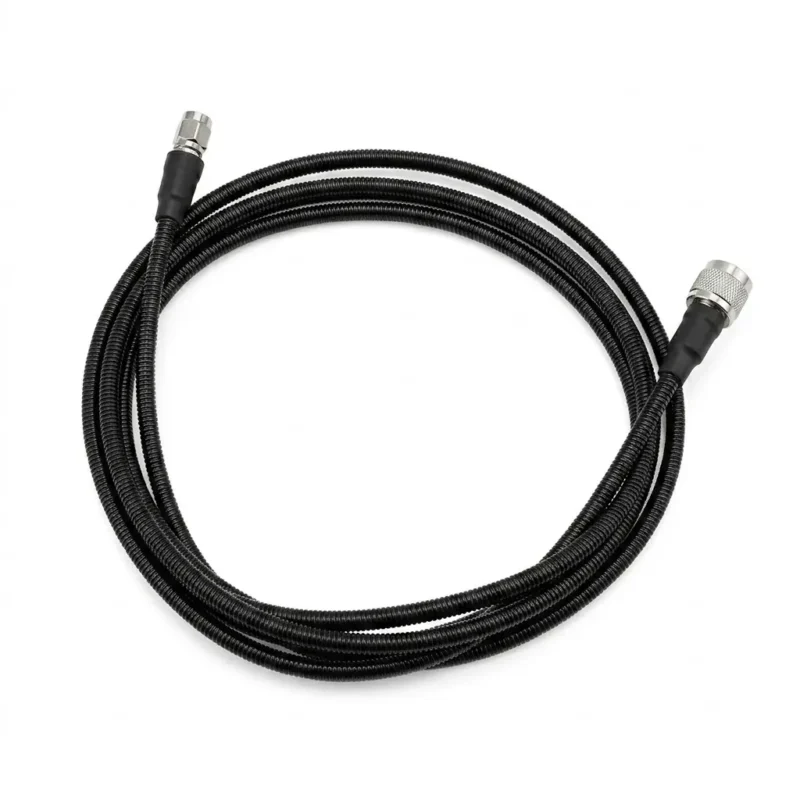
Radiation-resistant Cables
Features
- Shielding effectiveness above 100 dB blocks interference and keeps signal transmission clean and reliable
- Microporous PTFE dielectric resists radiation-induced degradation for long-term reliability in harsh environments
- Silver-plated inner conductor delivers high conductivity and resists oxidation over the cable’s service life
- Operates reliably across an extreme temperature range, from -100°C up to +150°C
- Lighter and more flexible than standard SFT cable at the same outer diameter
- Ultra-low loss and stable attenuation maintain consistent signal quality under continuous operation
- Low VSWR supports clean, high-frequency performance even in demanding applications
- Strong mechanical phase stability keeps phase shift minimal despite temperature fluctuations
- FEP jacket withstands abrasion, chemicals, and wide temperature swings in radiation environments
- Proven for aerospace, nuclear, and scientific research where signal integrity cannot fail
- sales@connector-sensor.com
- +86 15120067961
- Cable Assemblies9 products
- Connectors126 products
- Sensors121 products
- Automotive Sensors11 products
- Position Sensors1 product
- Proximity Sensors1 product
- Flow Sensors9 products
- Force Sensors21 products
- Gas Sensors18 products
- Photoelectric Sensors14 products
- Pressure Sensors19 products
- Temperature and Humidity Sensors3 products
- Temperature Sensors24 products
- Vision Sensors10 products
- IMU Sensor1 product
- Optoelectronic Modules1 product
Radiation-resistant Cables
Radiation breaks down ordinary cable insulation fast. Gamma rays and neutron flux attack polymer chains until the insulation cracks, hardens, and eventually fails. That’s a real risk in aerospace, nuclear power, and scientific research, where one cable failure can shut down an entire system.
Our Radiation-resistant cables solve this problem at the material level. Built with a silver-plated inner conductor, a microporous PTFE dielectric, a precision-wound outer conductor, and an FEP jacket, these cables keep performing long after standard cables would have failed. They deliver shielding effectiveness above 100 dB, ultra-low loss, and stable performance across a working range of -100°C to +150°C — all while staying lighter and more flexible than comparable SFT cable.
Whatever your radiation environment looks like, these cables are built to keep transmitting.
Why Choose Our Radiation-resistant Cables
- A proven material system.
The PTFE and FEP combination handles sustained radiation exposure without giving up electrical performance — so signal quality holds steady over the long term, not just on day one.
- Engineered for extremes.
From the deep cold of orbit to the elevated heat near a radiation source, a -100°C to +150°C range means one cable design covers both ends.
- Lighter and easier to route.
At the same outer diameter, our cables stay more flexible than SFT cable, which simplifies routing in tight enclosures without sacrificing shielding.
- Built for critical systems.
Aerospace programs, nuclear facilities, and research institutions all depend on signal integrity they can’t afford to lose. That’s the standard these cables are held to.
Our Radiation-resistant Cable Specifications
| Parameter | Value |
|---|---|
| Series | MCC / MCJ |
| Inner conductor | Single silver-plated wire |
| Dielectric | Microporous PTFE |
| Outer conductor | Precision-wound metal tape + braid |
| Jacket | FEP |
| Shielding effectiveness | > 100 dB |
| Attenuation | Ultra-low, stable |
| VSWR | Low |
| Phase stability | High mechanical and thermal phase stability |
| Weight & flexibility | Lighter and more flexible than SFT cable at the same diameter |
| Operating temperature | -100°C to +150°C |
Applications of Radiation-resistant Cables
-Aerospace and space systems
Satellites and spacecraft face constant radiation exposure with no chance for in-flight repairs. Cables here need to transmit signal and power cleanly for the full mission life, through launch vibration and orbital temperature extremes alike.
-Nuclear power and radiation facilities
Instrumentation, control, and power cables inside nuclear plants sit near radiation sources for years at a time. A cable that degrades early leads to unplanned outages and safety concerns, so nuclear radiation-resistant cables need to hold up for the long haul.
-Scientific research and particle accelerators
Particle detectors, accelerators, and irradiation facilities push radiation-resistant cables to their limits. Consistent signal transmission, even after high cumulative dose, keeps sensitive research data accurate.
Customization
No two applications carry the same radiation dose, temperature profile, or mechanical constraints. That’s why our cables can be tailored to fit yours — including cable length, diameter, connector interface, and shielding configuration.
Send us your requirements — radiation environment, temperature range, frequency, and mechanical constraints — and we’ll help you configure the right cable, standard or custom, for your project.
Need a Reliable Radiation-resistant Cable Solution?
Whether you’re designing systems for aerospace, nuclear facilities, scientific research, or other harsh environments, our engineering team is ready to help. We offer standard and custom radiation-resistant cable assemblies with a wide range of cable types, connector interfaces, lengths, and performance options to match your application.
Contact us today to discuss your project, request technical support, or receive a customized quotation. We’ll help you find the right cable solution for reliable performance in the most demanding environments.
FAQ
1.What makes a cable “radiation-resistant”?
It comes down to materials. Radiation-resistant cables use dielectrics and jackets — like microporous PTFE and FEP — that resist the molecular breakdown gamma rays and neutrons cause in ordinary plastics. The conductor and shielding also need to hold their properties after long radiation exposure, not just the insulation.
2. Is a radiation-resistant cable the same as a radiation-resistant fiber optic cable?
Not quite. A radiation-resistant fiber optic cable carries data as light through a radiation-hardened optical fiber. A radiation-resistant cable like our MCC and MCJ Series carries RF energy through a shielded coaxial structure instead. Both are built for the same harsh environments, but they answer different needs — pick the one that matches whether your application needs RF/energy transmission or optical data transmission.
3. What temperature range can these cables handle?
Our MCC and MCJ Series cables run from -100°C to +150°C, which covers the extreme cold of space and the elevated heat found near radiation sources or engine bays.
4. How do these cables compare to SFT cable?
At the same outer diameter, ours stay lighter and more flexible than SFT cable. That makes routing easier in tight enclosures, without giving up shielding or electrical performance.
5. Can these cables be customized for my project?
Yes. Length, connector type, shielding configuration, and dimensions can all be adjusted to match your specific radiation environment and mechanical requirements. Share your application details, and we’ll recommend the right configuration.
Send Message to get Datasheet.
Strict Production Process
Engineers develop optimized electronic circuits and structural designs based on real application needs.
High-quality components and materials are carefully selected from trusted suppliers to ensure long-term reliability.
Automated SMT and precision soldering technologies are used to build stable and high-performance circuit boards.
Sensor elements or connector terminals are assembled with the PCB and housing to ensure accurate operation and strong mechanical stability.
Each product undergoes strict calibration and functional testing to guarantee accuracy and stable performance.
Every unit is carefully inspected, labeled, and securely packaged to ensure it arrives safely and performs reliably for your applications.
Strict Production Process of Yafeite