












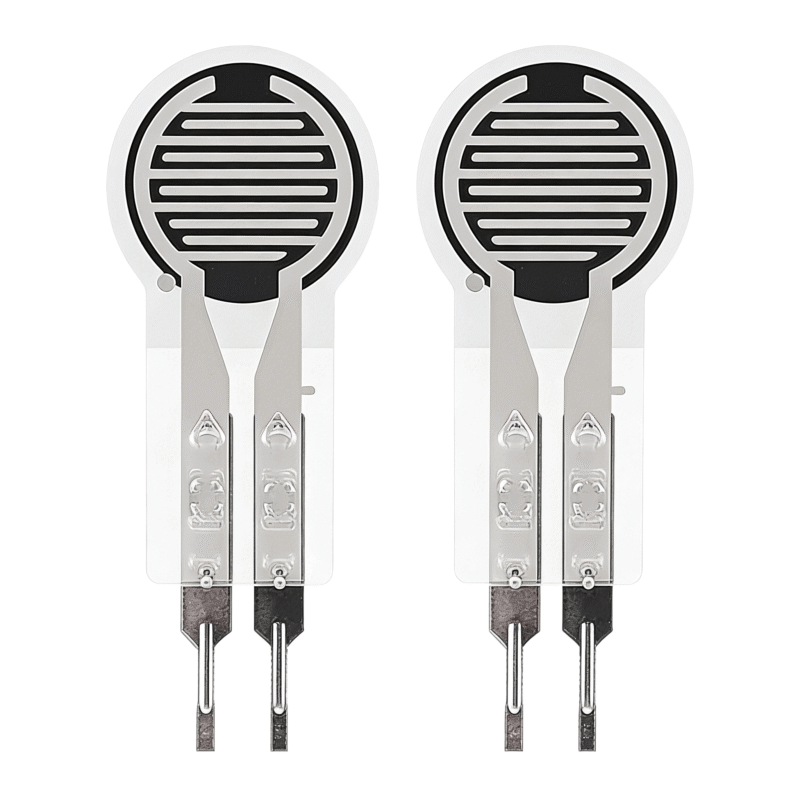
Thin Film Pressure Sensor, Force Sensitive Resistor (FSR), Ultra-Thin Flexible Pressure Sensor Pad, High Accuracy Resistance-Type Force Sensor for Arduino, IoT, Robotics & Smart Devices
Thin film pressure sensors are precision sensing devices that use advanced thin-film technology to convert pressure into electrical signals.
Our ultrathin, flexible film force sensors (FSRs) are designed for a wide range of force and pressure sensing applications, replacing traditional rigid load cells that are either too bulky or too expensive. Their thin and flexible design allows for easy integration into small consumer electronics, curved surfaces, and wearable devices.
Advantages of Thin Film Pressure Sensor
- High stability & ultra-low drift for long-term operation
- High measurement accuracy up to ±0.2% FS
- Wide operating temperature range for harsh environments
- Excellent anti-vibration and anti-shock performance
- Compact & miniature size for easy integration
- Long service life and high reliability
- No oil filling, no leakage risks
- Wide pressure ranges & strong customization capability
Thin Film Pressure Sensor Specifications
| Parameter | Specification |
|---|---|
| Sensor Type | Thin Film Pressure Sensor |
| Pressure Range | 0–50 kPa / 0–100 kPa / 0–500 kPa (customizable) |
| Output Type | Analog voltage / Digital signal (I2C, SPI, or custom) |
| Accuracy | ±0.5% FS to ±1% FS |
| Resolution | 0.01 kPa (typical) |
| Response Time | ≤1 ms |
| Operating Temperature | -40°C to +85°C |
| Storage Temperature | -40°C to +125°C |
| Humidity Range | 0–95% RH (non-condensing) |
| Mechanical Shock | 50 g / 11 ms |
| Vibration Resistance | 10–500 Hz, 5 g |
| Power Supply | 3.3 V / 5 V (typical) |
| Size / Thickness | ≤1 mm thin film |
| Material | Polyimide / PET film with metallic sensing layer |
| Lifespan | ≥10 million cycles |
| Protection Level | IP65 / IP67 / optional IP68 |
Typical Applications of Thin Film Pressure Sensor
-
Human–machine interface (HMI): Force‑sensitive buttons, sliders and touch pads in consumer electronics, musical instruments, gaming controllers and interactive installations.
-
Robotics & cobots: Gripping force control, tactile “skin” on robot arms and fingers, collision detection and soft robotics feedback where low‑cost, distributed force sensing is required.
-
Wearables & smart textiles: Pressure and contact detection in smart gloves, insoles, shoes, sports equipment and interactive garments, enabling motion tracking and activity recognition.
-
Medical & rehabilitation devices: Seating and bedding pressure monitoring, rehab training equipment, prosthetics and orthotics where contact force and load distribution must be monitored in real time.
-
Smart furniture & smart home: Occupancy detection in chairs, sofas and beds, hidden force‑sensitive switches in panels, doors and lighting systems.
-
Industrial & automation: Force and contact detection in assembly fixtures, end‑effectors, test jigs and safety switches, providing simple feedback control without complex mechanical design.
Related Products:
MEMS Pressure Sensor
Friendly Link: