
















5 Common Temperature Sensor Types You Need to Know

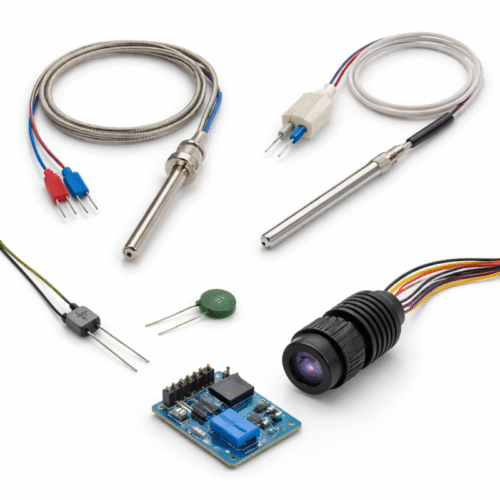
Temperature sensing is everywhere in modern life. It keeps industrial machinery running safely, ensures your food is properly stored, makes your home comfortable through HVAC systems, and even enables the smartwatch on your wrist to track your health. Whether you’re an engineer selecting components or just someone curious about how things work, understanding temperature sensors helps make sense of the technology around us.
In this article, we explore five widely used temperature sensor types, how they work, and where they’re typically applied.
1. What Is a Temperature Sensor?
A temperature sensor is a device that detects the temperature of an object or environment and converts that information into a readable electrical A temperature sensor detects the temperature of an object or environment and converts that information into an electrical signal that can be read by a display, controller, or computer. These sensors form the backbone of countless measurement and control systems across industries. You’ll find them in manufacturing plants, agricultural operations, medical devices, food storage facilities, HVAC systems, and consumer electronics.
Modern temperature sensors combine high accuracy with fast response times and reliable long-term performance. This makes them essential for everything from industrial automation to the everyday gadgets we use without a second thought.
2. Contact vs. Non-Contact Sensors
Temperature sensors fall into two main categories based on how they take measurements.
Contact sensors must physically touch whatever they’re measuring. They work through heat transfer, waiting until they reach the same temperature as the target object before producing a reading. This approach works well for measuring solid surfaces, liquids, and gases, though it does require a brief stabilization time. In some cases, inserting a probe can slightly disturb the temperature of what you’re measuring.
Common contact sensors include thermocouples, RTDs, thermistors, and digital temperature sensors.
Non-contact sensors measure temperature without touching the object at all. They detect thermal radiation, typically infrared energy, emitted from a surface. Because they don’t require physical contact, these sensors are ideal for measuring moving objects, extremely hot surfaces, electrically energized equipment, or hard-to-reach targets. They provide very fast measurements and don’t interfere with what they’re monitoring.
The most common non-contact option is the infrared temperature sensor.
3. Five Common Temperature Sensor Types
Based on how they work, five temperature sensors dominate industrial and electronic applications.
3.1 Thermocouples
A thermocouple is one of the most widely used industrial temperature sensors. It works based on the thermoelectric effect, where two different metal conductors joined together generate a voltage when exposed to temperature differences.
Thermocouples offer an extremely wide measurement range, making them suitable for high-temperature environments.
Common Thermocouple Types
- Type K (Chromel–Alumel): −200°C to 1350°C, most commonly used
- Type J (Iron–Constantan): 0°C to 750°C, often used in vacuum environments
- Type T (Copper–Constantan): −200°C to 400°C, excellent for low-temperature measurements
- Type S / R (Platinum-Rhodium): up to 1600°C, used in laboratory and precision applications
Advantages
- extremely wide temperature range
- durable and resistant to harsh environments
- fast response to temperature changes
- relatively low cost
Limitations
- lower accuracy compared to RTDs
- requires cold junction compensation and signal conditioning
Typical Applications
- steel and metal processing
- glass manufacturing
- furnaces and kilns
- industrial heaters and appliances
3.2 RTD (Resistance Temperature Detector)
An RTD sensor measures temperature by detecting changes in the electrical resistance of a metal element. Platinum is the most commonly used material due to its stable and predictable resistance characteristics.
Common RTD types include:
RTDs are well known for their high accuracy and excellent stability, making them ideal for precision measurements.
Advantages
- very high accuracy
- excellent long-term stability
- good linear response
Limitations
- higher cost than thermocouples
- sensing elements can be fragile
- requires precise measurement circuitry
Typical Applications
- pharmaceutical manufacturing
- food and beverage processing
- HVAC systems
- laboratory equipment
- medical devices
3.3Thermistors
A thermistor is a temperature sensor made from semiconductor materials. Its resistance changes significantly with temperature, allowing it to detect very small temperature variations.
Thermistors are typically classified into two types:
NTC Thermistors
Negative Temperature Coefficient (NTC) thermistors decrease in resistance as temperature increases. These are widely used for temperature measurement.
PTC Thermistors
Positive Temperature Coefficient (PTC) thermistors increase in resistance as temperature rises. They are commonly used for over-current protection and self-regulating heaters.
Advantages
- extremely high sensitivity
- small size and fast response
- low cost
Limitations
- relatively narrow temperature range (typically −50°C to 150°C)
- nonlinear resistance-temperature relationship
- possible long-term drift
Typical Applications
- medical equipment
- consumer electronics
- battery management systems
- household appliances
- fire detection systems
3.4 Digital Temperature Sensors
A digital temperature sensor integrates the sensing element with signal processing and analog-to-digital conversion circuits in a single chip.
Instead of outputting analog signals, it provides direct digital temperature data.
Common communication interfaces include:
- I²C
- SPI
- SMBus
- 1-Wire
Advantages
- easy integration with microcontrollers
- no external signal conditioning required
- compact size and low power consumption
Limitations
- narrower temperature range compared to thermocouples or RTDs
Typical Applications
- computers and CPUs
- IoT devices
- smartphones
- wearable electronics
- smart home systems
3.5 Infrared Temperature Sensors
An infrared (IR) temperature sensor measures temperature by detecting infrared radiation emitted from an object’s surface.
Because it does not require physical contact, it can measure temperature very quickly and safely.
Advantages
- non-contact measurement
- extremely fast response time
- ideal for moving or hazardous targets
- does not disturb the measured object
Limitations
- accuracy can be affected by smoke, dust, or humidity
- surface emissivity influences readings
Typical Applications
- medical thermometers (ear and forehead)
- electrical equipment inspection
- industrial process monitoring
- food temperature screening
4. Temperature Sensor Comparison
The table below summarizes the key differences between common temperature sensors.
| Sensor Type | Temperature Range | Accuracy | Response Time | Cost | Typical Use |
|---|---|---|---|---|---|
| Thermocouple | −200°C to 1800°C | ±1–2°C | Fast | Low | Industrial furnaces |
| RTD | −200°C to 850°C | ±0.1–0.3°C | Medium | High | Laboratories, HVAC |
| Thermistor | −50°C to 150°C | ±0.1–1°C | Fast | Very Low | Electronics |
| Digital Sensor | −55°C to 150°C | ±0.5°C | Medium | Medium | IoT devices |
| Infrared Sensor | −50°C to >1000°C | ±1–2% | Very Fast | Medium | Non-contact measurement |
5. How to Choose the Right Temperature Sensor
Selecting the right temperature sensor means matching its capabilities to your specific needs.
Start with temperature range. What are the minimum and maximum temperatures you need to measure? Some applications require the extreme range of thermocouples, while others stay within the narrower comfort zone of thermistors or digital sensors.
Consider accuracy requirements carefully. Laboratories and pharmaceutical processes demand the precision that RTDs provide. If you’re working with tighter tolerances, accuracy becomes a deciding factor.
Think about response time. How quickly do temperatures change in your application? Fast-moving processes need sensors with rapid response times, like thermocouples, thermistors, or infrared sensors.
Evaluate environmental conditions. Will the sensor face vibration, corrosion, humidity, or high pressure? Industrial environments often demand rugged, well-protected sensors like thermocouples or specialized RTD probes.
Check physical constraints. Space limitations might restrict sensor size or probe length, especially in compact devices like wearables or consumer electronics where thermistors or digital sensors shine.
Consider integration needs. Do you need simple analog output, digital communication, or remote monitoring capabilities? This often determines whether a basic thermocouple or a digital sensor makes more sense for your project.
Factor in cost and maintenance. Weigh not just the sensor price but installation complexity, calibration requirements, and long-term reliability against your budget. Thermistors offer the lowest upfront cost, while RTDs may save money long-term through stability and reduced calibration needs.
6. FAQ
6.1 What is the most accurate temperature sensor?
RTD sensors generally provide the highest accuracy and stability, often achieving precision within ±0.1°C under controlled conditions.
6.2 Which temperature sensor works best for high temperatures?
Thermocouples are the best choice for extremely high temperatures, with some types capable of measuring up to around 1800°C.
6.3 What is the difference between RTD and thermistor?
RTDs provide higher accuracy and better long-term stability over a wider temperature range. Thermistors are more sensitive and cost-effective but operate within a narrower temperature range.
7. Conclusion
Temperature sensors are essential components in modern technology, enabling accurate monitoring and control across countless industries. From contact sensors such as thermocouples, RTDs, thermistors, and digital temperature sensors to non-contact infrared sensors, each type offers unique advantages and application scenarios.
Choosing the right temperature sensor requires careful evaluation of temperature range, accuracy requirements, response time, environmental conditions, installation constraints, and cost. By matching the correct sensor technology to your application, you can ensure reliable temperature measurement, improve system efficiency, and maintain safe operating conditions.