














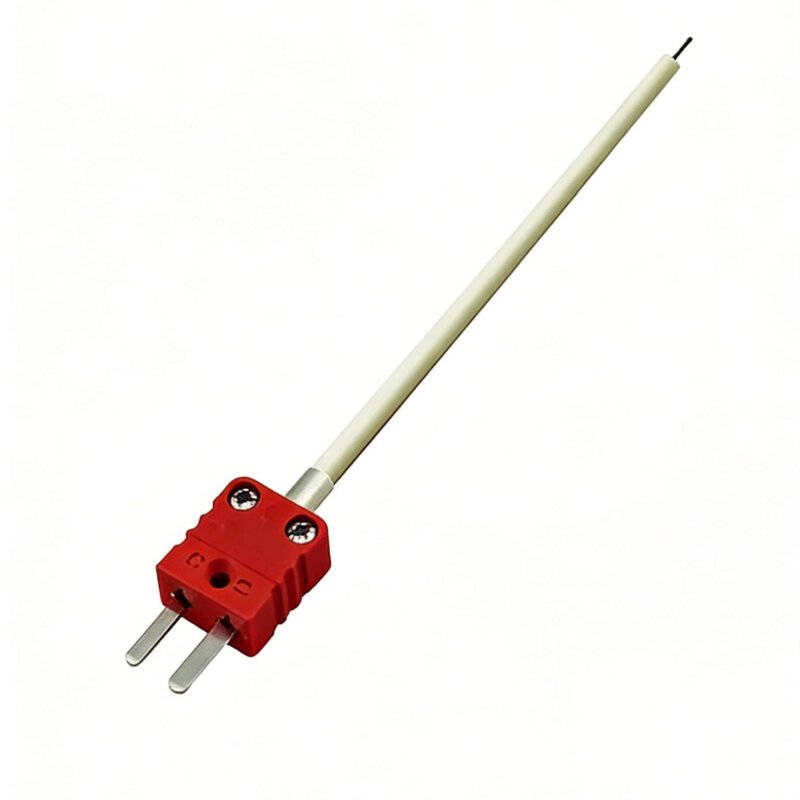
Type C Thermocouple Sensor – High-Temperature Alloy for Industrial & Laboratory Measurement
Product Description
Our type C Thermocouple (W5Re/W26Re) delivers premium-grade temperature sensing for ultra-high temperature environments that demand durability, stability, and precision. We craft it from tungsten-rhenium alloys to achieve superior performance up to 2300°C (4170°F) in inert or vacuum atmospheres—perfect for laboratories, aerospace, and metallurgical applications.
Unlike conventional types (K, J, N, or S), Type C outperforms with exceptional resistance to oxidation and corrosion at high temperatures, dramatically extending sensor lifespan in tough conditions.
Advantages of Type C Thermocouple
Ultra-high temperature measurement up to 2300°C (4170°F)
Tungsten-rhenium alloy (W5Re/W26Re) for extreme durability
Excellent linearity and repeatability in high-temperature ranges
Low drift and high stability during prolonged operation
Customizable sheath (tungsten, molybdenum, alumina) and length options
Inert gas and vacuum compatible for laboratory environments
Fast thermal response and high signal accuracy
Factory-direct manufacturing for OEM and industrial integration
RoHS compliant, reliable calibration and performance traceability
Designed for metallurgy, aerospace, furnace control, and R&D
Type C Thermocouple Sensor Specifications
Typical Applications
Industrial & High-Temperature Processing
Metallurgical furnace and sintering process monitoring
Heat treatment and thermal processing systems
Titanium, molybdenum, and tungsten alloy production
Aerospace & Laboratory Research
Aerospace engine and material testing
Vacuum and plasma environments
R&D high-temperature experiments
Semiconductor & Energy Industries
Thermal analysis in wafer and crystal growth systems
Power generation turbine and nuclear research
FAQs
1. What temperature range does a Type C thermocouple measure?
It’s designed for extreme environments, accurately measuring temperatures from 0°C to about 2300°C (4170°F).
2. What materials are used in the Type C thermocouple?
It uses tungsten-5% rhenium and tungsten-26% rhenium alloys, known for stability and durability at very high temperatures.
3. Can the Type C thermocouple be used in air?
No. It should be used in an inert gas or vacuum environment since tungsten oxidizes in air at high temperatures.
4. Do you provide custom thermocouples?
Yes, we offer OEM/ODM customization — wire diameter, sheath material, cable length, and connector type can all be specified.
5. How is the thermocouple calibrated?
All sensors are factory-calibrated to ASTM E230 standards, ensuring reliable and traceable performance.
6. What industries commonly use Type C thermocouples?
They’re widely used in metallurgy, aerospace, R&D labs, semiconductor processing, and high-temperature furnace applications.
7. How long does a Type C thermocouple last?
Service life depends on temperature level and environment, but under vacuum conditions, lifespan is significantly longer than common thermocouple types.
8. Do you ship internationally?
Yes, we export globally with OEM supply options for distributors, manufacturers, and research institutions.
Related Thermocouple Products
| Type K Thermocouple |
| Type S Thermocouple |
| Type E Thermocouple |
| Type N Thermocouple |
| Type J Thermocouple |
| Type T Thermocouple |
| Type R Thermocouple |
Friendly Link: