



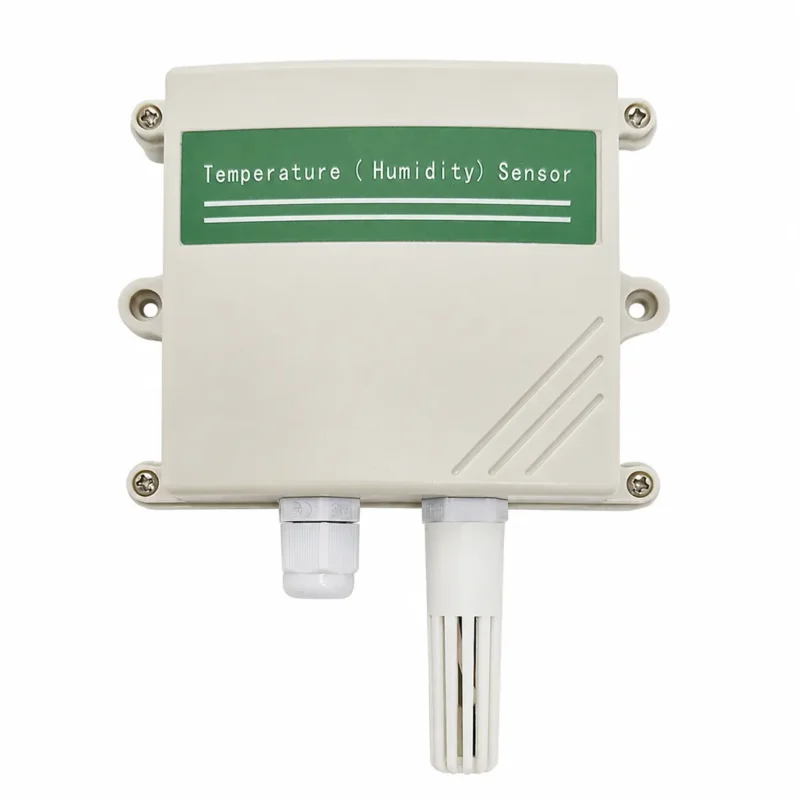
4-20mA Temperature and Humidity Sensors – Industrial-Grade Transmitters for Reliable Environmental Monitoring
4-20mA temperature and humidity sensors are industrial-standard transmitters that convert ambient temperature and relative humidity into a stable 4–20 mA analog current signal. The 4-20mA current loop is the industry standard for transmitting sensor data because it provides noise immunity and works over long distances. These sensors are the preferred choice for engineers who need accurate, interference-free environmental data in HVAC systems, industrial facilities, pharmaceutical cleanrooms, cold storage, greenhouses, and building automation systems.
At Huada, we supply a full range of 4-20mA temperature and humidity sensors, including wall mount, duct mount, outdoor, and probe versions — in both standard and high-protection IP65/IP68 configurations. Whether you are integrating into a PLC, BMS, or SCADA system, our sensors deliver stable, long-distance signal transmission with minimal wiring complexity.
What Is 4-20mA Temperature and Humidity Sensor?
A 4-20mA temperature and humidity sensor is a device that converts temperature and humidity signals into analog current signals (4-20mA). It converts the signals collected by the temperature and humidity sensor into a standard 4-20mA current signal for transmission and control.
The sensor typically consists of a temperature-sensing element, a humidity-sensing element, a signal conditioning circuit, and an output stage. Together, these components process the raw environmental measurements and output a proportional current: 4 mA represents the minimum measured value, while 20 mA represents the maximum.
This linear relationship simplifies signal interpretation. For example, if a temperature sensor has a range of 0–100°C, 4 mA represents 0°C, 20 mA represents 100°C, and 12 mA represents 50°C.
4-20mA Temperature and Humidity Sensor Types and Mounting Styles
Different installations require different form factors. For that reason, we offer multiple mounting and enclosure configurations to match your specific application.
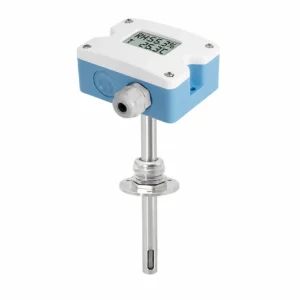
Duct Mount Temperature and Humidity Sensor
The duct mount enclosure allows the sensor to be mounted in a return air duct. The sensor can be programmed to detect humidity levels from 0 to 100% RH, with a stability of 1% RH typical at 50% RH over five years. This design is ideal for HVAC air handlers, air conditioning units, and ventilation systems where monitoring the air stream directly is required.
 Wall Mount Temperature and Humidity Sensor
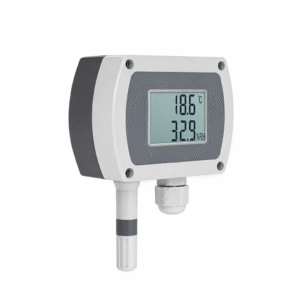 Wall Mount Temperature and Humidity Sensor
Wall mount sensors are the most widely used configuration for indoor environmental monitoring. There are two loop-powered 4-20mA outputs, one representing ambient temperature and one representing ambient relative humidity. These sensors suit offices, warehouses, server rooms, communication rooms, and laboratory spaces where a clean, professional installation is needed.
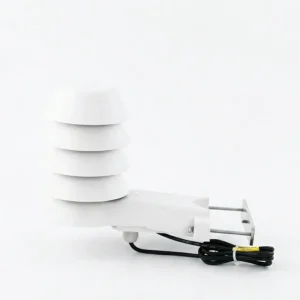
Outdoor Temperature and Humidity Sensor
For outdoor monitoring applications, all connections are made via screw contacts in the waterproof IP65 housing. In addition to the output of the measurement signal as a 4-20mA signal, measurement values can also be output via the RS485 interface. IP65 and IP68-rated housings protect against dust ingress, rain, and temporary immersion, making them well suited for weather stations, agricultural fields, and outdoor industrial installations.
 Temperature and Humidity Sensor Probe
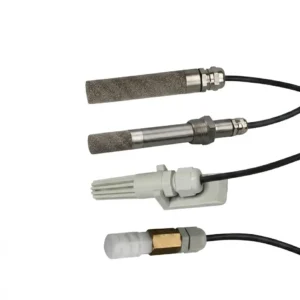 Temperature and Humidity Sensor Probe
Probe sensors feature a detachable sensing element on a cable, which allows placement in hard-to-reach locations such as soil, grain bins, incubators, or storage chambers. Thanks to the digital conditioning circuit, the probe sensor turns the test result into a stable 4-20mA output.
4-20mA Temperature and Humidity Sensor Specifications
| Parameter | Typical Range |
|---|---|
| Output signal | 4–20mA (two independent channels) |
| Temperature range | –40°C to +120°C (model dependent) |
| Humidity range | 0–100% RH |
| Temperature accuracy | ±0.3°C to ±0.5°C |
| Humidity accuracy | ±2% to ±3% RH |
| Supply voltage | 10–30V DC |
| Response time (humidity) | ≤8 s at 1 m/s |
| Response time (temperature) | ≤25 s at 1 m/s |
| Long-term stability | ≤1% RH/year; ≤0.1°C/year |
| Protection rating | IP40 / IP65 / IP68 |
| Load resistance | ≤600Ω (current output) |
| Mounting styles | Wall mount, duct mount, probe, outdoor |
| Optional output | RS485 Modbus RTU, 0–5V, 0–10V |
Applications of 4-20mA Temperature and Humidity Sensors
4-20mA temperature and humidity sensors serve a wide range of industries wherever stable, accurate, and interference-resistant environmental monitoring is required.
HVAC and Building Automation
Humidity sensors transform moisture readings into useful data that powers HVAC systems, industrial equipment, and building controls. Wall mount and duct mount 4-20mA sensors integrate directly into building management systems (BMS) and programmable logic controllers (PLCs), enabling automatic climate control, energy optimization, and occupant comfort monitoring.
Industrial Automation and Process Control
Engineers widely deploy RHT transmitters for environmental control in cold chambers for fruit ripening, cold storage facilities, HVAC systems, laboratories, clean rooms, and automated production lines where humidity and temperature measurement is critical to process quality. In addition, their architecture allows easy integration with controllers, PLCs, and supervisory systems.
Pharmaceutical and Cleanroom Environments
In pharmaceutical manufacturing and cleanroom operations, even minor deviations in temperature or humidity can compromise product integrity, process validation, and regulatory compliance. 4-20mA sensors deliver continuous, real-time data to monitoring systems, supporting GMP documentation and audit trails.
Greenhouse and Agricultural Monitoring
These sensors support wide application in data detection, outdoor greenhouses, warehouse storage, and building automation. In agricultural environments, precise humidity and temperature control directly affects crop yield, disease prevention, and energy consumption. 4-20mA sensors integrate seamlessly with greenhouse control systems and irrigation PLCs.
Cold Chain and Warehouse Storage
In food-grade cold rooms, pharmaceutical cold storage, and logistics warehouses, continuous temperature and humidity monitoring is both a regulatory requirement and an operational necessity. 4-20mA sensors deliver reliable real-time data to alarm systems and data loggers, ensuring product safety and compliance.
Data Centers and Server Rooms
Excessive humidity causes condensation and corrosion, while low humidity increases the risk of electrostatic discharge. 4-20mA temperature and humidity sensors help data center operators maintain optimal environmental conditions and protect critical IT infrastructure.
Weather Stations and Environmental Monitoring
Outdoor-rated 4-20mA sensors serve meteorological stations, air quality monitoring networks, and remote environmental sensing installations, where long cable runs and exposure to the elements make current-loop transmission the most practical choice.
Medical and Laboratory Equipment
Hospitals and laboratories use 4-20mA temperature and humidity sensors to measure and control environmental conditions, ensuring the normal operation of medical equipment and experiments.
How to Select the Right 4-20mA Temperature and Humidity Sensor
Choosing the correct sensor depends on your installation environment, signal requirements, and integration needs. Consider the following factors:
1. Mounting Style
First, determine where the sensor will sit. Choose wall mount for room-level monitoring, duct mount for HVAC airstream measurement, outdoor/IP65+ for exposed environments, or probe-style for immersion and remote-sensing applications.
2. Measurement Range
Then confirm the required temperature and humidity range. Standard models cover –40°C to +60°C or +80°C. For high-temperature environments such as drying ovens or industrial processes, select a model that handles +120°C or above.
3. Accuracy Requirements
Next, consider how tightly your application needs control. Pharmaceutical and cleanroom applications typically demand ±1% RH or better, while general HVAC and warehouse monitoring works well with ±2–3% RH accuracy.
4. Protection Rating
After that, assess the environmental conditions. IP40 suits clean indoor environments; IP65 provides dust-tight and water-jet protection; IP68 adds submersion protection for outdoor and washdown applications.
5. Output Configuration
Finally, confirm your system’s input requirements. Pure analog 4-20mA offers the simplest integration path. If your system also requires digital communication, consider models that combine RS485 Modbus RTU output with the 4-20mA analog loop.
Why Choose Our 4-20mA Temperature and Humidity Sensors?
Industrial-Grade Construction
Our sensors are built for long-term deployment in demanding environments. High-quality polymer humidity elements, digital microprocessor signal conditioning, and robust housing materials ensure stable performance year after year.
Broad System Compatibility
Because they output the universal 4-20mA standard, our sensors connect directly to virtually any PLC, DCS, SCADA system, BMS, or data logger without additional signal converters or protocol adapters.
Multiple Configuration Options
From compact wall-mount transmitters to heavy-duty outdoor probes, our range covers standard and custom configurations to match diverse installation requirements.
OEM and Custom Support
We support OEM customers with customized measurement ranges, modified housings, special cable lengths, and private-label configurations. In addition, we provide engineering assistance for connector selection, integration guidance, and bulk supply.
Calibration and Documentation
Each sensor ships with full specifications and calibration data. We provide traceable calibration certificates on request, supporting compliance documentation for pharmaceutical, food, and laboratory applications.
FAQ
1. What is a 4-20mA temperature and humidity sensor?
Is an industrial transmitter that measures both temperature and relative humidity and outputs each measurement as a proportional 4–20 mA current signal. The signal then trt iavels over long distances to a PLC, BMS, data logger, or other control system.
2. Why is 4-20mA better than 0-10V for humidity and temperature sensing?
4-20mA suits temperature and humidity transmitters well due to its robustness and long-distance transmission capabilities. It also resists noise and interference. Unlike 0–10V signals, the current loop ignores voltage drop along the cable, making it far more reliable over long wiring runs in industrial environments.
3. How far can a 4-20mA temperature and humidity sensor transmit its signal?
In theory, a 4-20mA signal can travel over several kilometers, depending on the power supply voltage, cable cross-section, and total loop resistance. In practice, standard instrumentation cable supports reliable transmission over hundreds of meters without issue.
4. Can a 4-20mA sensor detect wiring faults?
Yes. Because the live zero sits at 4 mA rather than 0 mA, a reading below 4 mA indicates a broken wire or sensor failure, allowing the monitoring system to trigger an alarm automatically.
5. What is the difference between a 2-wire and 3-wire 4-20mA sensor?
A 2-wire (loop-powered) sensor uses the same two wires for both power supply and signal transmission, simplifying installation. A 3-wire sensor uses separate wires for power and signal, which can improve performance in some configurations but requires additional wiring.
6. Are your sensors compatible with Modbus and BACnet systems?
Many of our models combine 4-20mA analog output with RS485 Modbus RTU digital output, supporting integration into both legacy analog systems and modern BACnet/Modbus-based building automation platforms.
7. What IP rating do I need for outdoor installation?
For outdoor use, we recommend at least IP65, which provides dust-tight and water-jet protection. For wet or washdown environments, IP67 or IP68-rated models add full submersion protection.
8. Do you supply calibration certificates?
Yes. Every sensor ships with calibration data, and we provide traceable calibration certificates on request for regulatory and quality management applications.
Find the Right 4-20mA Temperature and Humidity Sensor
From wall mount and duct mount transmitters to outdoor IP68 probes and high-accuracy OEM sensing elements, our range of 4-20mA temperature and humidity sensors covers virtually every industrial and commercial monitoring application.
Contact our engineering team with your application requirements — mounting style, measurement range, accuracy class, and integration system — and we will help you select the correct sensor quickly and accurately.