




PT100 vs PT1000: Which RTD Sensor Should You Choose

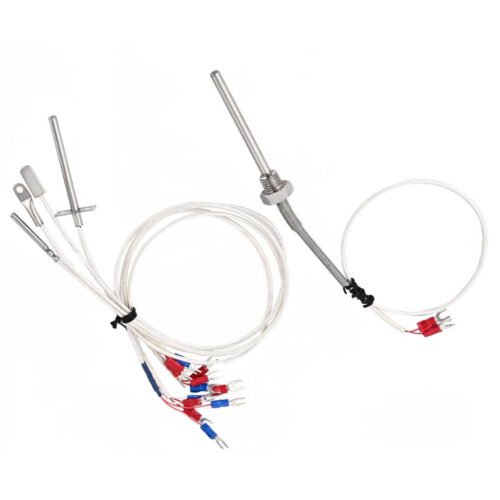
In industrial plants, commercial HVAC systems, medical devices, and even laboratory instruments, PT100 and PT1000 are two of the most commonly used RTD temperature sensors. Both use platinum sensing elements and work on the exact same principle—resistance changes with temperature. However, differences in their base resistance, signal strength, and wiring sensitivity directly affect which one is better suited to your specific application.
By the end of this guide, you will clearly understand the core differences between PT100 and PT1000, and you will be able to confidently choose the right sensor for everything from large industrial furnaces and battery‑powered IoT nodes to precision medical equipment.
1. What Are PT100 and PT1000 RTD Sensors
What is an RTD sensor
An RTD (Resistance Temperature Detector) is a type of temperature sensor that measures temperature by detecting changes in the electrical resistance of a metal element. Here’s how it works: as temperature increases, the resistance of the platinum element increases in a highly predictable and nearly linear way. By measuring that resistance, the sensor’s electronics can calculate the exact temperature.
The most common and accurate RTDs use platinum as the sensing material – which is why you often see names like PT100 and PT1000.
PT100 RTD sensor
The PT100 is the most common RTD sensor in the world. Its name tells you its key specification: it has a resistance of 100 Ω at 0 °C. Made of high‑purity platinum, the PT100 is reliable, cost‑effective, and widely available.
Typical specifications:
- Temperature range: –200 °C to +850 °C
- Accuracy: Class A (±0.15 °C) or Class B (±0.30 °C)
- Temperature coefficient: 0.00385 Ω/Ω/°C (IEC 60751 standard)
- Common wiring: 2‑wire, 3‑wire, or 4‑wire (3‑wire and 4‑wire are recommended for long distances)
Because of its balance between cost and performance, the PT100 is used everywhere – from chemical reactors and power plants to HVAC systems, automotive engines, and food storage monitoring.
PT1000 RTD sensor
The PT1000 works exactly like a PT100, but with a 10× higher base resistance: 1000 Ω at 0 °C. It uses the same platinum material and follows the same IEC 60751 curve. However, because its resistance is ten times larger, a small temperature change produces a ten times larger change in resistance – about 3.85 Ω per °C for PT1000, compared to 0.385 Ω per °C for PT100.
Typical specifications:
- Temperature range: –200 °C to +600 °C (some special versions can reach +850 °C, but they are rare)
- Accuracy: same as PT100 (Class A, Class B, etc.)
- Temperature coefficient: 0.00385 Ω/Ω/°C
This higher signal strength makes the PT1000 excellent for detecting small temperature fluctuations. You will often find it in medical equipment (MRI machines, blood storage units), laboratory instruments, semiconductor manufacturing, and any application where every tenth of a degree matters.
2. PT100 vs PT1000: Key Differences
The table below summarises the most important differences. After the table, we will explain why each difference matters in practice.
| Feature | PT100 | PT1000 |
|---|---|---|
| Resistance at 0 °C | 100 Ω | 1000 Ω |
| Temperature range | –200 °C to +850 °C | –200 °C to +600 °C (typically) |
| Sensitivity (ΔR/ΔT) | ~0.385 Ω/°C | ~3.85 Ω/°C |
| Effect of lead wire resistance | Larger (needs 3‑wire/4‑wire for long runs) | Smaller (2‑wire acceptable for many medium‑length runs) |
| Signal‑to‑noise ratio | Lower | 10× higher (better in noisy environments) |
| Typical excitation current | 1 mA | 0.1–0.3 mA |
| Power consumption & self‑heating | Higher | Lower |
| Cost | Lower, mass‑produced | Slightly higher |
| Common applications | General industrial, HVAC, automotive | Medical, lab, precision, low‑power, long‑distance 2‑wire |
Why the base resistance difference matters
The most obvious difference – 100 Ω vs 1000 Ω – affects almost every other behaviour.
Lead wire resistance. Long cables add a few ohms of resistance. For a PT100, an extra 2 Ω of lead resistance causes a 2 % error (2 Ω out of 100 Ω). For a PT1000, the same 2 Ω causes only 0.2 % error. This means PT1000 can often be used in a simple 2‑wire configuration over distances of 10 meters or more, whereas PT100 would require a 3‑wire or 4‑wire setup to cancel lead resistance.
Signal strength and noise immunity. Because PT1000 produces a 10× larger resistance change per degree, the voltage signal reaching your measurement circuit is much stronger. In electrically noisy environments – near motors, VFDs, or generators – the PT1000 gives a better signal‑to‑noise ratio, resulting in more stable readings.
Power consumption and self‑heating. RTDs need a small excitation current to produce a voltage. PT100 typically uses 1 mA. PT1000 can use much lower currents (0.1–0.3 mA) while still generating a usable signal. Lower current means less power dissipation inside the sensor, which reduces self‑heating error and extends battery life – a critical advantage for wireless sensors and portable devices.
3. Advantages and Disadvantages of Each Sensor
PT100 Advantages
The PT100’s greatest strength is its ubiquity. It is the industrial standard. Nearly every temperature controller, PLC, and RTD transmitter supports PT100 directly. Because it is produced in huge volumes, it is also more affordable and easier to source.
Another advantage is its wiring flexibility. While 3‑wire or 4‑wire is best for long runs, a PT100 can still work acceptably with 2‑wire over very short distances (under a few meters). Its proven reliability over decades of use in harsh environments – high temperatures, vibration, chemical exposure – is hard to beat.
PT100 Disadvantages
The PT100’s lower signal strength means it is less sensitive to small temperature changes. If you need to detect a 0.1 °C difference reliably, the PT100 will require a very good measurement circuit. Also, for long‑distance 2‑wire installations, the lead resistance error can become unacceptable without compensation.
PT1000 Advantages
The PT1000 shines in three specific areas: precision, low power, and long‑distance 2‑wire operation.
Because its output signal is ten times larger, it easily resolves tiny temperature variations – ideal for medical devices, laboratory incubators, and semiconductor manufacturing. The lower excitation current reduces self‑heating, which is particularly important for cryogenic or low‑temperature measurements where even a small heat source can distort the reading. And as noted earlier, the higher base resistance makes it far more tolerant of lead wire resistance, so you can use a simple 2‑wire cable over tens of meters without significant error.
PT1000 Disadvantages
The PT1000 is not as universally supported as the PT100. Some older PLCs or temperature controllers may not have a PT1000 input mode. It is also slightly more expensive, though the price difference has narrowed over the years. Finally, while special high‑temperature PT1000 sensors exist, most standard PT1000 probes are rated only to +600 °C, not +850 °C.
4. Which One Should You Choose?
Your choice depends on three practical factors: temperature range, wiring distance and method, and power budget.
Choose PT100 if:
- Your maximum temperature exceeds +600 °C (up to +850 °C).
- You need to connect to existing industrial equipment that expects a PT100 input.
- You can use 3‑wire or 4‑wire wiring for longer cable runs.
- Cost and easy availability are top priorities.
- You do not need to detect extremely small temperature changes (e.g., <0.2 °C).
Typical use cases: industrial furnace monitoring, chemical reactor control, automotive engine testing, commercial HVAC.
Choose PT1000 if:
- You require high resolution (detecting 0.1 °C or better).
- You want to use 2‑wire wiring over distances of 10 meters or more.
- The sensor is battery‑powered (wireless nodes, portable thermometers, data loggers).
- You work in a high‑electrical‑noise environment (motors, welding equipment).
- Your temperature range stays within –200 °C to +600 °C.
Typical use cases: medical MRI temperature monitoring, laboratory incubators, semiconductor wafer processing, blood storage units, remote weather stations, and long‑distance pipeline temperature monitoring using 2‑wire cable.
5. Practical Installation Tips
Regardless of which sensor you choose, a few good practices will ensure accurate readings.
Use the correct wiring configuration. For PT100, always use 3‑wire or 4‑wire if the cable run exceeds 3 meters. For PT1000, you can use 2‑wire up to about 20 meters with minimal error, but for very long runs (over 50 meters) 3‑wire is still better.
Calibrate regularly. Even the best RTD drifts over time. Annual calibration is recommended for industrial applications, and more frequent checks may be needed in medical or laboratory settings.
Protect the sensor from moisture and chemicals. While platinum is robust, the leads and insulation can degrade. Use a proper thermowell or protective sheath in harsh environments.
Avoid self‑heating. Keep the excitation current as low as your measurement system allows. For PT1000, 0.2 mA is usually sufficient. For PT100, try not to exceed 1 mA.
6. Common Troubleshooting Issues
Inaccurate or erratic readings are often caused by incorrect wiring. Double‑check that you are using the right configuration (2‑wire, 3‑wire, or 4‑wire) and that the measurement device is configured for the correct RTD type (PT100 or PT1000). Loose connections or corroded terminals are another frequent culprit.
No signal usually means a broken wire or a failed sensor. Use a multimeter to check continuity. A PT100 should read near 100 Ω at room temperature; a PT1000 should read near 1000 Ω.
Drifting readings over time suggest sensor aging or contamination. Recalibrate first; if the drift persists, replace the sensor.
7. FAQ
- Can I directly replace a PT100 with a PT1000?
No. Because their base resistances are different (100 Ω vs 1000 Ω), the measurement circuit must be reconfigured or replaced. Simply swapping them will produce wildly inaccurate readings.
2. Which is more accurate: PT100 or PT1000?
Both can achieve the same absolute accuracy (e.g., Class A ±0.15 °C). However, the PT1000 makes it easier to resolve small temperature changes because of its higher sensitivity.
3. What is the maximum temperature for PT100 and PT1000?
Standard PT100: –200 °C to +850 °C. Standard PT1000: –200 °C to +600 °C. Some manufacturers offer extended‑range PT1000 elements, but they are less common.
4. Do these sensors require calibration?
Yes. Annual calibration is recommended for most applications. Medical and laboratory uses may require more frequent calibration.
5. Which is better for long‑distance installations?
For 2‑wire systems, PT1000 is clearly better because lead resistance errors are much smaller. For 3‑wire or 4‑wire systems, both work well, but PT100 is often more cost‑effective.
8. Conclusion
There is no single “best” RTD sensor – only the right fit for your specific application.
Choose PT100 if you need a rugged, affordable, industry‑standard sensor for temperatures up to +850 °C, and you can use 3‑wire or 4‑wire wiring. It is the workhorse of industrial temperature measurement.
Choose PT1000 if you need high resolution, low power consumption, or the simplicity of 2‑wire wiring over long distances – and your temperatures stay within –200 °C to +600 °C. It is the preferred choice for medical devices, laboratories, battery‑powered systems, and electrically noisy environments.
By understanding the trade‑offs between base resistance, signal strength, wiring sensitivity, and power consumption, you can confidently select the right RTD for your next project.