
















How to Use R-type Platinum-Rhodium Thermocouple in semiconductor manufacturing?

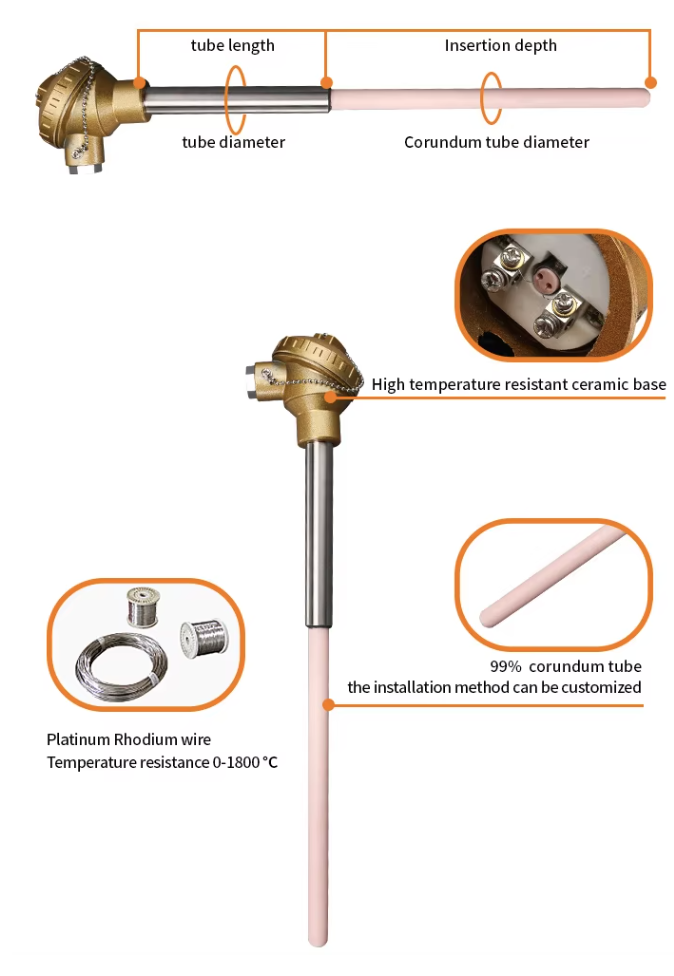
1. What is Type R Thermocouple?
Type R latinum-Rhodium thermcoupe is High-performance precious metal temperature sensor. And its main usage is for Precise measurement of high temperature ,such as manfucruing industry and scientific research field . It is suitalbe for oxidizing and inert atmospheres. The long-term operating temperature is up to 1300℃ and a short-term operating temperature is up to 1600 ℃ .
2.Learn what is Thermocouples
2.All You Need to Know about Platinum-Rhodium Thermocouples
3.R type Thermocouples Specification
3.Type R Thermocouples– echnical Data
| Conductor Combination | Approximate generated EMF change in µV per ºC change (referenced to 0ºC) at: | Approximate Working Temperature Range | Initial Calibration Tolerances to ASTM E-230 (whichever is greater) | Thermocouple Output Tolerances to IEC 60584-1 | ||||||||
| + Leg | – Leg | 100ºC | 500ºC | 1000ºC | ºF | ºC | Standard | Special | Type | Class 1 | Class 2 | Class 3 |
| PLATINUM – 13% RHODIUM | PLATINUM | 8 | 10 | 13 | 32 to 2700 | 0 to 1480 | ±1.5 or ±0.25% | ±0.6 or ±0.1% | Temperature Range Tolerance Value Temperature Range Tolerance Value | 0°C to +1100°C ±1.0°C 1100°C to 1600°C ±(1 +0.003 (t ⋅ 1100)°C | 0°C to +600°C ±1.5°C 600°C to 1600°C ±0.0025 ⋅ |t| | – – – – |
4.R Thermocouple Sensor Application :
| Application Feild | Typical applications | Reasons for selection |
| Iron and Steel Metallurgy | Metal smelting, furnace temperature control, and heat treatment process monitoring | It has high measurement upper limit, high accuracy, and good stability, and is suitable for high-temperature environments such as molten metal. |
| Glass manufacturing | Furnace temperature monitoring and molding process control | It provides excellent high temperature resistance and oxidation resistance, and it can work stably in molten glass and high temperature furnace gas for a long time. |
| Semiconductor manufacturing | Temperature control in crystal growth, diffusion, epitaxy and other processes | It boasts high precision and stability, meeting the extremely stringent temperature control requirements of semiconductor processes. |
| Chemical industry | Temperature monitoring and process control of high-temperature reactors, cracking furnaces, and conversion furnaces | It is antioxidant and corrosion resistant, and suitable for high-temperature oxidation or inert environments in the chemical industry. |
| Scientific Research Experiment | High-temperature materials research, thermal analysis, calibration standards | With high accuracy and good reproducibility, it is often used as a precision temperature measuring element in laboratories and imported equipment. |
5.Application Examples and scenarios:
R-type thermocouples are primarily using in high-temperature thermal processes in semiconductor manufacturing .It need extremely stringent precision and stability requirements. Below are some specific application examples and scenarios:
5.1 thermocouples Application in Single-crystal silicon growth (Czochralski method)
This is one of the core applications of R-type thermocouples in the semiconductor field. When growing 300mm-large-size silicon ingots, R-type Temperature Sensor are embedded in the inner wall of a graphite heater,and it dynamically track the solid-liquid interface temperature upto approximately 1420℃. The precision of this temperature control directly determines the crystal quality and yield. It has been reported that by combining high-precision R-type thermocouples with AI algorithms, the yield can be improve to 92%. Their high stability and oxidation resistance at high temperatures are key to achieving at this.
5.2 Temperature Sensor usage in Epitaxial Deposition Reactor
In the epitaxial growth process of silicon-based or other compound semiconductor materials, the temperature uniformity and accuracy within the reactor directly determine the thickness and doping uniformity of the epitaxial layer. R-type thermocouples can monitor this ultra-high temperature environment of 1000-1600℃. Due to their high precision and stability, they ensure the repeatability and reliability of the epitaxial deposition process, which is a key guarantee for the production of high-performance semiconductor devices.
5.3 Diffusion Furnace Process
In diffusion furnaces, it requre precise temperature measurement at multiple points within the furnace. And this will ensure uniform distribution of doped impurities within the wafer. So It commonly need to use R-type thermocouples in these processes, covering a temperature range of 800°C to 1200°C. In particular, we design Spike thermocouples dspecifically for diffusion furnaces. They offers robustness, customizability, and fast response. They can even employ dual thermocouple designs for redundancy and sensor drift monitoring, which is crucial for semiconductor processes requiring continuous operation for weeks.
5.4 Platinum-rhodium thermocouples using in Wafer Surface Temperature Measurement
Also, During the manufacturing process, to more accurately reflect the actual temperature of the wafer, R-type thermocouples are manufactured in a special wafer shape (wafer thermocouples) . In this way ,it can directly measure the surface temperature of 4-inch, 6-inch, 8-inch, and 12-inch wafers. These sensors are typically manufactured and packaged in cleanroom environments and avoid wafer contamination .Thus, this ensure that measurement data meets the stringent standards of the semiconductor industry. however, their common application is for temperature monitoring in processes such as Rapid Thermal Annealing (RTP).
5.5 Thermoelectric couple Application in Other High-Temperature Processes
R-type thermocouples are also widely applided in other high-temperature semiconductor manufacturing processes, such as:
Ion implantation: Monitoring wafer temperature during the implantation process.
Chemical vapor deposition (CVD): Ensuring uniformity of the temperature field, within the reaction chamber to obtain high-quality thin films.
Liquid phase epitaxy: Precisely controlling the temperature in the molten state.
In semiconductor manufacturing, R-type thermocouples are not the only option, they also work in conjunction with other types of thermocouples, so they can meet the specific needs of different process stages.
| Thermocouple type | Typical Applications | Main advantages |
| R/S type (platinum-rhodium-platinum) | Single crystal silicon growth, epitaxial deposition, rapid annealing | It features high precision and good high-temperature stability, making it suitable for core high-temperature processes. |
| Type K (NiChromium-NiSilicon) | diffusion furnace low-temperature section, CVD, oxidation furnace, etching equipment | It offers high cost-effectiveness and antioxidant properties, making it suitable for medium and low temperature ranges (<1300℃) and cost-sensitive areas. |
| Type B (Platinum-Rhodium 30 – Platinum-Rhodium 6) | High-temperature oxidation furnace, annealing process | It has a higher upper temperature resistance (>1600℃) and strong resistance to pollution. |
| Type C (Tungsten-Rhenium) | MOCVD, silicon carbide (SiC) crystal growth | Ultra-high temperature measurement (>2000℃), but must be used in an inert or reducing atmosphere. |
6.Application for single crystal silicon growth (Czochralski method)
In the Czochralski process for growing single-crystal silicon, temperature measurement and control are paramount. They directly determine whether the silicon melt can crystallize stably; and it also significantly impact the quality and yield of the final crystal. At following,I will break down the details of temperature measurement for you.
6.1 Precise temperature measurement at multiple points: Constructing a three-dimensional thermal field profile
The temperature distribution is a complex three-dimensional field inside a single-crystal furnace. To achieve precise control, It need deploy temperature sensors at key locations. R-type (or S-type) thermocouples are the primary sensors used.
| Temperature measurement points | Eaxact Location | Main Target | Common temperature measurement methods |
| Bottom of Crucible | Insert through the crucible shaft into the center of the bottom of the graphite crucible. | Measuring the temperature at the bottom of the crucible and monitoring the radial temperature gradient of the melt in real time helps prevent overcooling or overheating at the bottom, providing a basis for adjusting the heater power. | Contact thermocouple (R/S type) |
| Near the heater | Inside or outside of the graphite heater | Directly monitoring the temperature of the heat source is the main feedback signal for temperature closed-loop control, ensuring the stability of heating power output. | Contact thermocouples (R/S/B type) |
| Melt interior | Directly inserted into the silicon melt | Obtaining the true temperature of the melt is crucial data for thermal field modeling and analysis. However, due to the high temperature and corrosiveness, the requirements for the protective tube are extremely high, making it relatively rare. | Contact thermocouple (with special protective tube) |
| Crystal surface | For the already pulled crystals | Measuring the temperature distribution on the crystal surface is used to verify and correct numerical simulation results, thereby enabling in-depth study and control of micro-defects within the crystal. | Non-contact (radiation thermometer) |
| Outer wall of the crucible | Observation windows opened on the furnace wall | Monitor the temperature distribution and thermal uniformity of the quartz crucible to prevent softening, deformation, or cracking due to localized overheating, thus ensuring process safety. | Non-contact (infrared thermal imager) |
6.2 Core temperature measurement point: The key role of the bottom of the Crucible.
Of all temperature measurement points, monitoring the temperature at the bottom of the crucible is particularly crucial for process control.
And Its design details are as following:
Installation Method:
In this way,We introduce The thermocouple sensor from the bottom of the single-crystal furnace, pass through the hollow crucible shaft, and insert upwards to the center of the bottom of the graphite crucible. This design aims to be as close to the melt as possible, it can avoid direct contact with the corrosive silicon melt.
Core Objective:
Because with placing a temperature measuring point at the bottom of the crucible, the system can capture temperature fluctuations in real time.
Temperature changes at this location directly reflect the stability of the longitudinal temperature gradient.Of cource, it is crucial for preventing abnormal crystallization at the bottom of the melt and optimizing the thermal field during the later stages of crystal pulling.
6.3.The rigorous testing and special requirements of type R thermocouples Sensers:
Inside a single-crystal silicon growth furnace, the working environment of R-type thermocouples is extremely harsh, thus placing special requirements on them:
Ultra-high precision and stability:
Silicon has a melting point of approximately 1414°C. Even a deviation of just a few degrees in the solid-liquid interface temperature can lead to interruption of crystal growth or the generation of numerous defects. Due to their laboratory-grade precision (Class I precision up to ±1.5°C) and long-term stability, R thermocouples have become the “gold standard” in this core temperature range.
Resistance to high-temperature creep:
When operating temperatures above 1400°C for extended periods, the negative electrode (pure platinum) of an R-type thermocouple is prone to “high-temperature creep” (i.e., slow deformation under stress).Eventually It lead to breakage.
Therefore, high-end applications use oxide dispersion-strengthened (ODS) platinum alloys as the negative electrode material. Its high-temperature strength can be several to ten times higher than that of conventional pure platinum. And this can significantly extend the thermocouple’s lifespan.
Corrosion resistance and contamination prevention:
High-temperature silicon vapor and oxygen atmosphere within the single-crystal furnace can corrode and contaminate precious metal thermocouples, causing them to drift and fail.
Therefore, to protect type R thermocouples , we need high-purity alumina or corundum tubing to completely isolatethem from the furnace environment.
Extreme signal transmission:
The weak millivolt-level signal is generated by the thermocouple . It must transmitt the signal accurately to the controller via dedicated compensating wires. Poor contact at any connection point or use of the wrong type of wire will introduce significant measurement errors, causing the entire control system to fail.
6.4 From Measurement to Control: A Dynamic Closed Loop
While, with these precise temperature measurement points, the control system can implement complex control strategies. For example, the control system adjusts the heater power based on minute changes in the temperature at the bottom of the crucible;
Simultaneously, it dynamically adjusts the pulling speed by combining crystal diameter measurements (observing the halo reflected from the meniscus of the melt using a CCD camera), together maintaining the precise position and morphology of the solid-liquid interface. Essentially, this utilizes temperature measurements from a finite number of discrete points (thermocouples) to fit the real-time state of the entire thermal field through a heat conduction model and control it along an ideal standard temperature curve.
In summary, in the Czochralski method for single-crystal silicon growth, a contact temperature measurement system centered on R-type thermocouples, combined with non-contact temperature measurement methods such as infrared, constructs a comprehensive temperature monitoring network from the furnace body to the melt, from static points to dynamic interfaces.
The high precision and long-term reliability of this network are the cornerstone of the modern semiconductor industry’s ability to pull large-size, defect-free single-crystal silicon ingots.