














Type T Thermocouple, Temperature Sensor
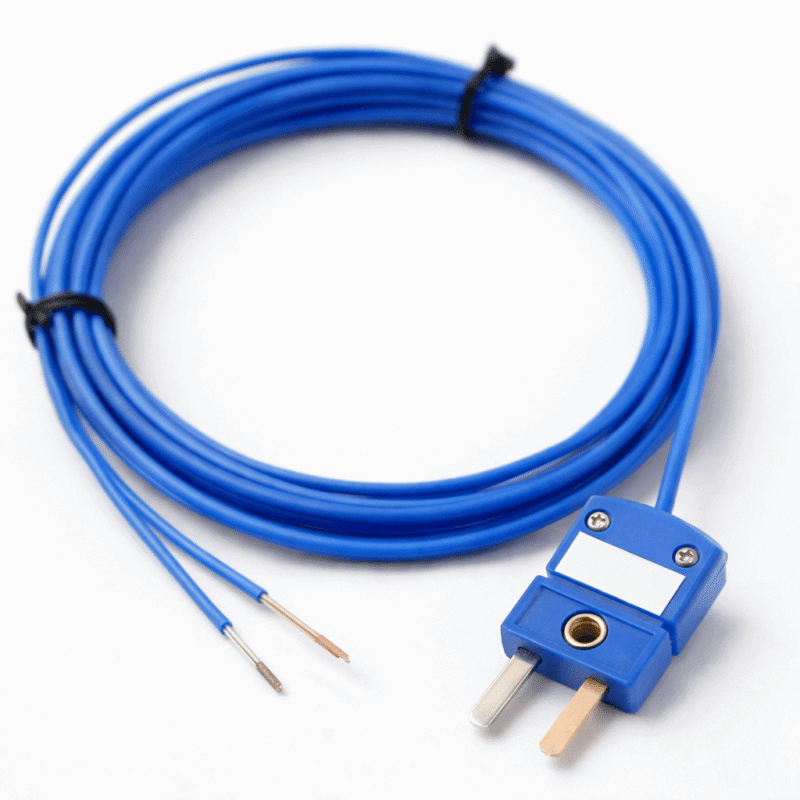
Type T Thermocouple, Temperature Sensor
Key Features
Temperature range: -200°C to 350°C (continuous), up to 400°C for short-term use
High measurement accuracy with excellent stability, especially in low-temperature applications
Copper–Constantan conductors for reliable and repeatable signal output
Mineral insulated (MgO) sheathed construction for superior electrical insulation and long service life
Fast response time for precise and stable temperature control
Excellent performance in low-temperature, humid, and cryogenic environments
Good resistance to vibration, suitable for industrial and laboratory use
Performs well in oxidizing, inert, and moisture-prone atmospheres
Compatible with standard temperature controllers, PLCs, and data acquisition systems
Customizable probe length, diameter, sheath material, mounting type, and connector
CE, RoHS, ISO certified for global industrial applications
- sales@connector-sensor.com
- +86 15120067961
Type T Thermocouple – Copper Constantan Temperature Sensor for Low-Temperature Precision Applications
Type T thermocouple is a high-accuracy temperature sensor designed for low-temperature and moisture-prone environments. Constructed from Copper–Constantan (Cu-CuNi) conductors and protected by a mineral-insulated sheath, it delivers excellent stability, repeatability, and long-term performance, especially in sub-zero and cryogenic applications.
Compliant with international standards such as IEC 60584 and ASTM E230, our type T thermocouples are widely used in food processing, pharmaceutical storage, environmental testing, laboratory equipment, and HVAC systems where precise low-temperature measurement is critical.
Main Types of Type T Thermocouple
At Huada, we specialize in high-quality Type T thermocouples known for their excellent accuracy, stability, and corrosion resistance. Besides, We provide a full range of Type T thermocouple products and accessories, with flexible customization services to meet your specific technical and environmental requirements.
1. Type T Thermocouple Probes/Sensor
2. T Type Plugs And Jacks
3. T Type Thermocouple Wire
4. Type T Thermocouple Extension Cables
5. Type T Thermocouple Connector
6. Type T Thermocouple Assemblies
7. Type T Thermocouple Heads & Terminal Blocks
Key Features of Type T Thermocouple
Temperature measurement range: -200°C to 350°C (continuous)
Short-term temperature capability up to 400°C
High-purity Copper / Constantan conductors for excellent accuracy and signal stability
Superior performance in low-temperature and cryogenic environments
MgO mineral insulated (MI) construction for fast response and reliable electrical insulation
Laser-welded, hermetically sealed sensing tip for moisture resistance and long service life
Excellent stability with low thermal drift
Suitable for oxidizing, inert, and humid environments
Strong anti-interference performance for industrial control systems
Flexible, bendable structure with high mechanical strength
Compatible with standard temperature controllers, PLCs, and data acquisition systems
CE and RoHS certified
Customizable probe diameter, length, sheath material, mounting thread, and connector type
Typical Applications
Type T thermocouples are commonly used in:
Food and beverage processing
Cold storage and refrigeration systems
Pharmaceutical and vaccine storage
Environmental chambers and climate testing
Laboratory and scientific equipment
HVAC and building automation systems
Cryogenic and low-temperature measurement
Medical and biotechnology equipment
Type T Thermocouple Specifications
| Parameter | Specification |
|---|---|
| Thermocouple Type | Type T (Copper–Constantan) |
| Standards | IEC 60584, ANSI/ASTM E230 |
| Temperature Range | -200°C to +350°C |
| Max Temperature | 400°C (short-term) |
| Accuracy Class 1 | ±0.5°C or ±0.4% |
| Accuracy Class 2 | ±1.0°C or ±0.75% |
| Insulation | MgO Mineral Insulated |
| Sheath Materials | SS 304, SS 316, Inconel 600 |
| Probe Diameter | 1.0–6.0 mm |
| Response Time | t0.5 < 1s |
| Protection Level | IP 65 (IP 68 optional) |
| Installation | Threaded / Flanged / Welded / Plug-in |
Why Choose Our Type T Thermocouples?
With over 20 years of manufacturing experience, HUADA Group supplys reliable temperature sensors for global industrial and scientific applications.
Monthly capacity: 50,000+ units
Sample lead time: 3–7 days
Mass production: 7–15 days
Factory direct pricing
Strict quality control and full calibration
Fast technical support within 12 hours
Full OEM & custom design available
Our Type T thermocouples are engineered for high accuracy, long-term stability, and dependable performance in low-temperature and high-moisture environments.
Related Products:
| Type K Thermocouple |
| Type S Thermocouple |
| Type E Thermocouple |
| Type N Thermocouple |
| Type J Thermocouple |
| Type B Thermocouple |
| Type R Thermocouple |
FAQ
1. What is a T-type thermocouple made of?
A T-type thermocouple is made of copper (positive leg) and constantan (negative leg, copper-nickel alloy).
This material combination offers excellent stability, good linearity, and reliable performance at low to moderate temperatures, making Type T especially suitable for laboratory, refrigeration, food processing, and cryogenic applications.
2. What is the temperature range of a T-type thermocouple?
The typical operating range of a T-type thermocouple is approximately –200°C to +350°C (–328°F to +662°F) for most industrial probes.
In some cases, thermocouple-grade wire may cover a broader range, but the actual usable temperature depends on factors such as:
- sheath material
- insulation type
- probe construction
- operating environment
For most practical industrial applications, –200°C to +350°C is the commonly recommended range.
3. What is the T-type thermocouple color code?
Under ANSI/ASTM color coding, a T-type thermocouple is commonly identified as:
- Positive leg (Copper): Blue
- Negative leg (Constantan): Red
However, color codes may vary by region or standard, especially between ANSI and IEC systems. To avoid wiring errors, always confirm the polarity and wire identification with the supplier’s datasheet before installation.
4. How accurate is a T-type thermocouple?
T-type thermocouples are known for good accuracy and excellent repeatability, especially at lower temperatures.
Typical accuracy depends on the wire grade and tolerance class:
- Standard grade: typically around ±1.0°C
- Special Limits of Error (SLE): typically around ±0.5°C
Actual performance may vary depending on:
- sensor construction
- wire quality
- calibration condition
- measuring instrument
For precision applications, calibrated or SLE Type T thermocouples are usually recommended.
5. What is the measurement uncertainty of a T-type thermocouple?
The measurement uncertainty of a T-type thermocouple depends not only on the sensor itself, but also on the complete measurement system.
Typical sources of uncertainty include:
- thermocouple tolerance
- cold junction compensation (CJC)
- transmitter or instrument accuracy
- calibration method
- installation environment
In most applications, the sensor’s own tolerance is only one part of the total system uncertainty. For critical measurements, a full calibration and uncertainty evaluation is recommended.
6. How sensitive is a T-type thermocouple?
A T-type thermocouple has a sensitivity of approximately 43 µV/°C near common reference temperatures.
This relatively high output makes Type T a good choice for:
- low-temperature measurement
- high-resolution sensing
- stable signal acquisition
Its sensitivity is one reason why Type T is widely used in scientific, medical, refrigeration, and food temperature monitoring applications.
7. What is the difference between Type K and Type T thermocouples?
| Feature | Type K (Chromel/Alumel) | Type T (Copper/Constantan) |
|---|---|---|
| Typical range (approx.) | –200 °C to +1260 °C | –200 °C to +350 °C |
| Typical accuracy class | ±2.2 °C or ±0.75 % (standard) | ±1.0 °C or ±0.75 % (standard) |
| Sensitivity | ~41 µV/°C | ~43 µV/°C |
| Main use case | General‑purpose, high‑temperature industrial | Low‑temperature, cryogenic, lab, moist environments |
| Color code (ANSI) | Yellow (positive) / Red (negative) | Blue (positive) / Red (negative) |
Send Message to get Datasheet.
Strict Production Process
Engineers develop optimized electronic circuits and structural designs based on real application needs.
High-quality components and materials are carefully selected from trusted suppliers to ensure long-term reliability.
Automated SMT and precision soldering technologies are used to build stable and high-performance circuit boards.
Sensor elements or connector terminals are assembled with the PCB and housing to ensure accurate operation and strong mechanical stability.
Each product undergoes strict calibration and functional testing to guarantee accuracy and stable performance.
Every unit is carefully inspected, labeled, and securely packaged to ensure it arrives safely and performs reliably for your applications.
Strict Production Process of Yafeite