




Types of Pressure: Absolute, Gauge, Differential & Vacuum

Pressure is everywhere. You feel it when you check your tire pressure. You interact with it when HVAC systems keep your office comfortable. Oil refineries, weather stations, and medical devices all rely on accurate pressure measurements. Yet most people can’t name more than one or two types of pressure.
That matters in industrial settings. Pick the wrong pressure type for your application, and you get inaccurate readings. Inaccurate readings lead to process failures, safety issues, and costly downtime.
1. What is Pressure
Pressure is force applied perpendicularly to a defined area. Simple as that. But here’s what most explanations miss: pressure has no direction. It acts equally on all surfaces. That’s why your hand won’t mark a wall, but a nail pushed with the same force will punch right through—the force concentrates on a tiny area, creating massive pressure.
The formula is straightforward:
P=F/A
- P = pressure
- F = force (mass × acceleration, typically using gravity)
- A = surface area (length²)
Where:
Standard units matter. Scientists use the Pascal (Pa)—one Newton per square meter. Industry often uses pounds per square inch (PSI). Convert between them: 1 PSI = 6,895 Pa.
Here’s the critical insight most miss: all pressure measurements are differential by nature. You’re always measuring the difference between your target value and a reference condition. That reference point is what defines the pressure type.
2. Absolute Pressure
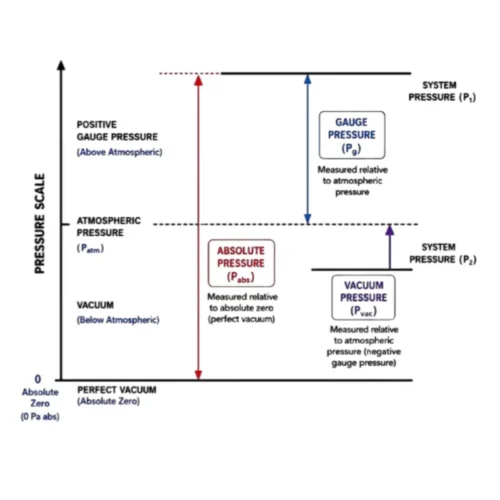
Absolute pressure measures a system relative to a hard vacuum—zero pressure, theoretically perfect emptiness. This reference never changes, regardless of weather, altitude, or location.
When you read absolute pressure, you’re seeing the total pressure including atmospheric pressure. That’s why absolute pressure values are always higher than gauge pressure values for the same system.
When Engineers Use Absolute Pressure:
Absolute pressure isn’t your everyday measurement. Specialized applications demand it:
- Meteorology: Barometric pressure measurements must use absolute reference to track weather patterns accurately
- Oceanography: Water depth and wave height calculations require absolute pressure since atmospheric pressure varies
- Oil & gas industry: Well pressure measurements need absolute reference for reservoir calculations
- Vacuum systems: Semiconductor manufacturing, vacuum chambers, and distillation processes
- Sealed vessels: Autoclaves, sterilizers, and pressurized containers where ambient pressure shouldn’t affect readings
The formula for converting gauge to absolute:
Pabs=Pg+Patm
Where Patm is atmospheric pressure (14.7 PSIA at sea level).
When your application crosses altitude changes or operates in weather-sensitive environments, an absolute pressure sensor eliminates reference drift caused by changing atmospheric conditions.。
3. Gauge Pressure
Gauge pressure is what you encounter most often. Tire pressure gauges, compressor readings, hydraulic system monitors—all use gauge pressure. It measures pressure relative to surrounding atmospheric pressure.
Think of it this way: gauge pressure answers “How much higher (or lower) is this pressure than the air around me?” When your tire gauge reads zero, the tire isn’t empty. It’s at atmospheric pressure. The gauge shows the difference.
Why Gauge Pressure Dominates Industry
Gauge pressure works for most industrial applications because:
- It’s intuitive. Operators understand “100 PSI in the line” when that means 100 PSI above atmosphere
- Most processes operate above atmosphere. Compressors, pumps, pipelines—these don’t care about absolute values
- Weather effects often don’t matter. A compressor running at 150 PSI gauge isn’t significantly affected by a 0.5 PSI atmospheric swing
- Equipment is calibrated locally. Gauges account for your altitude at installation
Common Gauge Pressure Applications
When atmospheric pressure shifts (weather fronts, altitude changes), your gauge pressure reading shifts too. For most applications, that’s fine. When it’s not, you need absolute pressure instead.
Most industrial facilities use a gauge pressure sensor for routine monitoring because it provides exactly what operators need without unnecessary complexity.
4. Atmospheric Pressure
Atmospheric pressure—also called barometric pressure—is the weight of air above you pressing down. Standard atmospheric pressure at sea level measures 14.7 PSIA (pounds per square inch absolute).
Here’s what most people don’t realize: atmospheric pressure changes continuously. Three factors drive these changes:
Altitude
The higher you go, the lower the pressure. Every foot of elevation reduces atmospheric pressure:
| Location | Elevation | Atmospheric Pressure |
|---|---|---|
| Sea Level | 0 ft | 14.7 PSIA |
| Denver, CO | 5,280 ft | 12.1 PSIA |
| Denver, CO | 5,280 ft | 83.6 kPa absolute |
| Mount Everest | 29,032 ft | 4.9 PSIA |
That elevation-based variance explains why your ears pop driving down a steep hill. Pressure at the bottom exceeds pressure at the top. Your body can’t equalize fast enough.
Weather Patterns
High-pressure systems bring clear skies. Low-pressure systems bring storms. These swings typically range 0.5-1.5 PSI around the local average.
Temperature
Warm air is less dense than cold air. Temperature changes affect atmospheric pressure, though less dramatically than altitude.
Why Atmospheric Pressure Matters for Measurement
Pressure measurement tools must account for local barometric conditions. A gauge pressure reading taken at sea level means something different than the same reading at 5,000 feet elevation.
Standard atmospheric pressure (14.7 PSIA) is a reference point, not a constant. Precision applications require local calibration.
5. Differential Pressure
Differential pressure (ΔP) measures the difference between two pressures. Technically, all pressure measurements are differential—you’re always comparing to something. But “differential pressure” specifically refers to measuring between two process points rather than against atmosphere or vacuum.
Most differential pressure sensors have two connections: one for high pressure, one for low pressure. The sensor reports the difference.
The Physics: Bernoulli’s Principle
Differential pressure enables flow measurement through Bernoulli’s equation: as fluid velocity increases, static pressure decreases. When fluid passes through a restriction (orifice plate, venturi tube), velocity increases and pressure drops. Measure that pressure drop, and you calculate flow rate.
ΔP∝Q2
Where Q is flow rate. Pressure drop is proportional to the square of flow rate.
Critical Differential Pressure Applications
Flow Measurement: Water distribution, air handling, chemical processing, oil and gas operations. Once calibrated, DP gauges display flow rate directly.
Filter Monitoring: As filters clog, pressure drop across them increases. Monitor ΔP to schedule maintenance before failure.
Level Measurement: Hydrostatic head pressure in tanks correlates directly to liquid level. Measure pressure at tank bottom versus top.
Leak Detection: Pressurized systems show differential pressure changes when leaks develop.
Cleanroom Pressure Control: Maintain positive pressure in cleanrooms to prevent contamination entry.
Differential pressure delivers accurate measurements despite turbulence and varied flow conditions. They maintain consistency even in difficult operating environments.
For flow measurement and filter monitoring applications, a dedicated differential pressure sensor provides the dual-port connection and precision needed for reliable readings.
6. Vacuum Pressure
Vacuum pressure—sometimes called negative gauge pressure—measures pressures below atmospheric pressure. When you see “-5 PSI” on a gauge, that’s vacuum pressure indicating 5 PSI below atmospheric.
Vacuum pressure uses atmospheric pressure as its reference, just like gauge pressure. The difference: vacuum pressure readings are negative because the measured pressure is less than atmosphere.
Vacuum Pressure Applications
| Industry | Application | Vacuum Range |
|---|---|---|
| Food processing | Vacuum packaging | 5-14 PSIA |
| Semiconductor | Thin-film deposition | 0.001-10 PSIA |
| Medical | Suction devices | 2-10 PSIA |
| Manufacturing | Vacuum forming | 5-14 PSIA |
| HVAC | Refrigerant evacuation | 0.5-5 PSIA |
Vacuum pressure matters when you’re removing air or creating suction. The packaging industry uses it to extend shelf life. Medical equipment uses it for wound therapy and suction. Semiconductor manufacturing requires extreme vacuums approaching perfect emptiness.
Compound gauges measure both positive pressure and vacuum on a single dial—handy for applications that swing above and below atmosphere.
7. Pressure Type Comparison
Here’s the decision-making table most guides skip. Use this to select the right pressure type for your application:
Choosing the wrong type creates problems:
- Use gauge pressure when you need absolute → readings drift with weather/altitude
- Use absolute when gauge suffices → unnecessary cost and complexity
- Use single-port when you need differential → can’t measure flow or filter condition
- Use vacuum gauge for positive pressure → instrument damage or inaccurate readings
When in doubt, match your sensor type to your reference requirement. A quality pressure sensor manufacturer offers all types—pick based on reference, not just range.
8. Why Calibration Matters for All Pressure Types
Pressure measurement is an exact science. Small anomalies create massive consequences. A 1% error in a chemical reactor could mean runaway reaction. A 2% error in aircraft hydraulics could mean landing gear failure.
Different pressure types require different calibration approaches. A pressure sensor used for absolute pressure needs vacuum reference calibration. Gauge pressure sensors calibrate against local atmospheric pressure. Differential pressure sensors require dual-port calibration.
Industry Standard: ISO/IEC 17025
The most recognized calibration standard is ISO/IEC 17025, defining competence requirements for testing and calibration laboratories. Facilities requiring regulatory compliance (pharmaceutical, food, aerospace) must use ISO 17025-accredited calibration.
Five-point testing across range (0%, 25%, 50%, 75%, 100%):
- Ascending test: Increase from zero to full scale, record at each point
- Descending test: Decrease from full scale to zero, record at each point
- Dwell time: Hold each point 30-60 seconds for sensor stabilization
- Document everything: Date, time, technician, equipment, environmental conditions
Zero and span adjustment
- Zero adjustment with no pressure applied (or vacuum reference for absolute sensors)
- Span adjustment at full-scale pressure
- Verify linearity across intermediate points
Environmental compensation: Account for temperature, humidity, and vibration effects on sensor performance.
Calibration Frequency by Industry
| Industry | Recommended Frequency | Critical Applications |
|---|---|---|
| Pharmaceutical | 6 months | FDA-regulated processes |
| Aerospace | 6-12 months | Flight-critical systems |
| Oil & gas | 12 months | Pipeline safety monitoring |
| Food & beverage | 12 months | CIP/SIP systems |
| General manufacturing | 12-24 months | Process monitoring |
| HVAC | 24 months | Non-critical monitoring |
Facilities using calibrated instruments for regulatory compliance must maintain calibration certificates. Never skip calibration because “the gauge still looks right.” Sensor drift happens silently.
Conclusion: Understanding pressure types is crucial for more accurate measurements.
Understanding pressure types isn’t academic. It’s practical. Choose the wrong type, and your measurements fail. Choose the right type, and you get reliable data for better decisions.
Key rules to remember:
- Absolute = vacuum reference. Use for weather, altitude, sealed vessels, boiling points
- Gauge = atmospheric reference. Use for tires, compressors, hydraulic systems, most industrial applications
- Differential = two-point measurement. Use for flow, filter monitoring, liquid level
- Vacuum = below atmosphere. Use for suction, packaging, medical devices
- Calibrate regularly. Follow ISO 17025 for regulated industries
- Match range to application. Don’t overspec or underspec
- Verify environmental compatibility. Temperature, chemicals, vibration matter
When you invest in quality instrumentation from a trusted manufacturer, you get sensors built for long-term reliability. Browse our complete catalog of pressure sensor solutions for absolute, gauge, differential, and vacuum applications in industrial settings.
Pressure measurement seems simple until it isn’t. Get the fundamentals right, and your process control, safety, and product quality improve immediately.