




Understanding GTMS Connectors

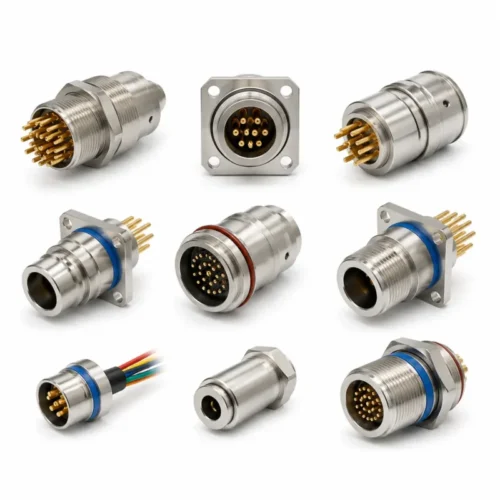
When your equipment operates miles beneath the ocean floor, inside a jet engine, or in the vacuum of space, a standard connector simply won’t survive. You need a sealing solution that holds up under extreme temperatures, resists crushing pressure, and prevents gas leakage over years of service. That’s exactly what a GTMS connector delivers.
In many mission-critical systems – from downhole drilling tools to implantable medical devices – even microscopic moisture ingress or gas leakage can trigger immediate failure or steadily degrade long-term reliability. Hermetic sealing ensures that an enclosure maintains a stable internal environment without relying on gaskets or polymers that can age, outgas, or allow diffusion over time. This is why glass-to-metal seal technology has become the proven choice for applications where sealing integrity cannot be compromised. With that foundation in mind, let’s look at what a GTMS connector actually is and how it works.
In this guide, we will walk you through everything you need to know about these connectors: what they are, how they work, and why leading engineers trust them for mission-critical systems. Whether you need a standard glass-to-metal-sealed connector or a fully custom glass-to-metal-sealed connector, this guide gives you the complete picture.
1. What are GTMS Connectors?
A GTMS (Glass-to-Metal Seal) connector is a type of hermetic connector that uses a glass-to-metal seal to form a highly reliable, leak-tight barrier between electrical conductors and a metal housing. The acronym stands for Glass-to-Metal Seal, and it describes the core technology: a glass preform melts and bonds chemically and mechanically to both the contact pins and the outer body, creating a rigid assembly that blocks gas and moisture.
Unlike connectors that depend on O-rings or epoxy potting, a glass to metal sealed connector fuses inorganic materials together. The result is a seal that can endure conditions where organic seals degrade, burn, or permit gas permeation. Engineers widely trust these connectors – often called hermetic connectors – when they must maintain a deep vacuum or contain hazardous gases. Manufacturers have refined glass-to-metal sealing over decades to meet the demanding requirements of aerospace, medical, and oil & gas industries.
2. GTMS Connector Materials and Construction
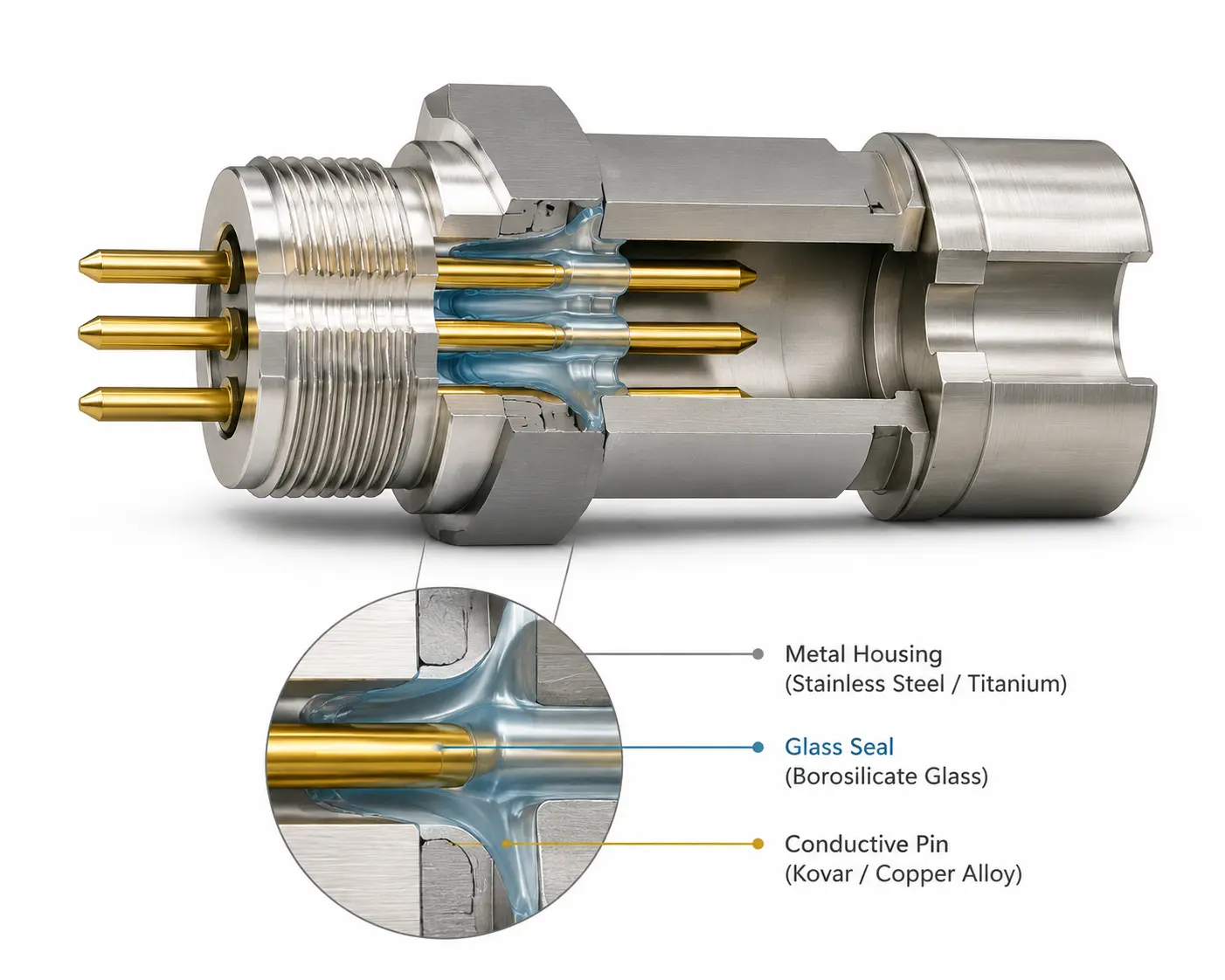
The performance of glass to metal seal connectors depends on how well three elements work together: the housing, the pins, and the glass. Engineers choose each material deliberately to balance thermal expansion and environmental resistance.
Housing Materials
The outer body typically uses stainless steel, with 304L and 316L as common choices for their corrosion resistance. For weight-sensitive applications, however, aluminum glass-to-metal-sealed connectors are gaining traction. Lightweight aluminum housings offer meaningful weight savings without sacrificing hermeticity – a significant advantage for in-flight aerospace systems. Other housing materials you may encounter include titanium, Kovar, and cold-rolled steel, each selected to match the thermal expansion characteristics of the glass and the demands of the installation environment.
Pin Materials
The conductor pins must carry current efficiently while expanding at nearly the same rate as the glass during the sealing process. Kovar, an iron-nickel-cobalt alloy, remains a classic choice because its thermal expansion coefficient closely matches borosilicate glass. For applications requiring higher current capacity, designers sometimes use copper-core pins, though these demand careful design to manage the expansion mismatch. Getting this match right is critical – even small discrepancies can cause micro-cracks that compromise the hermetic seal over time.
The Glass Seal
The glass here is not ordinary window glass. Manufacturers use a specially formulated material, typically a borosilicate composition, selected for its electrical insulation properties and chemical durability. Two primary sealing methods are available:
- Matched Seals: The housing, pins, and glass share a similar coefficient of thermal expansion. This creates a compression-free bond suitable for delicate applications where stress must be minimized.
- Compression Seals: The housing has a higher expansion coefficient than the glass. During cooling, the metal shrinks around the glass, placing it under permanent compression. This produces an exceptionally rugged seal, which is why compression designs are common in downhole oil tools and other high-shock environments.
3. How GTMS Connectors Work
The sealing process takes place inside a controlled atmosphere furnace. Operators load the metal housing, glass preforms, and contact pins onto a graphite fixture and heat them until the glass softens and flows. As the glass melts, it wets the prepared metal surfaces of both the pins and the housing, forming a strong chemical bond. During controlled cooling, the glass solidifies into a non-porous, rigid insulator that locks the conductors firmly in place.
This process creates a fused joint at high temperature – not a mechanical clamp or an adhesive bond. Because no organic material is involved, the resulting seal withstands temperatures up to 450°C (842°F) or beyond, though the exact limit depends on the specific glass and metal combination selected for the design.
4. Key Benefits of GTMS Connectors
Why do design engineers specify a glass-to-metal-sealed connector when lower-cost alternatives exist? The answer comes down to system-level reliability.
Proven Hermeticity
With helium leak rates typically below 1×10⁻⁸ cc/sec – depending on design geometry and applicable test criteria – these connectors provide a highly reliable gas-tight barrier, blocking moisture ingress and containing sensitive fluids or gases.
Broad Temperature Capability
A glass to metal sealed connector functions across a wide temperature range. Many designs qualify from cryogenic lows (around -196°C) to 350°C or higher, though the continuous-use rating depends on material selection and qualification requirements. Always verify the specific temperature limits for your application.
High Pressure Tolerance
You can design these connectors to withstand pressures exceeding 30,000 psi (approximately 2,000 bar), making them essential for deep-sea and downhole equipment. Few competing sealing technologies deliver comparable pressure resistance in a compact electrical connector format.
Long-Term Stability
Glass does not outgas, age, or creep the way polymers do. Once sealed, the connector’s performance remains stable for decades, even under vacuum conditions.
Chemical Inertness
The glass-and-metal fusion resists aggressive chemicals, solvents, and corrosive gases that would quickly degrade rubber gaskets or epoxy potting.
5. GTMS Connectors vs Other Sealing Solutions
Understanding where GTMS fits becomes clearer when you compare it with other sealing methods commonly found in industry.
| Sealing Solution | Hermeticity | Temperature Capability | Mechanical Robustness | Repairability | Best Fit |
|---|---|---|---|---|---|
| GTMS (Glass-to-Metal) | Excellent; leak-tight per helium test, design dependent | Up to 350°C+, material dependent | Very high; compression seals excel under shock and vibration | Non-repairable | High-reliability, permanent installations |
| Ceramic-to-Metal | Excellent; comparable leak-tight performance | Up to 450°C+ | Very high | Non-repairable | Ultra-high temperature applications |
| PAEK/PEEK Seals | Good, but not hermetic; gas permeation through polymer is possible | Up to 260°C | Good; offers some mechanical compliance | Seals sometimes replaceable | Harsh chemical environments, non-hermetic needs |
| Epoxy Seals | Moderate; permeable to gases over time | Up to 150–200°C | Moderate | Occasionally repairable | Non-critical, cost-sensitive enclosures |
| O-ring Compressed | Non-hermetic; dynamic leak paths possible | Up to 200°C, elastomer dependent | Good | Field-repairable | Low-pressure, accessible enclosures |
The Hermeticity Difference
When comparing PAEK (PEEK) connectors to glass to metal seal connectors, it is clear that PAEK offers excellent chemical resistance and serves as a capable insulator. However, PAEK seals are not truly hermetic by definition – gas permeation through the polymer is a physical reality. When your system must hold a vacuum for a decade or contain hazardous gas under the sea, a glass-to-metal-sealed connector remains the more dependable choice.
6. Common Applications of GTMS Connectors
You will find glass to metal seal connectors wherever failure carries unacceptable consequences. Here are the sectors that depend on them daily:
- Oil & Gas Downhole Tools: Field experience in measurement-while-drilling (MWD) and logging-while-drilling (LWD) tools shows that GTMS bulkhead connectors are essential for protecting sensitive electronics from temperatures exceeding 175°C and high mud pressures.
- Aerospace and Defense: Satellite feedthroughs, missile guidance systems, and avionics housings use lightweight aluminum glass-to-metal-sealed connectors. For defense applications, a glass-to-metal-sealed military connector maintains pressurization and provides reliable shielding against ice, vibration, and extreme battlefield conditions.
- Medical Implants: Hermetically sealed pacemakers and neurostimulators rely on custom glass to metal sealed connector technology to protect the body from the device, and the device from body fluids. Biocompatible metals and glass formulations are standard in this field.
- Cryogenic and Vacuum Systems: MRI machines, particle accelerators, and semiconductor wafer processing demand ultra-clean vacuum environments. GTMS connectors deliver the necessary helium leak-tight performance without outgassing.
- Nuclear and Harsh Industrial Environments: Where radiation resistance and absolute containment are required, the inorganic nature of the glass seal outperforms any polymer-based alternative.
7. How to Choose the Right GTMS Connector
Selecting the right glass to metal seal connector for your system means asking a few critical questions before you request a quote:
- What are your true temperature and pressure limits?
Look beyond normal operating conditions. Consider peak excursions, even if they are rare. A compression seal may handle thermal shock better than a matched seal in certain scenarios. - What material does your housing require?
If weight is a concern, explore aluminum glass-to-metal-sealed connectors. If corrosion resistance is the priority, stainless steel 316L is a reliable choice. Ensure the housing material is compatible with your enclosure’s welding or brazing process. - How many pins and what configuration?
GTMS connectors are available in single-pin (power feedthrough) and multi-pin (signal) arrangements. Multi-pin designs can be dense, but you must allow sufficient glass web between pins to prevent voltage breakdown. If standard products do not fit, a custom glass to metal sealed connector can be engineered to your exact specifications. - Which side of the connector faces the pressure?
Always specify the pressure direction. A GTMS bulkhead connector is designed so that pressure pushes the glass into the housing, not out of it. Reversing this without engineering review can lead to failure. - Do you require specific certifications?
For aviation, AS9100 traceability may be needed. For medical applications, biocompatibility testing documentation is essential. Reputable manufacturers provide full material certifications and leak test reports for every glass-to-metal-sealed connector shipped.
8. Conclusion
A GTMS connector is more than just a component; it is a fundamental engineering decision that protects your entire system’s integrity. Whether you are designing the next generation of downhole logging tools, a glass-to-metal-sealed military connector for defense systems, or a life-sustaining medical implant, understanding the materials, sealing mechanisms, and selection criteria helps ensure you get a connector that performs reliably over the full lifetime of your product.
If you are currently evaluating connector solutions for a demanding environment, we would be happy to discuss your specific requirements. The right glass to metal seal connector can make all the difference between a product that fails in the field and one that builds a reputation for reliability.
9. FAQ
What does GTMS stand for?
GTMS stands for Glass-to-Metal Seal. It refers to the technology of fusing glass to metal pins and housings to create a hermetic connector.
Are GTMS connectors repairable?
Generally, no. The glass-to-metal seal is a permanent, fused joint. If a pin is damaged or the glass cracks, the entire glass to metal sealed connector insert typically needs to be replaced. Field repair is not feasible, which is why careful handling during assembly is critical.
Can I get a GTMS connector in a lightweight material?
Yes. While stainless steel is the standard, aluminum glass to metal seal connectors offer excellent hermeticity with significant weight reduction, making them ideal for aerospace platforms.
What is the typical leak rate for a GTMS connector?
A properly manufactured GTMS connector typically achieves a helium leak rate better than 1×10⁻⁸ cc/sec at a one-atmosphere pressure differential. The exact acceptance value depends on the specific design and the test standard applied. Many high-reliability applications specify even tighter limits.
Do GTMS connectors meet REACH and RoHS requirements?
Yes. Modern glass formulations used in glass-to-metal-sealed connectors comply with RoHS and REACH regulations. The sealing process no longer relies on harmful heavy metals such as lead, which was common decades ago. Always request the compliance certificate from your supplier.
How small can a GTMS connector be?
They can be extremely compact. Miniature single-pin glass to metal seal connectors are used in implantable medical devices, with pin diameters well under a millimeter, demonstrating the technology’s precision. If you need a custom glass-to-metal-sealed connector for a miniaturized design, specialized engineering support is available.
What is the difference between a hermetic connector and a waterproof connector?
A waterproof connector prevents liquid water ingress, typically using gaskets or O-rings, and undergoes IP rating tests. A hermetic connector, such as a GTMS connector, provides a gas-tight seal that blocks the passage of gas molecules and undergoes verification through helium leak testing. Engineers choose hermetic connectors where even water vapor diffusion would cause failure, whereas waterproof connectors suffice for splash or immersion environments.
How is hermeticity tested?
Hermeticity testing most commonly uses helium mass spectrometry. The connector is pressurized with helium on one side, and a detector measures any helium that passes through the seal. This method can detect leak rates far below what anyone would consider water-tight, giving engineers confidence in the seal’s long-term integrity.
What is the difference between a matched seal and a compression seal?
In a matched seal, the housing, pins, and glass share a similar coefficient of thermal expansion, resulting in a stress-minimized bond suitable for delicate applications. In a compression seal, the housing expands more than the glass and shrinks around it during cooling, placing the glass under permanent compression. This makes compression seals especially resistant to shock and thermal cycling – a key reason engineers prefer them in downhole tools.
Are GTMS connectors suitable for subsea applications?
Yes. Industry uses GTMS connectors widely in subsea and deep-sea equipment because they can withstand extreme hydrostatic pressures while maintaining hermeticity. For these applications, material selection – particularly corrosion-resistant housing alloys – and qualification to relevant subsea standards are essential.