




Universal Quick Disconnect Couplings for AI & Data Center Liquid Cooling

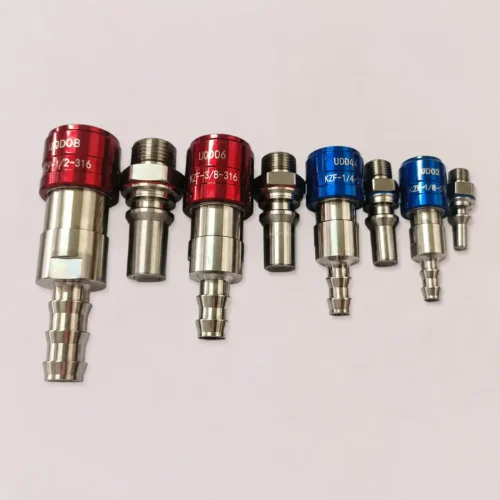
If you’ve spent any time researching liquid cooling for AI servers, you’ve run into the term UQD. It shows up on nearly every data center cooling spec sheet, and for good reason: it’s the closest thing the industry has to a universal standard for connecting and disconnecting coolant lines. This guide covers what a UQD connector is, the types and sizes available, where they’re used, how UQD compares to UQDB, and how to pick the right one for your system.
What Is a UQD Connector
UQD stands for Universal Quick Disconnect. It’s an open coupling standard, developed within the Open Compute Project (OCP) on an initiative originally led by Intel, for single-phase water/glycol cooling loops in data centers and HPC systems. In simple terms, a UQD connector lets you join or separate a coolant line by hand, without tools, and without spilling fluid.
That last part matters more than it sounds. Before UQD existed, most liquid cooling connections relied on proprietary couplings from a single vendor, which locked buyers into one supplier and complicated sourcing at scale. Because UQD is an open standard, any manufacturer can build to its published dimensions and performance requirements, so a plug from one vendor generally mates with a socket from another. That’s a big reason hyperscalers and IT equipment makers rally around it: it protects supply chains and keeps procurement flexible.
Structurally, a UQD coupling uses a bidirectional dry-break valve. Spring-loaded poppets in both the plug and socket close automatically the instant you disconnect, so each half seals independently. Connect them again, and both poppets open together, restoring full flow with minimal restriction. This is what makes UQD “hot-pluggable” — you can swap a server tray or a cooling module while the rest of the rack loop stays live, with no need to drain the system first.
Main Types of UQD Connectors
Not every UQD connector serves the same purpose. Here’s how the family breaks down.
Hand-mate vs. blind-mate. The standard UQD is a hand-mate coupling — a technician aligns and connects it manually, typically at a visible, reachable service point. Its counterpart, UQDB (Universal Quick Disconnect Blind-Mate), adds self-alignment so a tray or module seats and seals correctly even when nobody can see the port, such as when a chassis slides into a rack. We’ll compare the two in more detail below.
Straight vs. right-angle. Like most quick-disconnect couplings, UQD comes in inline (straight) and 90° elbow configurations. Straight fittings keep pressure drop to a minimum; right-angle versions help route tubing around tight rack layouts.
Termination style. OCP’s specification requires a barbed (push-lock hose barb) termination as standard, with a threaded O-ring boss (ORB) option also required at minimum sizes. Which one you need depends on whether your loop uses flexible hose or rigid tubing on that connection point.
V1 vs. the emerging V2 standard. UQD and UQDB started life as two separate OCP specifications, both released around 2020–2021. A newer draft, OCP UQD Specification v2.0, consolidates them into a single document and — notably — adds a hybrid configuration that lets a UQD plug mate directly with a UQDB socket. V2 is designed to stay backward compatible with V1 hardware, though OCP recommends end users assess their own deployment before mixing generations. If you’re speccing new equipment today, it’s worth checking which revision your supplier builds to.
Common UQD Sizes and Specifications
UQD couplings come in four standard nominal sizes: UQD02, UQD04, UQD06, and UQD08. Larger numbers mean a larger flow path and higher throughput, but also a bigger footprint, so size selection comes down to balancing your target flow rate against the space you have on the tray or manifold.
Beyond size, a few other specs are worth knowing before you buy:
| Spec | What to Know |
|---|---|
| Flow coefficient (Cv) | Determines how much fluid a coupling passes at a given pressure drop. Published datasheets vary by size and supplier — one common reference point is a minimum Cv around 0.8 for a mid-size coupling. Always check the specific model’s Cv rather than assuming it scales linearly across sizes. |
| Durability | The OCP specification requires a minimum of 5,000 make-and-break cycles, with full performance maintained at the first cycle and the 5,000th. |
| Shelf life & service life | OCP defines a 5-year shelf life and a 10-year service life — useful context when planning spares inventory. |
| Fluid loss | UQD is built to be effectively drip-free. Some manufacturers publish residual fluid loss figures well under a single drop per disconnect cycle. |
| Materials | Bodies are typically stainless steel or aluminum alloy; seal compounds are chosen for compatibility with water/glycol and, increasingly, with propylene-glycol-based fluids as OCP’s coolant guidelines mature. |
| Color coding | Suppliers commonly mark couplings red for warm (return) fluid and blue for cold (supply) fluid, which helps technicians avoid cross-connecting lines during a hot swap. |
Main Applications of UQD Connectors
UQD couplings show up anywhere a data center needs a fast, reliable, tool-free break point in a liquid cooling loop:
- IT equipment-to-facility loop connections. UQD is the defined interface where a server or rack’s Technology Cooling System (TCS) loop joins the broader facility water loop.
- Hot-swappable server trays and cooling modules. Because both halves seal on disconnect, technicians can pull a tray for service without draining the rack.
- CDU and manifold connections. Coolant Distribution Units and rack manifolds use UQD interfaces at their outlets and inlets, which keeps the whole system modular — add capacity or reconfigure distribution without custom plumbing.
- Cold plate and heat exchanger service points. Individual cold plates on GPUs and CPUs can be connected, tested, or replaced independently of the rest of the loop.
- Beyond the data center. The same non-spill, tool-free design has found its way into EV battery cooling, energy storage systems, and industrial electronics — though data centers and AI servers remain the dominant driver of demand.
UQD vs. UQDB: What’s the Difference?
Both share the same underlying valve technology and, under OCP’s emerging V2 spec, increasing interface commonality. The difference comes down to how a technician makes the connection.
| UQD (Hand-Mate) | UQDB (Blind-Mate) | |
|---|---|---|
| How it connects | Manually aligned and plugged in by a technician | Self-aligning; seats correctly even without a direct sightline |
| Typical location | Visible, hand-accessible service points | Enclosed chassis, sliding trays, hidden manifold connections |
| Best for | Routine maintenance, one-off connections | High-volume tray installs, automated or repeated blind connections |
| Coupling force | Minimized per OCP spec, published by supplier | Explicitly capped by spec (an early UQDB04 target was under 12 lbf) |
| Durability requirement | 5,000 make/break cycles minimum | 5,000 make/break cycles minimum |
| Interchangeability (V2) | Can mate with a UQDB socket in hybrid configurations | Can mate with a UQD plug in hybrid configurations |
In short: choose UQD where a person will make the connection by hand and can see what they’re doing. Choose UQDB where the connection needs to complete itself — for example, when a tray slides into place — and reliability can’t depend on a clear line of sight.
How to Choose the Right UQD Connector
A handful of questions will get you to the right spec quickly:
- What flow rate does this connection need to support? Match your target flow and acceptable pressure drop to a nominal size (02/04/06/08), and check the specific Cv the manufacturer publishes — don’t assume it scales evenly between sizes.
- Will a technician make this connection by hand, or does it need to self-align? Visible, reachable points call for standard UQD. Sliding trays, enclosed chassis, or any port a technician can’t easily see call for UQDB.
- What termination does your loop use? Confirm whether you need a barbed hose connection, a threaded ORB fitting, or both, and make sure your supplier offers it for the size you need.
- Which coolant are you running? Standard UQD couplings are built for water/glycol; if you’re using a different fluid chemistry, confirm seal and wetted-material compatibility first.
- Does cross-vendor sourcing matter to you? If supply chain flexibility is a priority, ask your supplier which OCP revision (V1 or the emerging V2) their couplings comply with, and whether they’ve published cross-validation results with other suppliers.
- How many cycles will this connection see over its service life? Frequent hot-swap points may warrant closer attention to durability ratings and coupling force, especially for blind-mate applications.
Still not sure which configuration fits your rack design? Send us your flow target and tray layout, and our engineering team can help you narrow it down. If your system also uses MQD multi-circuit connectors at the compute-tray level, we can help you plan both interfaces together.
Summary
UQD is the open, OCP-backed standard that lets data centers connect and disconnect liquid cooling lines quickly, safely, and without being locked into one supplier. It comes in four sizes (02/04/06/08), two mating styles (hand-mate UQD and blind-mate UQDB), and — with the emerging V2 specification — increasing interchangeability between the two. As AI racks push more heat through smaller spaces, UQD has gone from a niche fitting to one of the most important components in a liquid-cooled server. Getting the size, mating style, and termination right up front saves you rework later, and keeps your sourcing options open.
FAQ
1.What does UQD stand for?
UQD stands for Universal Quick Disconnect, an OCP open standard for hand-mate, drip-free, hot-pluggable liquid cooling connectors.
2.What sizes do UQD connectors come in?
Four standard nominal sizes: UQD02, UQD04, UQD06, and UQD08. Larger sizes handle more flow but need more installation space.
3. What’s the difference between UQD and UQDB?
UQD is the hand-mate version, connected manually by a technician. UQDB is the blind-mate version, built to self-align and seal correctly even when the port is out of sight.
4. Are UQD connectors interchangeable between manufacturers?
Generally, yes. Because UQD is an open OCP standard, couplings from different qualified suppliers are designed to the same interface dimensions. That said, always confirm compatibility for your specific size and revision (V1 or V2) before mixing vendors.
5. Do UQD connectors leak when disconnected?
No. Their bidirectional dry-break valve seals both halves independently the instant they separate, so any residual fluid stays limited to a trace amount rather than a spill.
6. How many connect/disconnect cycles can a UQD coupling handle?
The OCP specification requires a minimum of 5,000 make-and-break cycles while still meeting full performance requirements.
7. What’s the difference between UQD V1 and the new V2 specification?
V2 consolidates the previously separate UQD and UQDB specifications into one document and adds a hybrid configuration that lets a UQD plug mate with a UQDB socket, while remaining backward compatible with V1 hardware.
8.What coolant works with UQD connectors?
UQD couplings are built for single-phase water/glycol loops. If you’re running a different fluid or additive package, confirm seal and wetted-material compatibility with your supplier first.