



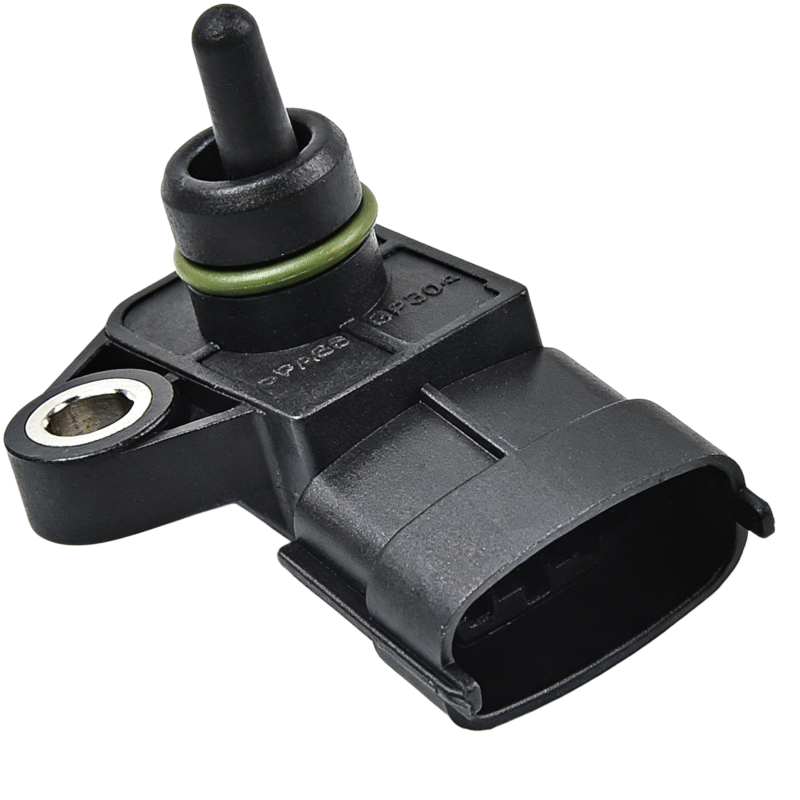
High-Precision Automotive Manifold Absolute Pressure(MAP) Sensor for Engine Control, Turbo Systems & Emission Optimization
What is MAP Sensor?
Manifold Absolute Pressure (MAP) Sensor is a critical engine management component that measures the absolute pressure inside the intake manifold and sends real-time data to the ECU to optimize fuel injection, ignition timing, and air–fuel ratio.
Our high-performance MAP sensors are designed using advanced MEMS sensing technology, providing accurate, fast, and reliable pressure measurement for modern automotive engines, turbocharged systems, and industrial engine control applications.
Advantages of MAP Sensor
High accuracy up to ±1% FS for precise engine load calculation
Fast response time (< 2 ms) for real-time ECU control
Wide pressure range from vacuum to 400 kPa, ideal for turbocharged engines
Compact MEMS design for easy integration into engine systems
Excellent temperature stability from -40°C to +125°C
High vibration and shock resistance for automotive environments
Low power consumption for energy-efficient operation
Long service life with high reliability under continuous operation
MAP Sensor Specifications
| Parameter | Specification |
|---|---|
| Sensor Type | Manifold Absolute Pressure (MAP) Sensor |
| Pressure Range | 20–115 kPa / 10–250 kPa / up to 400 kPa (turbo) |
| Output Signal | Analog voltage (0.5–4.5 V) / Digital (I2C, SPI optional) |
| Accuracy | ±1% FS (typical) |
| Response Time | ≤ 2 ms |
| Supply Voltage | 5 V or 3.3 V |
| Operating Temperature | -40°C to +125°C |
| Storage Temperature | -40°C to +150°C |
| Overpressure | 2× rated pressure |
| Vibration Resistance | 10–2000 Hz, 20 g |
| Shock Resistance | 100 g / 11 ms |
| Housing Material | Automotive-grade plastic or metal |
| Protection Level | IP67 / optional IP69K |
| Connector Type | Automotive standard connector or customized |
Why Choose Our MAP Sensor?
Engine performance optimization – Accurate manifold pressure data improves fuel efficiency and engine power.
Turbo-ready design – Supports high boost pressure for modern turbocharged and performance engines.
Automotive-grade reliability – Designed to meet harsh temperature, vibration, and humidity conditions.
Compact & lightweight – Ideal for space-limited engine compartments.
OEM & customization support – Pressure range, connector type, calibration, and output can be tailored.
Cost-effective alternative to complex airflow systems – Simplifies engine control architecture while maintaining high accuracy.
Typical Applications of MAP Sensor
- Automotive engine management
Engine load detection, fuel injection control, ignition timing optimization, and emission reduction in gasoline and diesel engines.
- Turbocharged and supercharged engines
Boost pressure monitoring and control for passenger cars, motorcycles, racing vehicles, and performance engines.
- Commercial vehicles & off-road equipment
Reliable pressure monitoring in trucks, agricultural machinery, construction equipment, and heavy-duty engines.
- Small engines & power equipment
Engine control for generators, lawn equipment, and industrial power units.
- Industrial engine control systems
Air intake pressure monitoring for stationary engines and energy systems.
FAQ
1. What does a manifold absolute pressure sensor do?
A manifold absolute pressure (MAP) sensor measures the absolute pressure inside the intake manifold and sends this data to the engine control unit (ECU). The ECU uses this information to calculate engine load, adjust fuel injection, optimize ignition timing, and maintain the correct air-fuel ratio for efficient combustion and lower emissions.
2. What are the common symptoms of a bad MAP sensor?
Common symptoms of a bad manifold absolute pressure sensor include:
Poor fuel economy
Rough idle or engine stalling
Hesitation or lack of power during acceleration
Check engine light with codes such as P0106, P0107, or P0108
Failed emissions test
Hard starting or misfires
3. Where is the manifold absolute pressure sensor located?
The manifold absolute pressure sensor location is typically on the intake manifold, throttle body, or connected via a vacuum hose. It may be mounted directly to the manifold plenum or on the firewall with a vacuum line. For specific vehicles like Chevy Cruze, Hyundai Sonata, or Ford, check your service manual – we also provide model‑specific guides.
4. How do I clean a manifold absolute pressure sensor?
Manifold absolute pressure sensor cleaning is a simple DIY task:
Disconnect the electrical connector.
Remove the sensor from the intake manifold.
Spray MAP sensor cleaner (or electronic contact cleaner) onto the sensing element – never use brake cleaner or carb cleaner.
Let it dry completely before reinstalling.
5. How to test a manifold absolute pressure sensor?
You can test a manifold absolute pressure sensor using a multimeter:
Connect the multimeter to the signal wire and ground.
With key on (engine off), voltage should be around 4.5–5.0V (at sea level).
Apply vacuum to the sensor port – voltage should decrease smoothly.
Compare readings to manufacturer specifications.
6. How to replace a manifold absolute pressure sensor?
Manifold absolute pressure sensor replacement is usually straightforward:
Locate the sensor, unplug the connector, remove one or two bolts, and pull it out.
Install the new sensor and reconnect.
Replacement cost typically ranges from $30–$120 for the part (aftermarket or OEM). Professional labor adds $40–$80. Many car owners replace it themselves in under 15 minutes.
7. What are the common MAP sensor error codes (P0106, P0107, P0108)?
Common fault codes related to the manifold absolute pressure sensor include:
P0106 – MAP/Baro sensor range/performance problem
P0107 – MAP sensor circuit low input
P0108 – MAP sensor circuit high input
These codes indicate a faulty sensor, wiring issue, vacuum leak, or ECU communication problem. Diagnose by testing the sensor and checking vacuum hoses.
8. Can a MAP sensor be used on turbocharged engines?
Yes – our manifold absolute pressure sensors are designed for turbocharged and supercharged engines. They support wide pressure ranges up to 400 kPa (absolute) , making them ideal for measuring boost pressure in performance cars, racing vehicles, and modern turbo engines.
9. What is the difference between a MAP sensor and a MAF sensor?
A MAP sensor measures intake manifold pressure (vacuum/boost), while a MAF sensor measures the mass of incoming air. Many modern engines use both for precise fuel control. However, a MAP sensor alone can calculate engine load using the speed‑density method – a cost‑effective alternative to complex airflow systems.
10. How does a manifold absolute pressure sensor work?
The sensor contains a MEMS pressure sensing element that converts absolute pressure into an electrical signal (usually 0.5–4.5V analog or digital I2C/SPI). The ECU reads this voltage to determine engine load. Higher manifold pressure (wide‑open throttle) produces a higher voltage; low pressure (idle or deceleration) produces a lower voltage.
11. Do you provide custom MAP sensors for specific vehicles or industrial engines?
Yes, we offer OEM and customization services including:
Pressure range (up to 400 kPa)
Output signal (analog or digital)
Connector type (standard automotive or custom)
Calibration curve
Housing material (plastic or metal)
Provide your vehicle model or engine specs for a tailored solution.
Related Products:
Friendly Link: