
















Thermistor vs. Thermocouple: A Comprehensive Comparison Guide

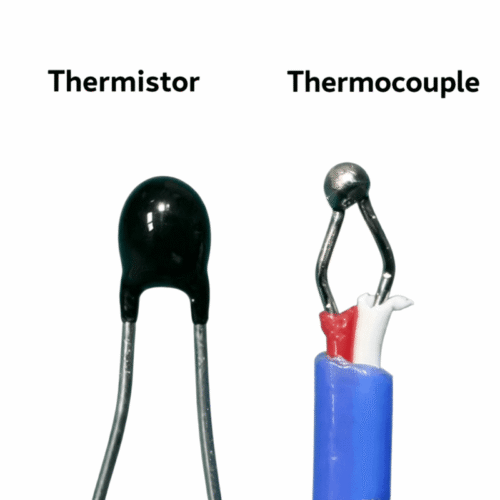
Temperature sensors are critical components in industrial heating systems, HVAC equipment, process control, and consumer electronics. Among the many types of temperature sensors, thermistors and thermocouples are the two most common.
This article will provide a comprehensive comparison of thermistors and thermocouples, analyzing their differences in measurement principles, performance, applicable scenarios, and cost to help you choose the temperature sensor best suited to your needs.
1. What Is a Thermistor?
A thermistor is an electronic component whose resistance changes significantly with temperature. It is mainly divided into two types based on the resistance-temperature relationship: NTC (Negative Temperature Coefficient) and PTC (Positive Temperature Coefficient).
NTC thermistors are more commonly used, characterized by resistance decreasing as temperature increases. They are made from semiconductor ceramics sintered from transition metal oxides such as manganese, nickel, cobalt, and copper. Common packaging forms include glass encapsulation, epoxy encapsulation, SMD chips, and lead probes.
They are primarily utilized in the fields of high-precision temperature sensing, monitoring, and compensation. Furthermore, power-type NTC thermistors are widely employed as inrush current limiters in power supply equipment to protect circuits from damage during initial startup.
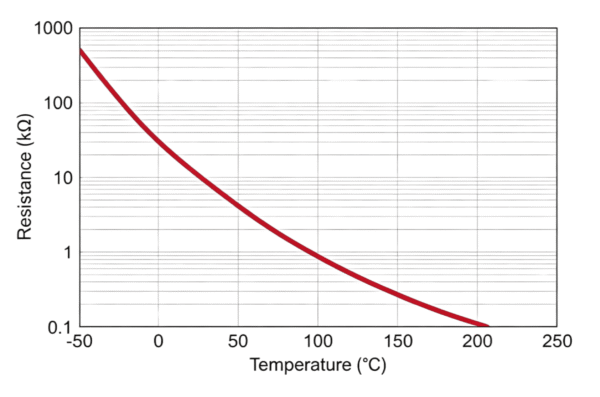
NTC Thermistor Resistance-Temperature Characteristic Curve
PTC thermistors work oppositely: resistance increases with temperature and rises sharply at the Curie point to achieve self-protection. By material, they are classified into ceramic PTC (barium titanate-based) and polymer PTC (polymer + conductive filler). They are most commonly used for overcurrent protection (often referred to as resettable fuses), where they “trip” into a high-resistance state during a fault. Because they can maintain a stable temperature once they reach their switching point, they are also frequently employed as self-regulating heating elements in devices like heaters and motor starters.
Advantages of thermistors include extremely high sensitivity, small size, fast response, low cost, and strong long-term stability, making them indispensable temperature sensing components in modern electronic systems.
2. What Is a Thermistor?
A thermocouple is a temperature sensor made from two different metals or alloys. One end is welded together to form the measurement junction (hot junction), while the other end connects to the measuring circuit as the reference junction (cold junction). When a temperature difference exists between the hot and cold junctions, a small voltage is generated—this phenomenon is called the Seebeck effect.
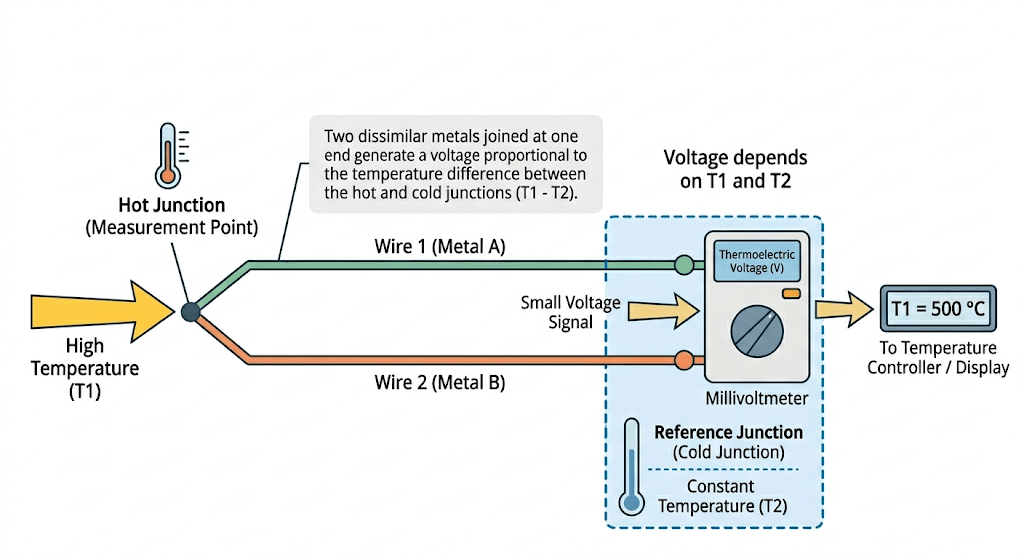
Thermocouple Working Principle (Seebeck Effect)
The thermocouple’s output voltage has a defined relationship with the temperature difference. In narrow temperature ranges, this relationship is approximately linear proportional—greater temperature difference produces higher voltage. By measuring this voltage, the hot junction temperature can be calculated.
Common thermocouple types include K-type, J-type, T-type, E-type, and R/S-type, each suited to different temperature ranges and environmental conditions. Some excel in high temperatures, others resist corrosion, while some are ideal for low-temperature measurement.
Due to their simple structure, rugged durability, and ability to withstand extreme temperatures exceeding 1800°C, thermocouples are widely used in high-temperature and harsh industrial environments.
3. Thermistor vs Thermocouple: Core Performance Comparison
To help you quickly understand the key differences between thermistor and thermocouples, the table below provides a direct comparison across measurement principle, temperature range, accuracy, response speed, and more. This table serves as a practical quick reference for product selection or system design.
| Parameter | Thermistor | Thermocouple |
|---|---|---|
| Principle | Resistance changes with temp (NTC↓/PTC↑) | Seebeck effect (voltage from metal temp diff) |
| Range | -50°C~150°C (special 300°C) | -200°C~1800°C (K:1260°C, R/S:1600°C+) |
| Accuracy | ±0.1°C~±0.5°C (high sensitivity) | ±1.5°C~±2.5°C (standard grade) |
| Response | Fast (seconds; beads <1s) | Ultra-fast bare wire (ms); sheathed medium |
| Signal | Resistance (needs excitation + linearization) | Voltage (self-powered + cold junction comp) |
| Stability | Excellent in clean env (0.02°C/yr drift) | Long-term high-temp stable (noble metals best) |
| Environment | Mid/low temp, clean, compact | High temp, vibration, corrosion, pressure |
| Applications | HVAC, appliances, batteries, medical | Furnaces, boilers, engines |
| Cost/Complexity | Low cost, simple circuit | Higher, needs compensation circuits |
| Limitations | – Narrow range (<300°C), ages at high temp – Strong nonlinearity (needs lookup/Steinhart-Hart) – Self-heating error (limit excitation current) – Low mechanical strength | – Lower accuracy (±1.5°C+), not for precision – Needs CJC/amp (complex circuit) – High-temp drift (e.g., K-type green rot) – Weak signal (µV-mV, noise-prone) |
4. Thermistor vs Thermocouple: How to Choose
The key to choosing between a thermistor or thermocouple lies in three main factors: temperature range, accuracy requirements, and operating environment. Follow this 4-step decision process for quick, accurate selection.
Step 1: Check Temperature Range
If the measured temperature is below 300°C, NTC thermistor is usually the better choice—offering high accuracy, excellent sensitivity, and simple circuitry. Above 300°C, thermistors age rapidly or fail completely, making thermocouples the only practical option, covering 300°C to 1800°C+.
Step 2: Evaluate Accuracy Needs
Need ±0.5°C accuracy or better, especially in narrow ranges like 0°C~100°C? Thermistor wins—it detects 0.01°C changes. Thermocouples offer standard ±2.5°C accuracy (high-grade ±1.5°C). Choose thermistors for precision applications; thermocouples for wide-range/high-temp where absolute precision matters less.
Step 3: Assess Environment & Reliability
Will the sensor face intense vibration, corrosive gases, high pressure, or frequent thermal shocks? Thermocouple durability shines—metal welds plus sheaths/ceramic insulation make it rugged. Thermistors are waterproof/moisture-resistant but have weaker impact resistance and may drift in prolonged high-temp/high-humidity conditions.
Step 4: Consider Circuit Complexity & Cost
Thermistor signal conditioning is simple: just a voltage divider resistor + ADC for direct readings, with minimal system cost. Thermocouples are trickier—mV/µV-level output requires precision amplifiers and cold junction compensation (CJC), or room temperature changes cause major errors. Thermocouple total system cost (amplification, compensation, linearization) typically exceeds thermistors.
5. Industrial Applications of Thermistors and Thermocouples
In industrial heating applications, thermistors and thermocouples each excel in their typical domains. The following representative cases illustrate how they are practically implemented.
5.1 Thermistor Application Examples
HVAC & Building Automation
HVAC systems typically operate between -20°C to +80°C—NTC’s ideal range. Widely used in room thermostats, duct sensors, and heat exchanger outlet temperature monitoring with ~±0.2°C accuracy. Low cost and compact size make integration into fan coil units or VAV boxes easy.
Appliances & Consumer Electronics
Rice cookers, air conditioners, refrigerators, and other appliances heavily adopt NTCs due to low cost, fast response, and simple circuitry. For example, rice cookers use NTCs to detect pot-bottom temperature for switching between cooking and warming modes; indoor AC units deploy multiple NTCs to prevent frost formation. Thermocouples are rarely used here—too expensive with excessive precision.
Battery Management Systems (BMS)
Lithium battery packs in electric vehicles and energy storage are extremely temperature-sensitive. Epoxy or thin-film NTCs mounted on cell surfaces provide real-time temperature difference monitoring, meeting ±0.5°C accuracy and seconds-level response. Thermocouples lack sufficient accuracy, and their metal construction poses short-circuit risks.
3D Printers
Most desktop 3D printers use NTCs (100kΩ, B=3950K) for hotends and heated beds, covering 150°C~300°C. For high-temperature plastics like PEEK (>400°C), K-type thermocouples are required as NTCs fail.
Medical Equipment
Incubators, patient monitors, and body temperature probes demand high accuracy (±0.1°C typical) and reliability—NTCs are the dominant choice.
5.2 Thermocouple Application Examples
Industrial Furnaces & Heat Treatment
Heat treatment furnaces in steel, ceramics, and glass industries often exceed 1000°C—thermocouple territory. K-type (0~1260°C) for general furnaces; R/S-type (0~1600°C) for high-precision measurement; B-type (up to 1800°C) for extreme oxidation environments. Typically equipped with ceramic protection tubes and metal sheaths for corrosion and impact resistance.
Boilers & Chemical Processing
Chemical reactors and pipelines range from -50°C~500°C. Low-temp sections can use NTCs; high-temp (>300°C) sections use thermocouples. Engineers often prefer RTDs for superior stability, but thermocouples remain common when budgets are limited or temperatures exceed 300°C.
Engine Exhaust
Car and ship engine exhaust reaches 800°C~1000°C amid intense vibration and corrosive gases. Sheathed K-type or N-type thermocouples (mineral insulation) are standard—fast response provides real-time ECU feedback for air-fuel ratio adjustment. Thermistors cannot withstand these conditions.
Power Plants (Flue Gas/Steam)
In coal, gas, or nuclear plants, boiler flue gas hits 600°C~1200°C, steam pipes 400°C~600°C—requiring long-term reliable measurement under high pressure, fast airflow, and corrosive products. Sheathed K/N-type thermocouples are standard; supercritical units or critical points use R/S or N-type. Thermocouples optimize combustion efficiency and reduce emissions—thermistors are unsuitable.
6. Summary
Thermistors and thermocouples are temperature sensors with completely different principles, performance, and applications. Neither is absolutely better than the other – it only depends on whether it suits your specific needs.
Thermistors (mainly NTC) excel at providing high accuracy, high sensitivity, low cost, and simple circuitry in the medium-to-low temperature range. Thermocouples, on the other hand, excel at providing ruggedness, very fast response, and resistance to harsh environments over a wide temperature range (especially at the high end).
7. FAQ
7.1 Thermistor vs Thermocouple vs RTD (Platinum Resistance Sensor): What Are the Differences?
- Thermistor (NTC) – resistance decreases as temperature rises. Highest sensitivity (-4%/°C), good accuracy (±0.1°C), but narrow temperature range (-50°C to 300°C), strongly nonlinear, lowest cost.
- Thermocouple – voltage generated from two dissimilar metals. Widest temperature range (-200°C to 1800°C+), rugged, but lower accuracy (±1.5°C to ±2.5°C), needs cold junction compensation.
- RTD (e.g., Pt100) – resistance of platinum increases linearly with temperature. Very high accuracy (±0.1°C to ±0.3°C), best long-term stability, medium range (-200°C to +600°C), but higher cost, slower response, requires precision constant current excitation.
7.2 What are the differences between NTC and PTC?
NTC (Negative Temperature Coefficient) and PTC (Positive Temperature Coefficient) are two major types of thermistors with completely different purposes:
- NTC – resistance decreases as temperature rises. Used mainly for temperature measurement (e.g., thermometers, HVAC sensors) and inrush current limiting (switching power supply input). Its output is a continuous analog signal.
- PTC – resistance increases sharply after the Curie point. Used mainly for overcurrent protection (resettable fuses) and self-regulating heating (e.g., electric mosquito repellent heaters, car seat heaters). Its output acts like a switch: low resistance in normal state, high resistance after tripping or when heating is complete.
7.3 Which responds faster – a thermistor or a thermocouple?
A bare-wire thermocouple (without a sheath) has the fastest response, reaching the millisecond range (thermal time constant τ < 10 ms), because its mass is extremely small and it is directly exposed to airflow. A sheathed thermocouple is slower, with τ around 0.1–1 second.
A thermistor typically has a response time in seconds (τ about 1–10 seconds); a very small bead or thin-film NTC can achieve τ < 1 second. Therefore, if your application requires extremely fast transient temperature capture (e.g., combustion analysis inside an engine cylinder), a bare-wire thermocouple is the better choice.
8. Final Thought
Thermistors and thermocouples each have their strengths – the choice mainly depends on temperature, accuracy, and environment. We hope this comparison helps you quickly clarify your decision.
Finally, remember that proper installation and signal conditioning are often more important than the sensor’s inherent accuracy. A small self-heating error or a mistake in cold junction compensation can ruin the performance of the entire measurement system.
If you have a specific application scenario or selection question, please contact our engineering team – we are happy to provide further support.