




What Are the Different Types of Pressure Sensors

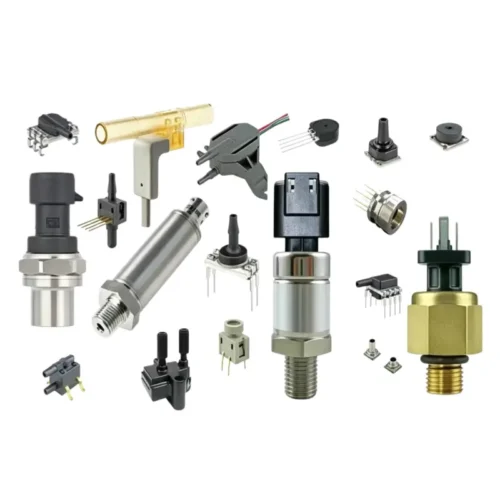
Pressure sensors show up everywhere once you start paying attention. For example, they keep production lines steady, help medical devices stay accurate, support HVAC systems, and warn teams before a pressure issue becomes a very expensive one.
What A Pressure Sensor Does
A pressure sensor measures the force a gas or liquid applies over an area, then converts that force into a readable output. In practice, that output can feed a display, trigger an alarm, guide automation, or help a control system make real-time decisions.
To evaluate pressure measurement properly, we must first look at how the pressure is referenced. Pressure gets measured against different reference points, which serves as the primary foundational classification in the industry:
Absolute Pressure (Pabs): Uses a perfect vacuum as the zero reference.
Gauge Pressure (Pg): Uses local atmospheric pressure as the reference.
Differential Pressure ( ΔP): Measures the gap or difference between two independent pressure points.
Sealed Gauge Reference: Relies on a fixed, sealed internal reference chamber (typically sealed at 1 atm) to remain immune to ambient atmospheric fluctuations.
Why Pressure Sensor Type Matters
However, picking the wrong sensor can cause more than a bad reading. It can create control issues, shorten service life, and make maintenance a constant nuisance. A vacuum chamber does not care how convenient a sensor is. It needs the right sensing method.
Therefore, we think about application first and technology second. Pressure range, response speed, media compatibility, calibration stability, vibration, and cost all shape the final decision.
7 Common Pressure-Measurement Methods and Instruments
To fully understand pressure measurement, it is important to distinguish between traditional mechanical instruments (which provide local physical readings) and modern electronic sensors/transducers (which convert force into electrical signals for automation and control).
| Sensor type | How it works | Best use case | Main strength | Main limitation |
|---|---|---|---|---|
| Aneroid barometer | Mechanical capsule flexes with atmospheric pressure | Weather and altitude sensing | Simple, durable | Slower response |
| Manometer | Liquid column shifts with pressure difference | Lab calibration | High accuracy in basic setups | Bulky and slow |
| Bourdon tube | Curved tube straightens under pressure | High-pressure industrial gauges | Tough and low cost | Sensitive to shock and vibration |
| Vacuum (Pirani) | Heated filament resistance changes as gas density shifts | Vacuum systems | Good for low-pressure ranges | Gas-dependent; requires specific calibration |
| Sealed pressure | Internal chamber provides fixed reference | Moisture-heavy or underwater uses | Stable reference | Less flexible than absolute sensing |
| Piezoelectric | Crystal generates charge under force | Dynamic pressure and combustion | Fast response | Not ideal for static pressure |
| Piezoresistive & Strain Gauge | Resistance changes as a diaphragm or strain element deforms under pressure | General industrial monitoring, HVAC, and heavy hydraulics | Versatile and widely used | Needs good signal conditioning |
1) Aneroid Barometer Pressure Sensors
An aneroid barometer uses a sealed, flexible metal capsule that expands or contracts as atmospheric pressure changes. As a result, that movement gets translated into a pressure reading through a mechanical linkage or dial mechanism.
These sensors are compact, rugged, and useful for atmospheric measurement where mechanical simplicity matters. That said, they are not the fastest option, so they are a weak fit for fast-changing or highly dynamic pressure environments.
2) Manometer Pressure Sensors
A manometer uses a liquid column to compare pressure differences. When pressure is applied, the liquid shifts, and the height difference shows the pressure value. In other words, simple idea. Very effective in the right setting.
We still see manometers in lab and calibration environments because the principle is easy to trust and can be very accurate under controlled conditions. However, they are not a good fit for compact, fast, or mobile systems.
3) Bourdon Tube Pressure Sensors
Bourdon tube sensor uses a curved metal tube that tends to straighten as internal pressure rises. Consequently, that movement drives a pointer or mechanism that displays the pressure value.
People like these sensors because they are tough, straightforward, and relatively inexpensive. They also perform well in high-pressure industrial environments, although shock and vibration can reduce reliability over time.
4) Vacuum Pressure Sensors
Vacuum sensors, especially Pirani sensors, are built for very low-pressure environments. They work by measuring how effectively gas molecules conduct heat away from a heated filament. At lower pressures (higher vacuum), fewer gas molecules are present, reducing thermal conductivity and causing the filament temperature and electrical resistance to rise.
Because the thermal conductivity varies depending on the specific gas, Pirani sensors are highly medium-dependent and require specific calibration for different gases (e.g., Nitrogen vs. Argon). They matter in semiconductor work, scientific equipment, and vacuum systems where standard pressure technologies simply are not sensitive enough.
5) Sealed Pressure Sensors
Sealed pressure sensors use a fixed internal reference chamber. That makes them useful when atmospheric changes would otherwise distort readings. In underwater systems and certain industrial environments, that stability can make a real difference.
The main advantage is reference stability. However, flexibility is limited. If a project requires a true vacuum reference, this type is not equivalent to absolute sensing.
6) Piezoelectric Pressure Sensors
Piezoelectric sensors generate an electrical charge when force is applied to certain crystals or materials. Because they respond so quickly, they work well for dynamic pressure events like engine combustion, impact testing, and rapid pressure spikes.
They are not ideal for slow, steady, long-duration measurements. But when the pressure changes fast, they really shine.
7) Piezoresistive andStrain Gauge Pressure Sensors
A piezoresistive sensor and a traditional strain gauge sensor both measure pressure by detecting electrical resistance changes in response to physical deformation. While they share this underlying piezoresistive effect, they utilize different materials for different industrial duties:
- Strain Gauge Sensors: Utilize bonded metal foil or wire elements. While less sensitive than silicon variants, they possess incredible ruggedness and structural endurance, making them highly preferred in ultra-high pressure applications such as heavy hydraulics and heavy machinery monitoring.
- Piezoresistive Sensors (Silicon MEMS): Utilize semiconductor silicon chip technology. They offer exceptional sensitivity and compact sizing, making them the absolute standard for modern general industrial monitoring, medical equipment, and HVAC systems.
Different Pressure Sensor Types Comparison
| Type | Static pressure | Dynamic pressure | Accuracy potential | Cost level | Typical industries |
|---|---|---|---|---|---|
| Aneroid barometer | Good | Limited | Moderate | Low to moderate | Weather, altitude |
| Manometer | Good | Poor | High in lab settings | Low | Labs, calibration |
| Bourdon tube | Good | Limited | Moderate | Low | Industrial gauges |
| Vacuum (Pirani) | Specialized | Limited | High in vacuum ranges | Moderate | Semiconductor, research |
| Sealed pressure | Good | Limited | High for specific use cases | Moderate | Marine, industrial |
| Piezoelectric | Poor | Excellent | High for fast events | Moderate to high | Automotive, test systems |
| Piezoresistive & Strain Gauge | Excellent | Good | High | Moderate | Industrial, Medical, HVAC, Heavy Machinery |
How To Choose The Right Pressure Sensor
Start with the pressure reference, because that decision quickly narrows the options. For pressure relative to atmosphere, gauge sensing is the natural starting point. When a fixed zero reference is required, absolute sensing is more appropriate. For applications that involve comparing two points, differential sensing is the best choice.
Then look at the real operating conditions. High vibration, corrosive media, moisture, fast transients, and temperature swings all affect performance. As a result, they may push you toward a different sensing principle.
If your project is industrial and you want application-ready options, review pressure sensor types and compare them against your pressure range, media, and output needs. For buyers working on process control or automation projects, industrial pressure sensors are often the best place to start. For readers evaluating use cases before purchase, pressure sensor applications can help connect the technology to the job.
Uses of Pressure Sensors
Pressure sensors show up in automotive systems, industrial automation, healthcare devices, HVAC equipment, and consumer electronics. Their growth is not hypothetical. Market research firms continue to forecast strong expansion, driven by safety systems, connected devices, and smarter factories.
In industrial settings, pressure sensing helps detect clogged filters, leaks, tank level changes, and pump issues before they lead to shutdowns.
In the medical field, it supports critical functions such as ventilation, infusion control, and patient monitoring. Meanwhile, HVAC systems rely on pressure sensors to manage airflow and maintain filter performance. As a result, these applications continue to expand as systems become smarter and more connected.
Final Thoughts
Pressure sensors are not one category with one solution. They are a family of technologies, each built for a different job. Once we match the sensing principle to the pressure reference, environment, and response requirement, the right choice gets a lot clearer.
For product selection, the smartest move is to define the application first and the sensor family second. That keeps the buying process grounded in performance, not labels.