




SMA vs SMB vs SMC Connectors: How to Choose?

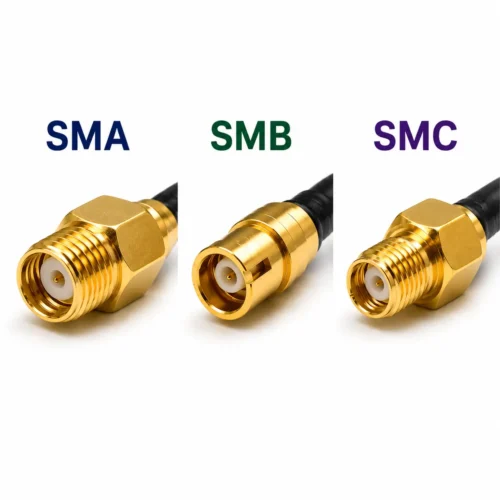
When engineers choose a subminiature RF connector, they often compare three closely related options: SMA, SMB and SMC connectors. At first glance, these connectors may look similar. However, they do not interchange directly, and each one fits a different set of electrical and mechanical requirements. The right choice depends on frequency range, mating style, vibration resistance, available space, cable type and system impedance.
In simple terms, start with SMA when you need higher frequency performance and a secure threaded connection. Select SMB when fast push-on mating and compact size matter most. Use SMC when you want a smaller threaded connector with better retention than SMB.
What Are SMA, SMB, and SMC Connectors?
SMA Connector
SMA connector is a 50-ohm RF coaxial connector with a threaded coupling mechanism. Engineers commonly use it in antennas, wireless modules, test equipment, microwave systems, base station equipment and RF instruments.
The main advantage of SMA comes from its combination of high-frequency capability, reliable mechanical retention and broad market availability. Manufacturers commonly rate standard SMA connectors to DC-18 GHz, while some extended or precision designs can go higher depending on construction, cable and manufacturer specifications.
As a result, SMA is usually the safest starting point when your design needs stable RF performance, repeatable mating and good availability across global suppliers.
SMB Connector
SMB connector is a compact RF coaxial connector with a snap-on coupling mechanism. Instead of screwing the connector into place, the user simply pushes it on and pulls it off.
Because of this push-on design, SMB works well in applications where assembly speed, small size and frequent connection or disconnection matter. Engineers typically use standard SMB designs up to DC-4 GHz, although some extended-range versions can reach around 10 GHz.
SMB connectors are available in both 50-ohm and 75-ohm versions. They are often used in RF, telecom, GPS, instrumentation and video or broadcast-related applications.
The tradeoff is mechanical retention. SMB offers convenience, but it usually should not be the first choice when the cable may be pulled, twisted or exposed to strong vibration.
SMC Connector
SMC connector belongs to the same subminiature RF connector family as SMB, but it uses a threaded coupling instead of a snap-on interface. In other words, SMC keeps the compact form factor while adding stronger mechanical retention.
SMC connectors support 50-ohm and 75-ohm systems. Manufacturers commonly rate standard versions around DC-4 GHz, while extended designs may reach around 10 GHz, depending on connector and cable configuration.
For this reason, SMC is a good choice when the design needs a compact RF connector but SMB’s snap-on retention is not secure enough. Engineers often use SMC in instrumentation, compact RF modules, wireless systems, telemetry and equipment exposed to vibration.
Key Differences Between SMA, SMB and SMC Connectors
1. Coupling Method
The coupling mechanism is the most visible difference.
SMA uses a threaded interface, which provides a firm mechanical connection. This makes SMA a strong fit for RF test systems, antennas and higher-frequency equipment.
By contrast, SMB uses a snap-on interface, so technicians can install and remove it faster. This helps in compact devices, production assembly and test setups where speed matters.
Meanwhile, SMC uses a threaded interface like SMA, but it fits into a smaller SMB-related form factor. It becomes a practical option when you want compact size plus vibration resistance.
2. Frequency Range
Frequency rating is one of the most important selection factors.
Among the three, SMA generally offers the highest frequency capability. Standard SMA products commonly support DC-18 GHz, and some extended designs go beyond that.
Engineers usually choose SMB for lower and mid-frequency RF systems, commonly around DC-4 GHz for standard designs. Extended versions may go higher, but the exact rating depends on connector geometry, cable and assembly quality.
SMC sits between SMB convenience and SMA mechanical strength. Manufacturers often list standard SMC connectors around DC-4 GHz, with extended designs reaching around 10 GHz.
As a rule, check the datasheet carefully if your operating frequency is above 4 GHz. If you need broad frequency margin, SMA is usually the better starting point.
3. Impedance Options
SMA primarily supports 50-ohm systems, which match most RF communication, microwave, antenna and test applications.
SMB and SMC commonly come in both 50-ohm and 75-ohm versions. This makes them useful in systems that require 75-ohm impedance, such as certain video, broadcast and data transmission applications.
However, you should never mix 50-ohm and 75-ohm versions casually. Even when connectors appear similar, impedance mismatch can increase return loss, reduce signal quality and create measurement errors.
4. Mechanical Reliability
For mechanical security, the general ranking is:
SMA / SMC > SMB
Threaded SMA and SMC connectors handle vibration, movement and long-term installation better than snap-on SMB connectors. SMB is easier to connect, but its snap-on interface provides less security under pull force or repeated vibration.
For outdoor or harsh environments, do not assume a connector is sealed just because it is threaded. Instead, specify waterproof, IP-rated or sealed versions when the application requires environmental protection.
5. Size and Assembly Speed
Teams usually prefer SMB when fast assembly and compact routing matter most. It mates quickly, requires no threading and saves labor time in production.
Since SMA uses a threaded interface, installation takes longer. In precision applications, the connector also needs proper torque.
Although SMC is also threaded and slower than SMB, it provides better retention in tight spaces.
Quick Comparison: SMA vs SMB vs SMC
| Feature | SMA Connector | SMB Connector | SMC Connector |
|---|---|---|---|
| Full name | SubMiniature version A | SubMiniature version B | SubMiniature version C |
| Coupling style | Threaded | Snap-on / push-on | Threaded, 10-32 UNF |
| Typical impedance | 50 ohm | 50 ohm, 75 ohm options | 50 ohm, 75 ohm options |
| Typical frequency range | DC to 18 GHz; extended versions higher | DC to 4 GHz; extended versions up to about 10 GHz | DC to 4 GHz; extended versions up to about 10 GHz |
| Mechanical security | High | Moderate | High |
| Installation speed | Slower | Fastest | Slower than SMB |
| Best for | Microwave, antennas, test equipment, telecom, aerospace | Compact RF modules, quick assembly, GPS, telecom, 75-ohm video systems | Compact threaded RF links, vibration-prone equipment, instrumentation |
| Main limitation | Needs proper mating torque; slower to connect | Less secure under vibration or cable pull | Less common than SMA/SMB in some markets |
Which Connector Should You Choose?
Start with SMA if your application needs high-frequency performance, stable RF characteristics, strong availability, antenna connections, test equipment compatibility or operation above 4 GHz.
SMB is the better option when your application needs quick push-on mating, compact size, frequent connect/disconnect cycles and 50-ohm or 75-ohm options, as long as the system will not face heavy vibration or cable pull.
For compact designs that need threaded retention, SMC offers a useful middle ground. It gives you a smaller connector than SMA in many layouts while improving mechanical security compared with SMB.
Common Applications of SMA, SMB, and SMC Connectors
Designers commonly use SMA connectors in RF test equipment, microwave modules, wireless base stations, antennas, GPS, Wi-Fi, radar, aerospace, defense and laboratory instruments.
SMB connectors fit compact RF modules, GPS systems, telecom equipment, automotive electronics, instrumentation and high-density board-to-cable assemblies.
SMC connectors suit compact RF equipment, instrumentation, telemetry, mobile systems, wireless devices and designs where vibration resistance matters more than fast push-on mating.
Common Mistakes to Avoid
Appearance alone should not drive connector selection. SMA, SMB and SMC have different mating interfaces, so users should not force them together.
Always confirm impedance. A 75-ohm SMB or SMC connector is not the same as a 50-ohm version.
Frequency ratings also vary by design. Right-angle connectors, cable type, PCB launch design and assembly quality can all reduce real-world performance.
In high-vibration systems, avoid standard SMB unless the design includes proper strain relief or a locking/sealed variant.
With SMA connectors, use the correct mating torque. Over-torque can damage threads and reduce repeatability.
FAQ
Is SMA better than SMB?
SMA is better for higher-frequency and mechanically secure RF connections. SMB is better when fast push-on mating and compact assembly are more important.
Is SMB smaller than SMA?
SMB is generally more compact and easier to mate quickly, while SMA provides stronger threaded retention and higher frequency capability.
Can SMA, SMB and SMC connectors be connected together?
No, they cannot connect directly. You need the correct RF adapter, and the adapter must match impedance, gender, polarity and frequency requirements.
Which connector is best above 4 GHz?
SMA is usually the first choice above 4 GHz. Some SMB and SMC extended versions can support higher frequencies, but you should verify the exact datasheet.
Final Thoughts
For most RF and microwave projects, SMA is the most versatile and widely available choice. For compact equipment where fast installation matters, SMB offers a practical and cost-effective option. For compact designs that also need a threaded connection, SMC provides a strong middle ground.
Ultimately, the best connector is not simply the smallest or highest-frequency option. It is the one that matches your system’s frequency, impedance, cable, mechanical environment and assembly workflow.
As a professional RF coaxial connector manufacturer, HUADA offers a comprehensive range of SMA, SMB, and SMC connectors, adapters, and cable assemblies, along with customized RF interconnect solutions tailored to diverse application requirements. Our products are widely used in telecommunications, wireless systems, test and measurement equipment, industrial electronics, and other high-frequency applications where stable and reliable signal transmission is essential.
Whether you need standard RF connectors or custom-designed solutions, HUADA provides complete technical support and one-stop sourcing services. We can customize board-mount, cable-mount, waterproof, and gold-plated SMA, SMB, and SMC connector configurations to meet your specific performance and installation requirements.
Contact our RF connector experts today for product selection assistance, custom development, and reliable RF connectivity solutions.