




Aerospace Connectors: Types, Standards, and Applications

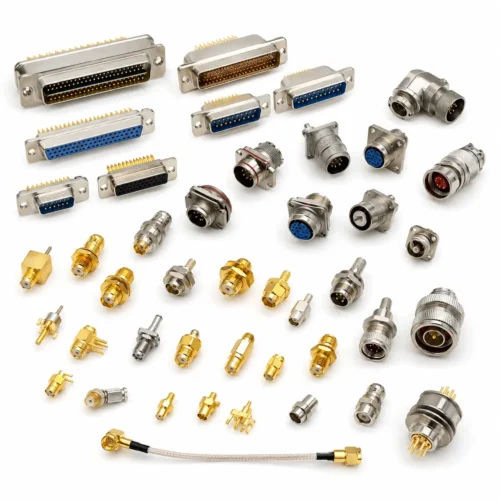
Aerospace connectors are highly specialized electrical interconnect devices. They maintain stable power, signal, and data transmission under the most unforgiving environmental conditions. Consequently, they are critical components in commercial aviation, military defense systems, and satellite architectures. These devices must operate flawlessly despite severe vibration, rapid atmospheric pressure drops, and violent thermal cycling.
Unlike standard commercial or consumer components, aerospace interconnects prioritize absolute operational reliability over cost. A single modern aircraft can house thousands of individual mating interfaces. Therefore, even a small connector failure can disrupt flight control computers, primary navigation, or vital sensor monitoring networks. For this reason, engineering and procurement teams must thoroughly understand their design principles, classifications, and technical attributes.
1. What are Aerospace Connectors?
Aerospace connectors are ruggedized interconnect interfaces specifically engineered for airborne, defense, and space applications. These devices provide the physical link between various electronic sub-systems, black boxes, and wiring harnesses.
Unlike consumer or light industrial connectors, they are designed as high-reliability systems. They do more than just establish an electrical path. Specifically, they must maintain continuous signal integrity while exposed to brutal mechanical and atmospheric stresses during supersonic flight or rocket launches.
Aerospace Connectors vs. Standard Connectors: Key Differences
To understand why specialized sourcing is necessary, you need to look at how aerospace components differ from standard industrial alternatives. Ordinary factory-grade connectors simply cannot survive the extreme environment of modern aviation.
- Extreme Thermal Resilience: Standard connectors usually fail or deform outside the 0°C to 80°C range. In contrast, aerospace connectors operate flawlessly from -65°C to +200°C. Consequently, they handle both high-altitude freezing and intense engine compartment heat.
- Advanced Environmental Sealing: Standard components rely on basic plastic lips to shield against dust. Aerospace variants utilize high-grade fluorosilicone interfacial seals. Therefore, they completely block aggressive liquids, including jet fuel (JP-8), hydraulic fluids, and salt spray.
- Vibration and Decoupling Resistance: Under continuous flight vibration, ordinary snap-on or latch locks will quickly back out or wear down. Consequently, aerospace designs integrate heavy-duty threaded self-locking ratchets or precision bayonet coupling to eliminate unexpected un-mating.
- Strict Material and Outgassing Standards: Industrial plastics often release volatile gases in a vacuum. This outgassing can ruin sensitive optical lenses on satellites. Aerospace-grade connectors utilize strictly qualified metals and low-outgassing polymers to ensure space-vacuum compatibility.
2. Main Types of Aerospace Connectors
Aerospace connectors are classified into distinct families based on their mechanical shape, locking structures, and pin density. Each family serves a unique role in the overall vehicle architecture.
2.1 Circular Aerospace Connectors
Circular designs offer optimal mechanical strength-to-weight ratios. Their symmetrical cylindrical geometry facilitates robust environmental sealing. In addition, they feature heavy-duty coupling mechanisms to resist severe decoupling forces under continuous shock.
- Heavy-Duty Threaded Connectors: These utilize robust, multi-start threads to lock the plug and receptacle firmly together in high-vibration zones.
- Bayonet Coupling Connectors: These rely on a quick-turn pin-and-slot mechanism. Consequently, they are ideal for systems requiring rapid maintenance and deployment.
- High-End M-Series Metric Connectors: Industrial interfaces like M12 and M8 are increasingly common in aerospace peripheral setups. Specifically, X-coded M12 connectors support Gigabit Ethernet lines within cabin sub-networks.
2.2Rectangular Aerospace Connectors
Space is highly restricted in modern cockpits and avionics bays. Consequently, rectangular platforms are becoming increasingly essential. They provide much higher contact density and better space utilization compared to traditional circular variants.
- Rack and Panel Connectors: These are designed for slide-in modular installation, allowing blind-mating inside dense electronic equipment racks.
- Micro and Nano-Rectangular Connectors: These ultra-dense configurations offer an exceptionally fine pin pitch down to 0.635mm. Therefore, they save critical PCB space in weight-restricted UAVs and missile guidance subsystems.
2.3 RF and High-Speed Data Connectors
Modern aircraft rely heavily on digital networking, wireless communications, and radar imaging. Therefore, specialized radio frequency (RF) and high-speed data interconnects are mandatory. They maintain controlled impedance ( 50 Ω or 75 Ω) to minimize signal attenuation at high frequencies.
3. Key Aerospace Standards and Qualifications
Because these components are mission-critical, engineers evaluate them against rigid international qualification frameworks. The table below highlights the primary military and commercial aviation standards.
| Connector Family | Industry Standards | Primary Shell Locking |
|---|---|---|
| Circular Rugged | MIL-DTL-38999, M12/M8 | Threaded Self-Locking |
| Rectangular Heavy | ARINC 600, ARINC 404 | Blind-Mate Rack |
| Micro-Rectangular | MIL-DTL-83513 (Micro-D) | Twist-Pin Screw Lock |
| High-Speed RF | MIL-PRF-39012 (SMA/TNC) | Threaded / Bayonet |
- MIL-DTL-38999 (Series I, II, III, IV): This is the definitive subminiature circular standard for defense electronics. Specifically, Series III features a triple-start threaded coupling with an anti-decoupling ratchet. Therefore, it is highly trusted near turbine assemblies.
- MIL-DTL-5015 & MIL-DTL-26482: These legacy lines are widely deployed in heavy-duty power distribution configurations. They utilize rugged materials to handle high electrical currents safely.
- ARINC 600 / ARINC 404: These standards govern commercial aviation avionics racks. They ensure absolute interchangeability for modular line-replaceable units (LRUs).
- MIL-DTL-83513 (Micro-D) & MIL-DTL-32139 (Nano-D): These strict standards specify the performance of micro-miniature rectangular blocks under intense mechanical shock.
4. Aerospace Connectors in Aerospace Subsystems
Each subsystem within an aircraft or spacecraft places unique mechanical and electrical demands on the interconnect network. Therefore, matching the connector type to the exact application environment is critical for flight safety.
Avionics and Fly-By-Wire Flight Control Systems
Flight control computers (FCC) depend heavily on millivolt-level signal continuity. Similarly, digital cockpit displays and navigation modules require stable interfaces. These networks connect directly to critical industrial sensor arrays, including Mass Air Flow (MAF) and pressure sensors. In addition, these signals must remain completely free from electromagnetic interference (EMI). For these setups, engineers typically specify high-density MIL-DTL-38999 Series III circular lines or Micro-D blocks to ensure constant data streaming.
Engine Compartments and High-Temperature Zones
Connectors installed near turbine blades experience extreme heat soak and severe continuous shock. Therefore, they require stainless steel or firewall-grade aluminum shells. Specifically, engineers specify Black Zinc-Nickel (Zn-Ni) plating for high conductivity, 500-hour salt spray endurance, and RoHS compliance. These power distribution connectors must maintain contact stability even during sudden thermal and electrical load changes.
In-Flight Entertainment and Connectivity (IFEC)
Passenger connectivity systems, cabin networks, and seat-back displays place more emphasis on data velocity and modularity. In these configurations, weight reduction is the primary goal. Consequently, designers choose composite shell materials and high-speed quadrax contacts. These components support rapid data transmission while drastically lowering the weight of the total wiring harness.
5. Selection Guide
Choosing the correct aerospace connector requires a structured evaluation process. Procurement managers and system integrators must look beyond basic catalog pages to focus directly on operational variables.
- Assess Mechanical Shock & Locking Style: For high-vibration zones, prioritize Threaded Self-Locking. However, for quick testing bays, Bayonet or Push-Pull mechanisms are far more efficient.
- Define Signal Integrity and Plating Requirements: Electroless nickel provides excellent EMI shielding. Nevertheless, it offers less protection against salt spray. Olive Drab Cadmium handles corrosion well but faces strict RoHS restrictions in commercial projects.
- Calculate Space Constraints and SWaP Limits: Modern aerospace budgets prioritize SWaP (Size, Weight, and Power) constraints. Selecting high-density rectangular or micro-circular series helps optimize limited cabin space.
6. Conclusion
Aerospace connectors may be small physical components, but they carry enormous responsibility within defense and commercial aviation. They ensure that power, high-speed data, and critical control signals stream reliably in harsh environments where system failure is completely unacceptable.
From rugged circular MIL-DTL-38999 series built for high-vibration engine compartments to high-density rectangular layouts designed for compact avionics bays, each connector type serves a dedicated engineering purpose. Consequently, selecting the proper interconnect architecture requires a deep understanding of international MIL-SPEC standards, material sciences, and exact subsystem application constraints.
As aviation and space technology continues to progress toward more electric aircraft (MEA) and lighter autonomous UAV platforms, interconnect engineering will evolve rapidly. Connectors are moving fast toward lighter composite shells, higher pin densities, and optical-copper hybrid configurations. In this fast-changing landscape, these precision components are no longer just basic hardware accessories. Instead, they are foundational enablers of flight safety, platform stability, and modern mission success.
FAQs
1. What is the clinical benefit of a Qualified Products List (QPL) status?
A QPL certification proves that a manufacturer passed extensive physical validation monitored by international defense agencies. Consequently, it guarantees that the connector meets all mechanical, electrical, and thermal limits in real flight conditions. For procurement teams, sourcing from a compliant manufacturer drastically minimizes long-term liability and unexpected component fatigue.
2. How do hermetic connectors differ from standard environmentally sealed options?
Standard sealed connectors use rubber or fluorosilicone O-rings to block dust and moisture. However, these elastomeric rings can degrade or leak under high-altitude vacuum pressure differentials. In contrast, hermetic connectors feature a permanent glass-to-metal fusion seal. Therefore, they maintain total structural isolation and zero gas leakage in outer space or pressurized firewalls.
3. Can M12 and M8 metric circular connectors be deployed in aerospace environments?
Yes, high-end M12 and M8 metric circular connectors with specific coding (such as X-code or A-code) are common. Specifically, they handle rugged industrial Ethernet networks, sensor telemetry, and cabin entertainment subsystems. In modern rail transit and specialized aviation, they provide a lighter, more cost-effective alternative to traditional heavy military shells.
4. What is the significance of AS9100 compliance for aerospace component manufacturing?
AS9100 is the international quality management standard specifically for the aerospace and defense industry. It builds upon ISO 9001 by adding rigid requirements for product safety, configuration management, and traceability. Consequently, sourcing from an AS9100 compliant factory ensures that every component has a fully traceable material history. This compliance is mandatory for tier-1 aviation supply chains.
5. How do engineers prevent fretting corrosion in high-vibration avionics connectors?
Fretting corrosion occurs when continuous micro-vibrations rub off the contact plating, exposing base metals to oxidation. To eliminate this issue, engineers specify precision-machined contacts with advanced gold plating thickness (typically 50 micro-inches). Furthermore, selecting a triple-start threaded coupling mechanism with an anti-decoupling ratchet prevents tiny movements within the contact interface.
6. Can you provide custom cross-reference solutions for obsolete military connectors?
Yes, we specialize in technical cross-referencing and custom component engineering. Specifically, we reverse-engineer or customize military-equivalent rectangular and circular configurations to match legacy shell styles and layouts. This capability allows international buyers to sustain aging defense platforms or find reliable, cost-efficient alternatives without re-designing the entire wire harness.