




BNC vs TNC Connectors: What’s the Difference?

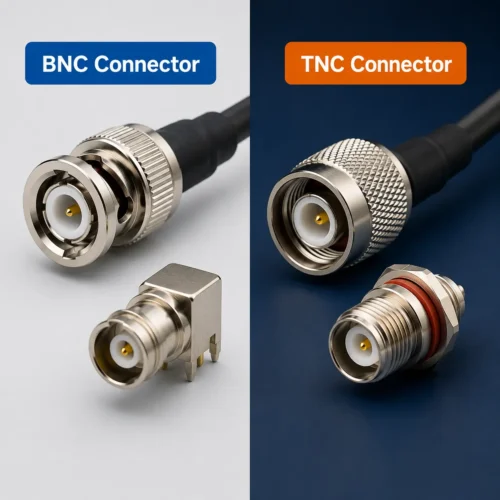
BNC and TNC connectors look almost the same and share the same basic RF design. Although BNC and TNC connectors look almost identical, their locking mechanisms are fundamentally different. BNC uses a quick quarter-turn bayonet lock, whereas TNC uses a threaded coupling system. That one mechanical difference is what decides frequency range, vibration resistance, mating speed, and cost.
This guide skips the trivia and focuses on what you need to make a sourcing or design decision: hard specs, real-world application fit, a torque table most datasheets bury, and a step-by-step way to choose between the two — plus what to put on your RFQ so you get the right part the first time.
What Is BNC Connector?
BNC is a coaxial RF connector that locks with a bayonet mechanism — two lugs on the female shell engage slots on the male connector, and a quarter turn locks it in place. No tools needed. It’s been the standard for lab equipment, video, and general RF work since the late 1940s, and it’s still specified today under MIL-PRF-39012 and MIL-STD-348, and internationally under IEC 61169-8.
Common configurations:
- Male and female, straight and right-angle bodies
- Panel-mount, bulkhead, and PCB-mount versions
- 50 Ω (RF/data) and 75 Ω (video/broadcast) impedance
- Solder, crimp, and clamp cable terminations
- Space-saving variants: Mini-BNC and HD-BNC for high-density racks
Materials: brass or zinc-alloy body with nickel plating, gold-plated copper or beryllium-copper center contact, PTFE (Teflon) dielectric.
While BNC became popular because of its quick-lock design, engineers soon identified limitations in high-vibration environments. This led to the development of TNC connectors.
What Is TNC Connector?
TNC is mechanically the same connector as BNC, but the bayonet lock is replaced with a 7/16-28 screw thread. It was developed specifically to fix BNC’s main weakness — the bayonet lock can loosen under continuous vibration. Threading the coupling nut solves that. As a result, TNC is governed by the exact same MIL-PRF-39012 and MIL-STD-348 standards as BNC, along with IEC 61169-17 internationally..
One variant worth knowing: TNCA, which uses an air gap instead of solid PTFE in the dielectric. It reduces signal loss and is common in precision, stainless-steel TNC connectors rated up to 18 GHz instead of the standard 11 GHz.
Common configurations: Generally speaking, TNC offers the same configuration range as BNC—including male/female, straight/right-angle, and multiple termination types. Additionally, it features RP-TNC (reverse-polarity) options, which have become the default standard on most Wi-Fi access points and antennas.
Materials: brass body (or stainless steel for precision grades) with nickel plating, gold-plated beryllium-copper or brass center contact, PTFE dielectric.
Difference Between BNC Connectors and TNC Connectors
1. Coupling Mechanism
First, BNC’s bayonet lock is fast: push, twist a quarter turn, and the connection is complete. However, it relies on spring tension rather than clamping force to stay locked. Therefore, under continuous vibration or repeated cable flexing, the connection can gradually work loose.
In contrast, TNC’s screw thread creates continuous, high-pressure clamping between the mating surfaces. This constant pressure not only keeps the connection tight under heavy vibration but also improves electrical contact. Because of this, TNC performs significantly better at higher frequencies.
Important, often-missed detail: a TNC connector only performs to spec if it’s torqued correctly. A loose TNC connection can actually perform worse than a properly-seated BNC. Recommended torque values (brass and stainless):
| TNC Type | Minimum Torque | Recommended Torque |
|---|---|---|
| Standard, brass | ~5 in-lb | ~12–15 in-lb |
| Precision, stainless steel | ~12 in-lb | ~13–14 in-lb (up to 20–26 in-lb for high-vibration/airframe grades) |
For everyday installs, hand-tight is usually fine. For lab measurements or anything near the top of the connector’s frequency rating, use a calibrated torque wrench — both too loose and too tight will hurt VSWR performance.
2. Frequency Range
- BNC, 50 Ω: rated up to ~4 GHz, best performance below ~2 GHz
- BNC, 75 Ω: rated up to ~1–2 GHz (a true 75 Ω match is hard to achieve in BNC’s standard dimensions)
- TNC, standard 50 Ω: rated up to ~11 GHz
- TNC, precision/stainless: rated up to ~18 GHz
Figures vary by manufacturer and grade — always check the datasheet for the exact part you’re using, especially near the top of the rated range.
3. Impedance
Similarly, both connectors are available in 50 Ω and 75 Ω versions. However, you must match the connector impedance to your cable and RF system to avoid reflections and signal loss— this matters regardless of whether you pick BNC or TNC. Mixing 50 Ω and 75 Ω causes reflections and signal loss.
4. Materials
Very similar between the two — both use brass bodies, gold-plated contacts, and PTFE dielectric. The performance gap between BNC and TNC comes from the locking mechanism, not the metal.
5. Vibration and Environmental Resistance
Both are commonly tested to the same standards:
- Vibration: MIL-STD-202, Method 204
- Salt spray/corrosion: MIL-STD-202, Method 101
- Thermal shock: MIL-STD-202, Method 107
- Moisture: MIL-STD-202, Method 106
Furthermore, both can be sealed to IP65/IP67 ratings with the right boots and gaskets. But in practice, TNC holds its environmental seal and connection far more reliably under continuous vibration (such as in vehicles, masts, drones, and machinery) because there is no bayonet lock to wiggle loose. Conversely, BNC is perfectly fine for stationary, indoor, low-vibration environments.
6. Operating Temperature
Both typically run -55°C to +155–165°C, mostly limited by the PTFE dielectric rather than the locking style. Differences between specific product lines are usually small — check the datasheet.
7. Size, Weight, and Mating Speed
BNC is slightly smaller and lighter, and it is also much faster to mate thanks to its quarter-turn design. This speed adds up quickly if the connector is handled many times a day (e.g., on test benches or patch panels). On the other hand, TNC’s thread adds a bit of physical size and installation time in exchange for a far more secure hold.
8. Mating Cycle Life
Both are typically rated for ≥500 mating cycles under MIL-PRF-39012 testing, and quality parts usually exceed this. Durability across repeated use is similar for both — the real difference is how well the connection holds between uses, where TNC has the edge.
9. Cost
Generally speaking, BNC is cheaper due to simpler tooling and higher production volumes. In contrast, TNC costs more, while precision stainless steel or air-dielectric (TNCA) versions cost more still—reflecting tighter manufacturing tolerances. Therefore, for budget-sensitive, non-critical, lower-frequency applications, BNC remains a highly economical choice
BNC vs TNC: Full Spec Comparison Table
| Parameter | BNC | TNC |
|---|---|---|
| Locking mechanism | Bayonet (quarter-turn) | Threaded, 7/16-28 |
| Standards | MIL-PRF-39012, MIL-STD-348, IEC 61169-8 | MIL-PRF-39012, MIL-STD-348, IEC 61169-17 |
| Impedance | 50 Ω / 75 Ω | 50 Ω / 75 Ω |
| Frequency (standard) | Up to ~4 GHz (50 Ω); ~1–2 GHz (75 Ω) | Up to ~11 GHz |
| Frequency (precision) | Not typically offered | Up to ~18 GHz |
| Typical VSWR | ~1.3:1 max | ~1.3:1 max at 11 GHz; ~1.2:1 for precision at 18 GHz |
| Body material | Brass or zinc alloy, nickel-plated | Brass (or stainless, precision), nickel-plated |
| Center contact | Copper alloy/BeCu, gold-plated | BeCu/brass, gold-plated |
| Dielectric | PTFE | PTFE (air-dielectric in TNCA) |
| Voltage rating | ~500 V RMS | ~500–1000 V RMS (grade-dependent) |
| Operating temperature | ~ -55°C to +155°C | ~ -55°C to +165°C |
| Mating cycles | ≥500 | ≥500 |
| Mating torque | Not applicable | ~5 in-lb min (brass) to ~26 in-lb (precision) |
| Mating speed | Instant, no tools | Slower; torque wrench recommended for critical work |
| Vibration resistance | Moderate | High |
| Max IP rating (properly sealed) | IP67 | IP67 |
| Relative size/weight | Smaller, lighter | Slightly larger, heavier |
| Relative cost | Lower | Higher |
Exact figures vary by manufacturer and grade. Always confirm against the datasheet for your specific part number.
TNC vs BNC Connector: What Do They Have in Common?
- Both are constant-impedance coaxial connectors for 50 Ω and 75 Ω systems
- Both use the same core materials: brass body, gold-plated contacts, PTFE dielectric
- Both are governed by the same military standards (MIL-PRF-39012, MIL-STD-348)
- Both are available in the same range of body styles and termination types
- Both offer reverse-polarity versions for regulated wireless equipment
- Both can be sealed to IP67 for outdoor use with the right accessories
Are BNC and TNC Interchangeable?
No. A BNC connector will not mate with a TNC connector, and vice versa — the bayonet lugs and screw threads are physically different, even though the connectors are similar in size and internal contact geometry. Don’t force it; you’ll damage the pin or shell on both sides.
If you need to bridge the two — say, a BNC test cable connecting to TNC-terminated equipment — a BNC-to-TNC adapter handles it cleanly, as long as both sides use the same impedance. Just know that every adapter adds a small amount of insertion loss and a possible VSWR discontinuity. Fine for most test setups; worth avoiding in precision microwave measurement chains.
Where BNC and TNC Connectors Are Used
| Application | Typical Choice | Why |
|---|---|---|
| Broadcast video, CCTV/SDI | BNC (75 Ω) | Industry standard for video; fast to patch in racks |
| Bench test equipment (scopes, signal generators) | BNC (50 Ω) | Fast, tool-free connect/disconnect, many times a day |
| Base stations, distributed antenna systems | TNC | Outdoor, vibration exposure, needs a secure long-term seal |
| Military and aerospace RF systems | TNC | Meets MIL-STD vibration/shock requirements |
| GPS/GNSS antennas | TNC (often RP-TNC) | Mast/rooftop mounted, exposed to wind and vibration |
| Wi-Fi access points and antennas | RP-TNC | Standard connector on most consumer/enterprise Wi-Fi gear |
| Vehicle-mounted or industrial equipment | TNC | Continuous mechanical vibration |
| Medical imaging/diagnostic equipment | BNC | Frequent cable swaps, lower-frequency signals |
| General RF lab work, ham radio | Either, 50 Ω | Depends on frequency and environment |
How to Choose Between BNC and TNC Connectors
- What’s your frequency? Under ~2 GHz, either works — BNC is usually simpler and cheaper. Above ~4 GHz, choose TNC. Above ~11 GHz, you need precision TNC (or a different connector family like N-type or SMA).
- Will it face vibration? Outdoor, vehicle, mast, or moving equipment → TNC. Indoor, low-vibration bench setup → BNC.
- How often will it be connected/disconnected? Frequent (daily test use) → BNC’s speed matters. Installed once, left alone → TNC’s extra install time is a one-time cost.
- Is your system 50 Ω or 75 Ω? Order the matching impedance no matter which connector you pick — this matters independently of BNC vs. TNC.
- Do you have space or weight limits? Tight enclosures may favor BNC’s smaller size, or a compact variant like Mini-BNC/HD-BNC.
- What’s your budget and volume? High-volume, low-criticality → BNC’s lower cost adds up. Mission-critical or high-reliability → TNC’s cost premium is usually worth it.
Then confirm every spec — frequency, VSWR, torque, temperature — against the actual datasheet for the part number before finalizing.
Common Mistakes to Avoid
- Treating TNC as a drop-in replacement for BNC. They aren’t compatible — swapping one for the other mid-project usually means redesigning the mating side too.
- Hand-tightening a TNC connector for a precision measurement. Without a torque wrench, results near the top of the frequency range can vary run to run.
- Ordering the wrong impedance because “BNC is BNC.” 50 Ω and 75 Ω BNC connectors look almost identical but aren’t interchangeable electrically.
- Choosing standard-grade BNC for an outdoor or vibration-heavy application just because it worked on a previous, less demanding project.
- Forgetting that adapters add loss. A BNC-to-TNC adapter is useful, but it’s an extra interface in the signal path, not a free connection.
- Mixing up RP-TNC and standard TNC. This is a very common cause of “why won’t this connector fit” on Wi-Fi and antenna installs.
FAQ
1.What’s the main difference between BNC and TNC?
BNC locks with a bayonet (push-and-twist) mechanism for fast, tool-free connections. TNC locks with a screw thread for a more secure, vibration-resistant connection. That difference is also why TNC handles higher frequencies better.
2. Can a BNC connector plug into a TNC jack?
No. They’re similar in size but the locking mechanisms are physically different. Use a BNC-to-TNC adapter (matched impedance) if you need to connect the two.
3. Which is better for outdoor or vibration-heavy environments?
TNC. The threaded lock resists loosening from vibration far better than BNC’s bayonet lock.
4. Is TNC always the better choice?
No — it depends on the application. BNC is faster to use, cheaper, and works well for indoor, frequently-reconfigured setups like test benches. TNC is the better choice when vibration resistance or higher frequency matters.
5. Do BNC and TNC both come in 50 Ω and 75 Ω?
Yes. Match the impedance to your cable and system — this applies regardless of which connector you choose.
6. Do I need a torque wrench to install a TNC connector?
For routine installs, hand-tight is usually fine. For calibration work or measurements near the top of the frequency rating, use a calibrated torque wrench (around 5–15 in-lb for brass, higher for precision stainless).
7. What is RP-TNC and when do I need it?
RP-TNC (reverse-polarity TNC) swaps the pin and socket gender compared to standard TNC. It’s the standard connector on most Wi-Fi access points and antennas, mainly for regulatory reasons.
Conclusion
In summary, BNC and TNC share the same basic design and materials. The locking mechanism is the one difference that drives everything else: frequency capability, vibration resistance, mating speed, and cost. Once you know your frequency range, environment, impedance, and budget, the choice between the two becomes straightforward.
Need help selecting or sourcing the right BNC or TNC connector, cable assembly, or adapter for your project? Contact our connector engineering team.