




M12 Connectors in Industrial Ethernet: The Ultimate Selection Guide

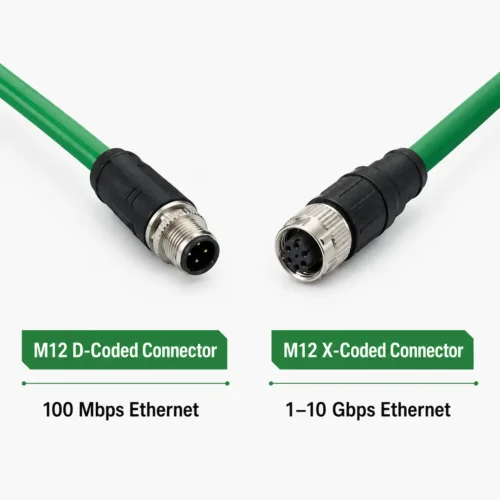
M12 ethernet connectors feature a circular threaded locking design that suits harsh factory environments. You will encounter them widely in Industrial Ethernet systems such as PROFINET, EtherNet/IP, and EtherCAT. The most common encoding types include M12 D encoding for 100 Mbps Fast Ethernet and M12 X encoding for Ethernet supporting up to 10 Gbps.
Compared to RJ45 connectors, M12 connectors offer stronger locking force, better vibration resistance, and a higher protection rating, making them more suitable for industrial automation applications. This article will detail the main applications of M12 connectors in Industrial Ethernet.
1. What Is an M12 Connector in Industrial Ethernet
M12 connector is a 12 mm metric circular connector series with a threaded locking interface. In industrial Ethernet, it reliably transmits Ethernet signals in industrial environments with vibration, dust, oil, coolant, and frequent movement.
The M12 connector has widely replaced RJ45 in industrial fields due to its higher mechanical reliability and environmental adaptability. M12 Ethernet connectors typically have an IP67 or higher protection rating, a threaded locking structure, and a fully shielded design. RJ45, on the other hand, mainly serves in office and IT network environments and typically operates under IP20 protection conditions.
Why choose M12 over RJ45 for industrial Ethernet?
In industrial equipment that needs to withstand vibration, repeated mating and unmating, washing and cleaning, or strong electromagnetic interference (EMI), the M12 is a more reliable connector solution.
Compared to traditional RJ45 connectors, M12 connectors offer significant advantages in the following aspects:
- Higher mechanical locking strength
- Stronger vibration and shock resistance
- Better electromagnetic shielding (EMC protection)
- Higher protection rating (typically IP67 and above)
- More suitable for industrial automation and industrial Ethernet systems
Therefore, in modern industrial network design, M12 has become the mainstream choice for field-level industrial Ethernet connections.
2. D-Coded vs X-Coded M12 Ethernet Connectors
M12 coding designs physically prevent incorrect mating. For industrial Ethernet applications, D-coded and X-coded are the two essential standards. While A-coded connectors are common in industrial settings, they serve sensors and DC power rather than data networking.
2.1 M12 D-Coded Connector (100 Mbps Ethernet)
M12 D-coded connector serves Fast Ethernet, supporting data transfer speeds up to 100 Mbps. While this speed may be slightly slower than office network speeds, it is the ideal “best choice” for most industrial devices, such as PLCs (Programmable Logic Controllers), sensor gateways, and distributed I/O systems. If your plant operates under PROFINET, EtherNet/IP, or EtherCAT protocols and does not require gigabit-level ultra-high bandwidth, the D-type encoded interface is your most reliable and cost-effective solution.
The advantages of the D-type encoded design lie in its simplicity and durability. It uses a 4-pin configuration and typically employs shielded CAT5 cable to block electrical noise from nearby motors or machinery.
For most standard industrial automation tasks, this 4-wire configuration provides sufficient stability. When you pair them with an IP67-rated housing, these connectors become completely waterproof and dustproof, ensuring your network stays online even in the dirtiest factory environments.
2.2 M12 X-Coded Connector (1–10 Gbps Ethernet)
If the D-type connector is a reliable local road, then the M12 X-type connector is a ten-lane highway. As modern factories become increasingly intelligent and data demands rise, the X-type interface has become the gold standard for high-performance networks. Standard connectors may struggle with large amounts of data, while the X-type connector handles transmission speeds up to 10 Gbps. This massive bandwidth ensures your network remains smooth and latency-free, even when transmitting massive amounts of information on the factory floor.
Why does your smart factory need X-type connectivity?
You can easily identify the X-type connector by its 8-pin configuration and unique “X”-shaped internal baffle that effectively shields each cable pair from interference. This makes it ideal for data-intensive applications such as machine vision (high-speed cameras), real-time quality inspection, and industrial backbone links connecting multiple machines. By using CAT6A-grade cable and maintaining a robust IP67 protection rating, our X-type solution perfectly blends office-grade speed with factory-grade ruggedness.
Note: The industry primarily defines M12 A-coded connectors for sensors, actuators, and DC power distribution. While they commonly serve as auxiliary power supply in PROFINET and other Industrial Ethernet systems, D-coded and X-coded connectors exclusively handle the high-speed Ethernet data communication (100 Mbps and above). Therefore, A-coding should be categorized under ‘Signal & Power’ when referring to Ethernet data transmission.
2.3 D-Coded vs X-Coded Comparison Tab
| Feature | D-Coded (Fast Ethernet) | X-Coded (Gigabit Ethernet) |
|---|---|---|
| Pin Count | 4-Position | 8-Position |
| Max Speed | 100 Mbps | 10 Gbps |
| Standard | CAT5 / Class D | CAT6A / Class EA |
| Frequency | Up to 100 MHz | Up to 500 MHz |
| Best For | PLCs, Sensors, Standard I/O | Machine Vision, Backbone Networks |
3.1 M12 D-Coded Pinout: 4-Pin Fast Ethernet Standard
The D-coded M12 connector is the standard solution for industrial Fast Ethernet applications. It uses a compact 4-pin layout to deliver stable 100 Mbps communication in factory automation systems.
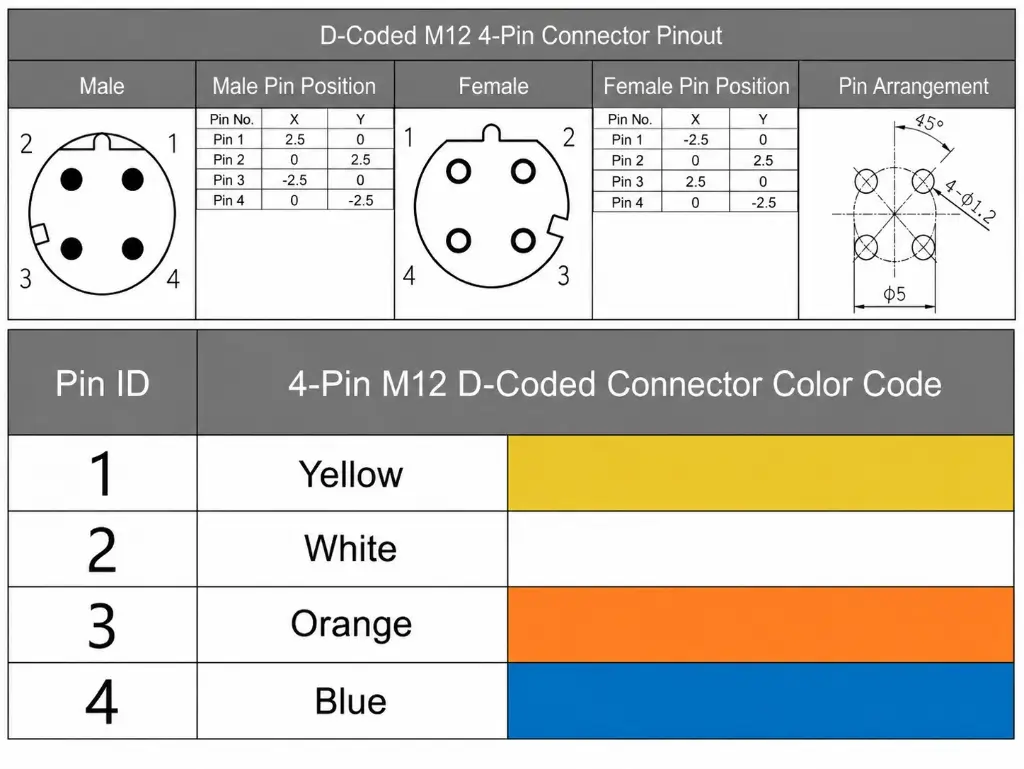
Signal Configuration: The four pins form two differential pairs that transmit and receive Ethernet signals. This configuration provides reliable communication for PLCs, sensors, I/O modules, and other field-level industrial devices.
Transmission Performance: D-coded connectors comply with CAT5 (Class D) requirements and support operating frequencies up to 100 MHz. Their design prioritizes stable data transmission in standard industrial Ethernet environments where reliability is more important than ultra-high bandwidth.
Typical Applications
D-coded interfaces are widely used in:
- PROFINET networks
- EtherNet/IP systems
- PLC communication
- Sensor and actuator connectivity
- Standard industrial automation equipment
3.2 M12 X-Coded Pinout: 8-Pin High-Speed Ethernet Standard
The X-coded M12 connector targets high-speed industrial Ethernet and data-intensive applications. Unlike D-coded versions, it uses an advanced 8-pin architecture capable of supporting Gigabit and 10 Gigabit Ethernet transmission.
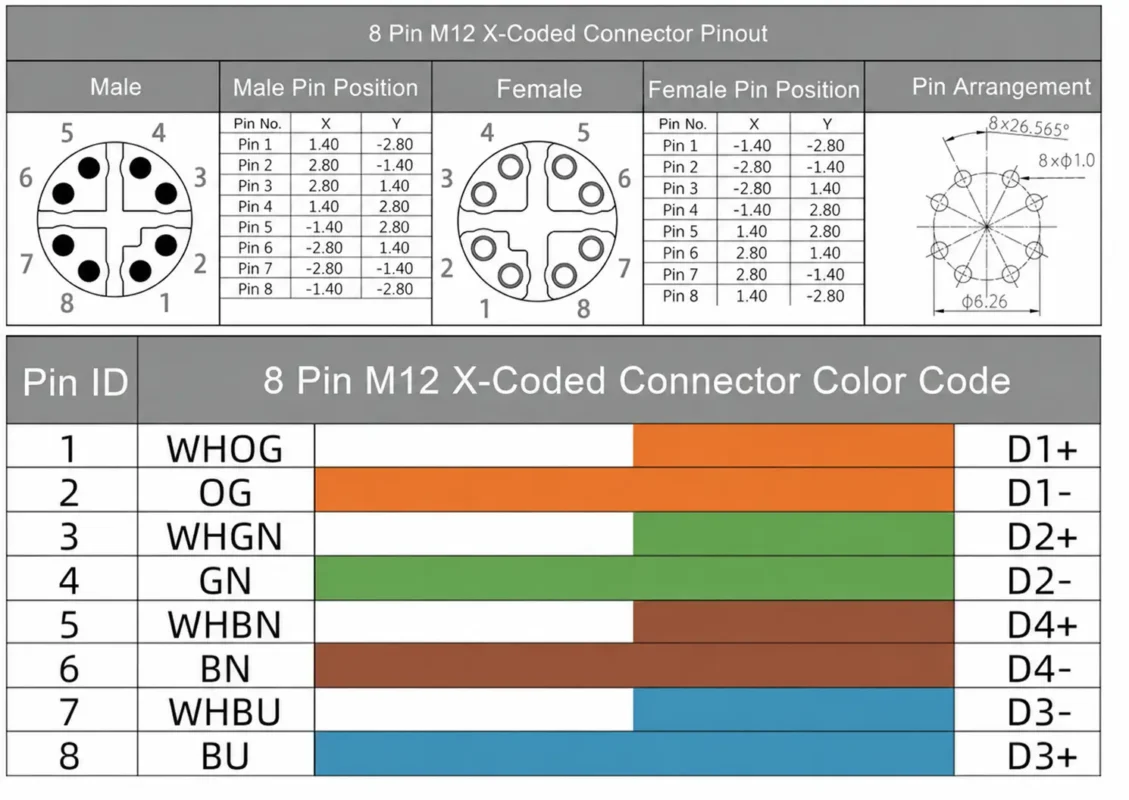
Signal Configuration: The eight pins form four fully shielded differential pairs. Its defining feature is the internal X-shaped shield separator, which physically isolates each signal pair to minimize near-end crosstalk (NEXT) and maintain high signal quality at elevated data rates.
Transmission Performance: X-coded connectors meet CAT6A (Class EA) standards and support frequencies up to 500 MHz with transmission speeds up to 10 Gbps. This makes them ideal for industrial systems that require high bandwidth and low latency.
Shielding and Signal Integrity: At Gigabit speeds, shielding performance becomes critical. To achieve stable high-speed communication, the connector and cable assembly must maintain continuous 360° shielding between the cable braid and connector housing.
Any impedance mismatch, poor shielding termination, or improper pair twisting can introduce return loss, EMI leakage, and unstable network performance.
Typical Applications
X-coded interfaces are commonly used in:
- Machine vision systems
- Industrial cameras
- Robotics and motion control
- High-speed data backbones
- Edge computing and smart manufacturing systems
4. M12 Connectors for PROFINET, EtherCAT, and EtherNet/IP
When building an industrial interconnection system, you will quickly find that M12 connectors are present across nearly every critical network layer. Whether you are deploying PROFINET, EtherNet/IP, or EtherCAT, these mainstream industrial Ethernet protocols all rely on M12 interfaces to ensure stable and reliable physical connections in harsh environments.
A simple selection logic can help you make the right decision:
For standard 100 Mbps field-level industrial Ethernet applications, D-Coded M12 connectors represent the most widely used and reliable choice.
For high-speed applications such as machine vision, edge computing, or backbone networks, X-Coded M12 connectors deliver the higher bandwidth and signal integrity (up to 1–10 Gbps) that these applications demand.
5. Industrial Installation Considerations
5.1 Cable and Shielding
In industrial environments, the connector is only part of the system. Cable quality and shielding design often determine overall network stability.
Typical pairing recommendations:
D-Coded systems → Cat5e cable
X-Coded systems → Cat6A cable
For shielding, we strongly recommend a 360° full shielding design, especially in environments with high electromagnetic interference such as motors, inverters, or CNC machines. This design significantly reduces crosstalk and packet loss.
Cable jacket selection is equally important:
PVC: Cost-effective solution for fixed installations
PUR: Ideal for environments with oil, abrasion, or moderate mechanical stress
TPE: Best suited for drag chain applications and high-flex motion systems such as robotic arms
5.2 Mechanical Design
Industrial installation environments vary significantly, so M12 connectors come in multiple mechanical configurations.
Common options include:
Angled (Right-angle) connectors: Ideal for space-constrained installations or tight cabinet layouts
Panel-mount receptacles: Serve fixed equipment interfaces and standardized machine integration
In terms of termination methods, two main options exist:
Overmolded cable assemblies: Provide maximum sealing performance and long-term reliability, ideal for mass production and harsh industrial environments
Field-wireable connectors: Allow on-site assembly and customized cable lengths, offering maximum installation flexibility
5.3 IP Ratings
M12 connectors stand out over RJ45 in industrial systems because of their high level of environmental protection.
Typical protection levels include:
- IP67: The standard protection level for most M12 connectors — they are dust-tight and withstand temporary immersion in water (1 meter for 30 minutes). Suitable for most industrial applications.
- IP69K: An optional higher protection rating that suits food, beverage, pharmaceutical, and washdown environments requiring resistance to high-pressure, high-temperature water jets (80°C, 80–100 bar). Note that ISO 20653 (originally DIN 40050-9) defines IP69K, not the IEC 60529 standard used for IP67/IP68 ratings.
5.4 Installation Tips
During installation, we recommend that you use a torque wrench to tighten the M12 connector. Typical tightening torque ranges from 0.4 to 0.6 Nm, depending on the connector design and manufacturer specifications. Always refer to the manufacturer’s datasheet for the specific torque value of your connector model.
If network instability occurs during commissioning, follow this troubleshooting sequence:
-Verify that the connector is fully locked
-Check whether the coding type matches the application
-Inspect whether the shielding maintains continuous 360° contact with the connector housing
-For field-wireable types, ensure wiring strictly follows the official pinout diagram instead of relying on wire color
In most cases, intermittent packet loss does not result from protocol issues, but from improper shielding continuity or grounding defects.
6. How to Choose the Right M12 Ethernet Connector
You can simplify the selection of M12 connectors into a clear three-step process:
Define the data rate
100 Mbps → D-Coded
1–10 Gbps → X-Coded
Match the cable category
Cat5e → standard industrial Ethernet
Cat6A → high-speed data applications
Adapt to the environment
Fixed vs. moving installations
Exposure to oil, vibration, or mechanical stress
By following this structured approach, you can ensure a stable physical layer foundation while significantly reducing maintenance costs and improving long-term network reliability.
7. Conclusion
M12 connectors have become a core component of modern industrial Ethernet systems, meeting the reliability, durability, and environmental protection requirements of harsh industrial environments. From factory automation and robotics to machine vision and high-speed data networks, choosing the right M12 connector directly impacts network stability and long-term system performance.
By understanding the coding, cable specifications, mechanical structure, and IP protection rating of M12 connectors, you can build a more reliable, future-proof industrial Ethernet infrastructure while reducing downtime and maintenance costs.
As industrial automation continues to evolve towards faster, smarter devices and more demanding operating environments, M12 Ethernet connectors will remain one of the most important foundations for industrial connectivity.
8. FAQ
8.1 Can M12 A-coded be used for industrial Ethernet?
No. A-coded M12 is mainly for sensors, actuators, and power or signal transmission, while D-coded and X-coded are the industrial Ethernet choices.
8.2 What is the difference between D-coded and X-coded?
D-coded is the 4-position choice that handles 100 Mbit/s industrial Ethernet, while X-coded is the 8-position choice for Cat6A / 10 Gbit/s networks.
8.3 Which M12 type should I use for PROFINET?
For most classic PROFINET Ethernet links, D-coded is the standard starting point. For higher bandwidth or future-proofing, X-coded becomes the stronger option.
8.4 Can M12 support Gigabit Ethernet?
Yes. M12 X-coded connectors support Gigabit Ethernet and can even support transmission speeds up to 10 Gbps.
8.5 Which cable do M12 Ethernet connectors need?
The cable type depends on the M12 coding and required Ethernet speed.
Typical recommendations:
| Connector Type | Recommended Cable |
|---|---|
| D-Coded M12 | Cat5e industrial Ethernet cable |
| X-Coded M12 | Cat6A industrial Ethernet cable |
In harsh industrial environments, we strongly recommend using shielded cables with 360° EMC protection to reduce electromagnetic interference and maintain stable network communication.