




MIL-DTL-5015 vs MIL-DTL-38999: Complete Connector Comparison Guide

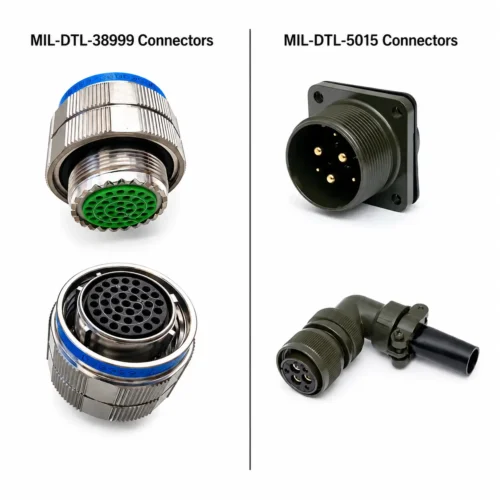
If you’re searching for the right rugged circular connector, you’ve probably narrowed it down to one question: MIL-DTL-5015 or MIL-DTL-38999? Whether you’re designing a high-current power harness for a mining truck, or a dense signal bundle for an avionics bay, your decision shapes weight, cost, EMI performance, and field maintainability. This guide gives you a direct, data-backed comparison so you can choose with confidence—fast.
Quick Answer: Which Connector Is Right for You?
Before we dive into the specs, here is the executive summary based on real-world engineering requirements.
| If You Need… | Choose |
|---|---|
| High-current power circuits | MIL-DTL-5015 |
| Legacy equipment compatibility (AN/MS5015) | MIL-DTL-5015 |
| Lowest procurement cost for industrial use | MIL-DTL-5015 |
| High-density signal & data bus connections | MIL-DTL-38999 |
| Aerospace, avionics, and space applications | MIL-DTL-38999 |
| Superior EMI/RFI shielding | MIL-DTL-38999 |
| Significant size and weight savings | MIL-DTL-38999 |
| A connector to replace an older MIL-C-5015 type | Evaluate both; often 5015 is required for form-fit-function |
Note: MIL-C-5015 is the historical DLA designation for this connector family. Military standards now reference SAE-AS50151 as the governing specification. While the industry often uses these terms interchangeably, formal procurement documentation should reference the current SAE specification.
What are MIL-DTL-5015 and MIL-DTL-38999 Connectors?
Both connectors come from military performance specifications, but they emerged from different eras and design priorities.
Engineers specify MIL-DTL-5015 (historical MIL-C-5015) as circular, threaded, AN type connectors with either solder or removable crimp contacts. Because they use a coarse single-start thread coupling and large shell sizes, they excel at high current, physical robustness, and simple field service. Their design traces back to the AN standard from the 1930s, and you’ll still find them widely specified in ground vehicles, power generation, and heavy equipment.
MIL-DTL-38999, on the other hand, defines a family of miniature, high-density, environment-resistant circular connectors across four series, as the official DLA documentation and MIL-STD-1560 describe:
- Series I: Bayonet coupling, fast mating
- Series II: Low-profile bayonet coupling (designed for weight and space savings in lower-vibration environments)
- Series III: Tri-start self-locking thread (the high-vibration aerospace standard)
- Series IV: Breech-lock coupling for extreme vibration environments
From the outset, designers built the 38999 standard for high contact density, controlled EMI shielding, and weight-critical platforms. As a result, it now serves as the baseline interconnect for modern avionics, radar, satellites, and tactical communication systems.
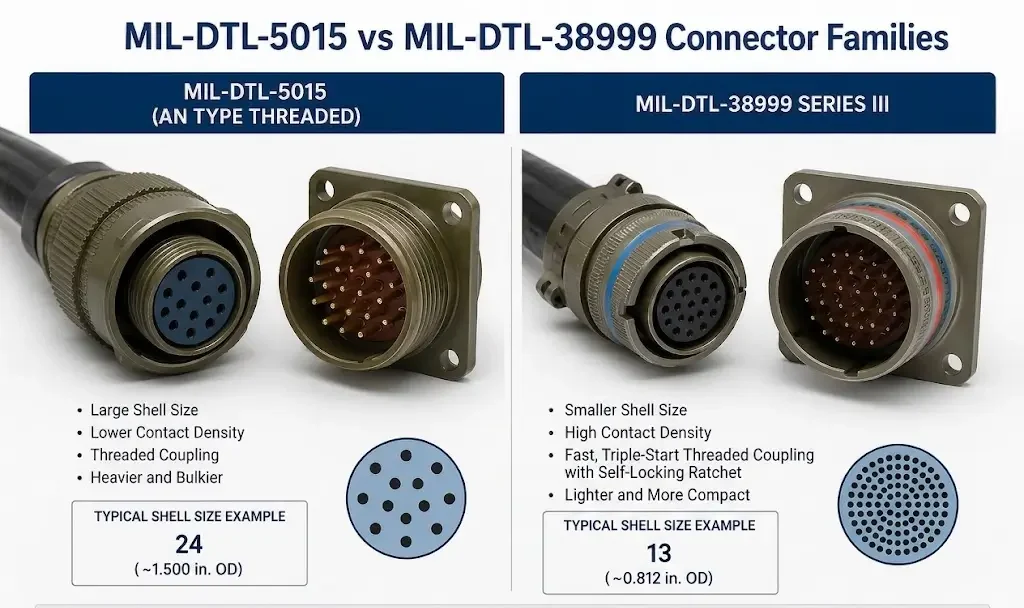
MIL-DTL-5015 vs. MIL-DTL-38999: Key Technical Differences
We base the following comparison on the governing specifications and verifiable manufacturer data. Where we note specific performance values, you should understand them as typical for certain commercial product families; they can and do vary by series, shell material, and manufacturer.
| Feature | MIL-DTL-5015 (SAE-AS50151) | MIL-DTL-38999 (SAE-AS38999) |
|---|---|---|
| Coupling | Single-start threaded | Series I & II: Bayonet; Series III: Tri-start self-locking; Series IV: Breech-lock |
| Contact Sizes | 16 to 0 (power-oriented) | 22D to 8 (density-oriented) |
| Contact Density (example) | Shell 28: max 37 × size 16 | Shell 25: up to 128 × size 22D (per AS81511 arrangements) |
| Sealing | Standard types depend on backshells; high-performance classes (e.g., Class L, W) provide integrated environmental & immersion sealing | Many commercial products are qualified to immersion levels; testing per MIL-STD-810, Method 512 |
| EMI Shielding | Shell-to-shell thread contact | Grounding spring design specified; shielding effectiveness varies by series and manufacturer |
| Weight (aluminum, typical) | Shell 28 ~120 g | Shell 25 ~80 g (aluminum) / ~55 g (composite, depending on manufacturer) |
| Cost Position | Generally lower unit cost | Typically higher unit cost |
Coupling Mechanism
The 5015’s single-start thread requires multiple turns to mate, but it resists vibration inherently when you secure it with safety wire. In contrast, Series III 38999’s tri-start thread mates in approximately one full turn and includes an anti-decoupling ratchet that withstands vibration without secondary locking. So, in tight equipment racks, this speed and one-handed mating offer a significant operational advantage.
Size and Weight
Because 5015 contacts are larger and less densely packed, the connector shells weigh more for a given signal count. However, you can achieve meaningful weight savings per connector if you switch from an aluminum 5015 to a composite 38999—depending, of course, on the specific shell material and configuration. When you multiply this across a platform with hundreds of interconnects, it translates into measurable fuel economy and payload gains—a critical factor in aerospace and next-generation ground vehicles.
Contact Density
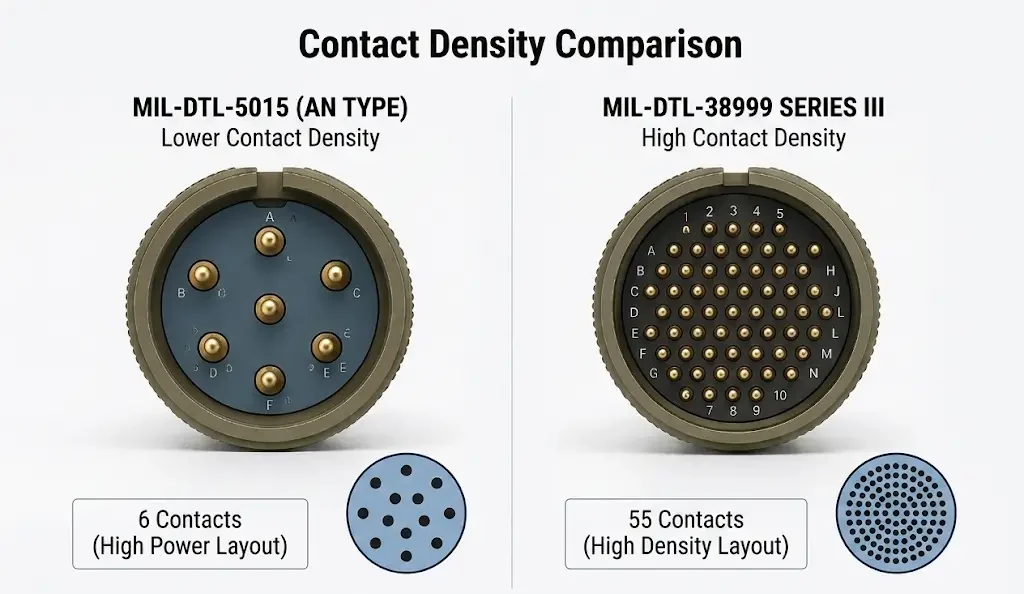
The 5015 contact system revolves around sizes 16 through 0, and its size 0 contacts can carry high current (continuous current ratings depend on wire gauge, temperature rise limits, and manufacturer design). The 38999, meanwhile, uses the AS39029 contact system to place 128 size-22D contacts in a shell size 25. This makes it ideal for carrying multiple MIL-STD-1553B, Ethernet, and discrete signals in one connector body.
EMI/RFI Shielding
The 5015 specification does not define a shielding effectiveness requirement; instead, it relies on intimate metal-to-metal contact along the threads. The 38999 specification, however, requires a grounding mechanism that engages before contact mating, creating a continuous shield path around the connector. Specific shielding effectiveness and transfer impedance values belong to individual connector part numbers and vary by series, shell material, and manufacturer—so you should always consult the specific product datasheet for the values that apply to your application.
Environmental Performance
If you equip a 5015 connector with an appropriate environmental backshell and wire sealing, it can achieve protection against dust and low-pressure water jets. Many 38999 Series III connectors, by comparison, undergo design and qualification to meet immersion requirements per MIL-STD-810, Method 512—a capability the 5015 specification does not mandate. You can find hermetic versions with glass-to-metal seals for both standards, but manufacturers catalog them more commonly for 38999.
Cost
On a unit-cost basis, 5015 connectors almost always cost less than equivalent-shell-size 38999 parts, thanks to simpler machining and a vast industrial supply base. But if your project demands high density, minimal weight, or certified EMI performance, the 38999 may offer a lower total system cost. It achieves this by reducing harness weight, eliminating backshells, and meeting shock/vibration requirements without additional components.
Where MIL-DTL-5015 and MIL-DTL-38999 Connectors are Typically Used
To help you contextualize the technical differences, let’s look at real-world deployment.
MIL-DTL-5015 (historical MIL-C-5015) Typical Applications:
- Ground power units and diesel generators
- Military vehicle power harnesses (e.g., engine compartments)
- Mining equipment and off-road heavy machinery
- Oil and gas drilling systems
- Shipboard power distribution and switchboards
- Any legacy equipment originally designed with AN or MS5015 connectors
MIL-DTL-38999 Typical Applications:
- Avionics suites and flight control computers
- Radar and electronic warfare systems
- UAVs and loitering munitions
- Missile systems and launch platforms
- Satellite buses and space payloads
- Tactical communications and C4ISR shelters
- Modern ground combat vehicles with digital backbone architecture
How to Choose Between MIL-DTL-5015 and MIL-DTL-38999 Connectors ?
When it’s time to decide, align your priorities with the right specification:
Choose MIL-DTL-5015 when:
- Your primary need is high current per contact (size 4 and 0 contacts)
- You’re maintaining or extending legacy AN/MS5015 systems
- Field repair simplicity and lower unit cost outweigh weight or density concerns
- Your environment is industrial, heavy mobile, or power-distribution focused
Choose MIL-DTL-38999 when:
- Signal density, weight savings, and EMI shielding are critical design drivers
- You are developing aerospace, avionics, or modern defense electronics
- Qualification to immersion, high vibration, or MIL-STD-461 is mandatory
- You need hybrid layouts (signal, power, RF, fiber) in a single connector shell
This decision framework, together with the technical details above, puts you in a position to specify with confidence.
FAQs
1. Is MIL-DTL-38999 replacing MIL-DTL-5015?
Not entirely. While 38999 has become the default for new aerospace and defense electronic systems, the installed base of the historical MIL-C-5015 connectors in industrial and military sustainment remains enormous. As long as legacy platforms stay in service and high-current, simple-circuits are required, engineers will continue to specify and procure 5015.
2. Can you directly mate a 5015 with a 38999?
No—you cannot. The coupling threads, keying, and interfacial dimensions are incompatible by design. For system upgrades, designers sometimes use a bulkhead adapter with a 5015 receptacle on one side and a 38999 plug on the other, but direct mating simply isn’t possible.
3. Which connector is better for military vehicles?
It depends on the vehicle generation and the specific subsystem. Older powertrain and power distribution harnesses use 5015. Modern vetronics, digital turret controls, and sensor suites have moved to 38999 for density, EMI control, and weight. New vehicle programs often mandate 38999 for electronic interfaces while retaining 5015 for high-current power runs.
4. Which connector supports higher current?
The 5015, with its larger contacts (size 4 and 0), generally supports higher current per contact than standard 38999 power contacts. You can rate a single size 0 contact for over 100 A continuous (depending on wire gauge and manufacturer), while the largest common 38999 power contact (size 8) carries a lower typical rating. For extremely high single-line amperage, 5015 gives you the more straightforward path.
5. Why is MIL-DTL-38999 more expensive?
The 38999 specification demands tighter tolerances, more complex coupling mechanisms (e.g., tri-start thread with ratchet), grounding spring integration, and often exotic materials (composite shells). On top of that, the aerospace qualification paperwork and traceability add to the unit cost compared to the mature, mass-produced 5015.
6. What is the difference between MIL-C-5015 and MIL-DTL-38999?
MIL-C-5015 (the historical DLA designation) is the older standard, designed for threaded, high-power circular connectors. MIL-DTL-38999 is the newer, high-density, lightweight counterpart that dominates modern military and aerospace electronics. Your choice between them hinges on whether your priority is high current/legacy compatibility or high signal density/weight savings.
7. Can I use 38999 for power circuits?
Yes, but with limitations. Hybrid 38999 connectors can incorporate size 8 or 12 power contacts alongside signal contacts. If your application demands current levels beyond what a single 38999 power contact can comfortably handle, paralleling contacts or using a separate 5015 power connector may prove more practical and cost-effective.
Conclusion
Both MIL-DTL-5015 and MIL-DTL-38999 connectors have proven themselves in the harshest environments on earth—and beyond. The right choice depends entirely on what you’re designing and what you’re maintaining.
- Specify MIL-DTL-5015 (the historical MIL-C-5015 family) for high-current simplicity, rugged power distribution, industrial machinery, and legacy sustainment where form-fit-function continuity is non-negotiable.
- Specify MIL-DTL-38999 for high-density signal routing, weight-critical platforms, mandatory EMI shielding, and any new aerospace, defense, or C4ISR design.
When you match your electrical, mechanical, and budgetary requirements to the specification that was built to address them, you arrive at a connector choice that the procurement team, the maintenance crew, and the platform engineers can all stand behind.