




M8 Connector Types, Advantages, and Applications

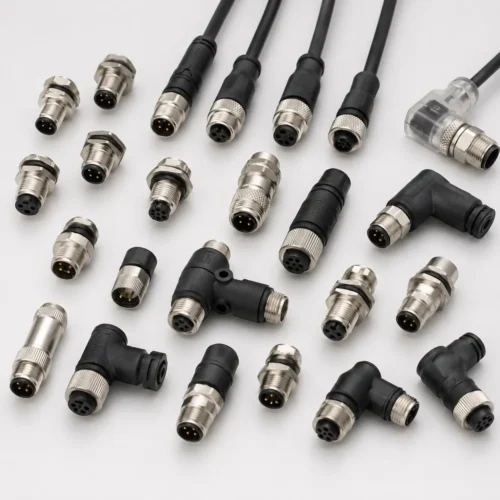
As industrial automation becomes more compact and more connected, the demand for reliable small-format connectors continues to grow. Engineers and equipment manufacturers increasingly need connectivity solutions that save space, simplify installation, and perform consistently in demanding environments. That is exactly where the M8 connector stands out.
Engineers widely use M8 connectors in sensors, actuators, robotics, machine vision systems, and compact automation equipment. With their small footprint, threaded coupling, and strong resistance to vibration and environmental exposure, they have become a trusted option for both simple signal transmission and industrial Ethernet in tight spaces.
In this article, we will take a closer look at M8 connector types, key advantages, and common applications. We will also compare M5, M8, and M12 connectors to help you choose the right connector for your system.
1. What Is an M8 Connector?
IEC 61076-2-104 defines an M8 connector as a compact circular connector featuring an M8×1 metric threaded locking interface — an 8 mm nominal diameter with a 1 mm thread pitch. This threaded coupling creates a secure, vibration-resistant connection and greatly reduces the risk of accidental disconnection. Because the standard specifies contact arrangements, coding, electrical ratings, and mechanical dimensions, M8 connectors offer assured
across different manufacturers.
Compared with larger circular connectors, engineers value M8 connectors for their compact size, easy installation, and stable performance. They commonly serve in sensor connections, actuator wiring, IO-Link communication, and low-power signal transmission in compact industrial devices. For many applications, the M8 connector delivers the optimal balance of size, durability, and reliability.
Why M8 Connectors Are Important
In industrial environments, connectors must do more than simply link two components. They must withstand vibration, movement, moisture, dust, and repeated mating cycles while maintaining stable signal quality. At the same time, modern systems are becoming smaller and more densely packed, which puts even greater pressure on connector design.
Manufacturers build M8 connectors to meet these challenges. The threaded locking structure helps keep the connection secure even under mechanical stress. In addition, the compact design makes them ideal for tight installation spaces. Moreover, the standardized format improves compatibility across many devices and systems. For automation engineers, machine builders, and system integrators, M8 connectors are a practical, dependable, and future-proof choice.
2. Types of M8 Connectors
You can find M8 connectors in several versions, and the right option depends on pin count, coding, mounting style, and cable routing requirements. Understanding these variations is essential for ensuring mechanical fit and electrical compliance.
2.1 M8 Connectors By Pin Count
M8 connectors come in 3-pin, 4-pin, 5-pin, 6-pin, and 8-pin versions.
- 3-pin M8 connectors often suit simple sensor and actuator applications that need only basic power and signal transmission, typically for DC switching signals.
- 4-pin M8 connectors serve as one of the most common options in industrial automation. Designers widely use them for sensor connections, IO-Link devices, and general signal transmission. In IO-Link systems, the standard pin assignment uses Pin 1 (L+, +24 V DC), Pin 3 (L-, 0 V), and Pin 4 (C/Q, combined switching and communication).
- 5-pin M8 connectors provide additional contact capacity and suit applications that require more wiring flexibility, such as sensors with dual outputs or heating elements.
- 6-pin M8 connectors offer the highest standard A-coded pin count under IEC 61076-2-104, serving devices that demand more signal lines without moving to a larger connector.
- 8-pin M8 connectors support even more complex signal requirements and suit applications that require multiple connections in a compact interface. It is important to note that 8-pin configurations often remain supplier-specific, and the standard A-coding may not cover them. Always verify compatibility with the specific manufacturer’s catalog.
2.2 M8 Connectors By Coding Type
Coding prevents mismating and ensures you use the connector only in the correct application. It also supports signal integrity and device compatibility. The three primary M8 coding types are A, B, and D.
- A-coded M8 connectors handle the majority of sensor, actuator, DC power, and general-purpose automation signal applications. They represent the standard interface for most 3-pin and 4-pin sensor connections.
- B-coded M8 connectors suit Profibus DP fieldbus applications. While Profibus installations are increasingly legacy systems, B-coded M8 connectors provide backward compatibility for existing process automation networks.
- D-coded M8 connectors (critical for modern networks) specifically target industrial Ethernet. The 4-pin D-coded M8 supports Cat5e-compliant data transmission and works with real-time Ethernet protocols such as PROFINET, EtherCAT, and EtherNet/IP. In space-constrained nodes, a D-coded M8 offers significant space savings compared to an RJ45 or even an M12 connector, making it the preferred choice for compact distributed I/O and vision systems.
Shielding Considerations for D-Coded Connectors
For reliable industrial Ethernet communication, always select shielded D-coded M8 connectors with 360° shield termination. The shielding braid connects through the threaded metal housing to the equipment chassis, creating a low-impedance path that protects against electromagnetic interference. By contrast, unshielded connectors suit only cost-sensitive, simple digital signal applications in benign environments.
2.3 M8 Connectors By Mounting Style
M8 connectors come in different mounting styles to suit field installation, panel integration, or PCB assembly.
- Cable connectors attach directly to flexible cables and suit field wiring, sensor-to-controller links, and machine harnesses.
- Panel-mount M8 connectors install on enclosures, equipment housings, or control panels to provide a fixed connection point. They come in male and female versions, while bulkhead and front- or rear-mount configurations allow design flexibility.
- PCB-mount M8 connectors integrate directly into printed circuit boards. They commonly appear in compact electronic modules, remote I/O blocks, and embedded controllers.
2.4 M8 Connectors By Connector Gender
Manufacturers produce M8 connectors in both male and female versions. Male connectors typically have exposed pins, while female connectors have recessed sockets. In general practice, engineers often specify the panel-mount or fixed side as a male (pin) connector to reduce the risk of contact damage when unmated. Selecting the correct gender is essential for proper mechanical mating and reliable electrical contact.
2.5 M8 Connectors By Straight or Right-Angle Design
- Straight M8 connectors suit installations where cable routing is straightforward and there is sufficient axial space behind the connector.
- Right-angle M8 connectors are the preferred choice in compact installations where depth is limited. They help reduce cable strain at the connection point and simplify routing inside tight enclosures and cable tracks.
3. Key Advantages of M8 Connectors
The widespread adoption of M8 connectors stems from their combination of compact mechanics, predictable electrical performance, and installation flexibility. Beyond general claims, the following quantifiable advantages demonstrate their engineering value.
Compact Design with Measurable Gains
With an 8 mm coupling thread, M8 connectors occupy significantly less panel space than M12 versions. In modern industrial devices, this small footprint allows higher I/O density and fits into smaller panels and tighter machine layouts, directly contributing to system miniaturization.
Secure Threaded Locking
When you tighten the M8×1 threaded coupling to the recommended 0.4 Nm to 0.6 Nm (typically 0.5 Nm), it provides a firm, vibration-resistant connection. Consequently, it prevents unintentional loosening that could cause signal interruptions — a critical factor in high-vibration environments such as robotic arms or stamping presses.
Strong and Quantified Environmental Resistance
Industrial-grade M8 connectors meet IP67 as a minimum: they are dust-tight and withstand temporary immersion in water. Many products achieve IP68 or IP69K, making them suitable for harsh washdown and outdoor environments. Standard operating temperature ranges typically span -25 °C to +85 °C, and high-performance materials extend that range from -40 °C to +105 °C. Housings usually consist of nickel-plated brass or stainless steel, and insulators use durable PBT or PA.
Predictable Electrical Ratings
A-coded M8 connectors commonly carry a rated current of 3 A or 4 A per contact (at 40 °C), with a rated voltage of 60 V AC/DC. D-coded Ethernet versions typically handle 1.5 A to 2 A per pin. In all cases, you must apply derating when energizing multiple contacts simultaneously. These clearly defined limits enable safe integration into control systems.
Easy Installation and Maintenance
Standardized tool-free or torque-wrench installation, combined with quick-disconnect capability, reduces commissioning time and simplifies replacement. This directly lowers maintenance windows in production systems where every minute of downtime counts.
Flexible Application Range and Interoperability
From simple sensor interfaces to IO-Link and 100 Mbit/s industrial Ethernet, M8 connectors cover a broad spectrum. With A, B, and D coding, multiple pin counts, and various mounting styles, they adapt easily. Furthermore, their adherence to IEC standards ensures interoperability with equipment from numerous suppliers, streamlining engineering and sourcing.
4. Common Applications of M8 Connectors
M8 connectors serve across many industries and equipment types. Their compact size and reliable performance make them especially valuable where space and signal integrity both matter.
Industrial Automation and IO-Link
M8 connectors form the backbone for sensor and actuator connections on IO-Link masters, remote I/O blocks, and valve manifolds. They carry simple discrete signals as well as bidirectional digital communication on standard 3- or 4-pin A-coded interfaces.
Sensors and Measurement Devices
Compact proximity, photoelectric, pressure, and temperature sensors often rely on M8 connectors for a rugged, small-form-factor connection that withstands vibration and tight mounting constraints.
Robotics
Robotic systems benefit from M8 connectors at the end effector and on arm axes, where space is limited and cables must endure continuous flexing and torsion. In particular, D-coded M8 enables Gigabit-capable vision sensors right at the wrist without bulky network cabling.
Machine Vision and Inspection Equipment
In machine vision, D-coded M8 connectors provide a space-saving Ethernet interface for cameras, while A-coded M8 connectors carry lighting power and trigger signals. This keeps cable routing clean and organized in cramped inspection stations.
Factory and Process Equipment
M8 connectors appear in machinery exposed to cutting fluids, dust, and washdown. Here, IP69K-rated versions with chemical-resistant PUR cable jackets ensure long-term reliability in demanding conditions.
Transportation and Mobile Equipment
Mobile industrial systems, including automated guided vehicles and mobile robots, use M8 connectors for secure locking and vibration resistance. As a result, they ensure stable connections even during constant movement and shock.
5. M5 vs M8 vs M12 Connectors
Choosing the right circular connector requires comparing physical size, electrical capacity, and application scope. The table below provides a parameter-based comparison to guide selection.
| Feature | M5 (IEC 61076-2-105) | M8 (IEC 61076-2-104) | M12 (IEC 61076-2-101) |
|---|---|---|---|
| Thread Size | M5×0.5 | M8×1 | M12×1 |
| Standard Codings | A | A, B, D | A, B, C, D, X, S, T, K, L, P, Y… |
| Typical Pin Counts | 3, 4 | 3, 4, 5, 6, 8 (8 often supplier-specific) | 2, 3, 4, 5, 6, 8, 12, 17 |
| Max. Rated Current | 1 A | 4 A (A-coded) / 2 A (D-coded) | 16 A (S/K/T-coded power) / 4 A (A-coded) |
| Typical Use Case | Micro-scale sensors, photoelectric switches where footprint is critical | Sensor/actuator, IO-Link, compact industrial Ethernet | Fieldbus, high-power, complex Ethernet, many signals |
| Main Advantage | Extremely space-saving; ideal for highly miniaturized devices | The balance of size, reliability, and versatility for general automation | Greater flexibility, higher pin counts, and robust power delivery |
When to select M8: M8 connectors are the preferred choice when M5 offers too few contacts or insufficient current, and M12 provides more bulk or capability than the system requires. They represent the optimal size-to-performance compromise for the majority of compact industrial connections.
6. How to Choose the Right M8 Connector
Choosing the right M8 connector involves methodically matching electrical and mechanical requirements to the application.
- Define the pin count and protocol. A simple proximity sensor may need only 3 or 4 pins. If the device uses IO-Link, select a 3-pin (without auxiliary output) or 4-pin A-coded M8 with the standard pin assignment (1: L+, 3: L-, 4: C/Q). For Ethernet, a shielded 4-pin D-coded M8 is mandatory.
- Verify coding. Always confirm the coding (A, B, D) matches both the connector and the mating device. This prevents mechanical mismating and network failures.
- Choose orientation. Select straight connectors where axial space allows; choose right-angle designs to minimize panel depth and reduce cable strain in tight conduits or machine corners.
- Evaluate environmental exposure. For IP67 environments, standard nickel-plated brass and PUR cables suffice. For washdown (IP69K) or chemically aggressive atmospheres, specify stainless steel housings and chemically resistant jacket materials. Additionally, verify the temperature range against the worst-case ambient.
- Select the mounting style. Decide between an overmolded cable connector for field connections, a panel-mount bulkhead for housing feed-through, or a PCB-mount version for direct board integration.
- Confirm electrical limits. Check that the connector’s rated voltage and current exceed the application’s maximum, and consider derating if you load multiple pins simultaneously. Mismatched electrical ratings can lead to overheating and contact degradation.
7. Best Practices for M8 Connectors
To achieve long-term reliability, install and maintain M8 connectors according to these engineering best practices:
- Use the correct mating torque. Tighten the coupling nut with a torque wrench set to 0.4–0.6 Nm. Under-tightening compromises IP sealing and vibration resistance; over-tightening can strip threads or crack the housing.
- Never mix incompatible codings. Forcing mismatched codings damages pins and connector bodies.
- Ensure proper shield termination. For D-coded shielded connectors, the cable shield braid must make a 360° low-impedance contact with the connector backshell, and you must firmly bond the connector body to the equipment chassis ground. A floating shield will cause intermittent Ethernet faults.
- Dress cables to relieve strain. Fix cables near the connector using strain-relief clamps and avoid sharp bends immediately at the connector exit. In moving applications, use rated drag-chain cables and allow sufficient bend radius.
- Inspect and maintain. Periodically check connectors for dirt, corrosion, or worn sealing gaskets. Clean with dry compressed air if needed, and replace damaged O-rings to preserve the IP protection rating.
8. FAQ
1. What is an M8 connector used for?
M8 connectors serve as standard interfaces for sensors, actuators, IO-Link devices, compact industrial Ethernet (PROFINET, EtherCAT), and other space-constrained automation equipment. They excel anywhere reliable signal transmission is needed in a small form factor.
2. What is the difference between M5, M8, and M12 connectors?
M5, the smallest, suits micro devices with minimal current. M8 provides the optimum balance of size, signal capacity, and robustness for mainstream automation. M12, the largest, handles higher pin counts, higher current (up to 16 A), or multi-gigabit Ethernet when needed.
3. Are M8 connectors waterproof?
Most M8 connectors, when properly mated and torqued, meet IP67 — dust-tight and able to resist temporary immersion. However, “waterproof” is a general term; always check the product data sheet for the exact IP code. For high-pressure washdown or continuous submersion, you must use IP68 or IP69K rated versions.
4. How many pins can an M8 connector have?
Standard A-coded M8 connectors come with 3, 4, 5, and 6 pins. 8-pin versions exist but may be specific to certain manufacturers. D-coded Ethernet connectors use 4 pins.
5. Are M8 connectors suitable for industrial automation?
Absolutely. They form a fundamental element in modern automation, supporting everything from 24 V sensor inputs to real-time Ethernet protocols, all within an internationally standardized footprint.
6. How do I choose the right M8 connector?
Match the pin count, coding (A, B, D), orientation, environmental rating (IP, temperature, materials), mounting style, and electrical ratings to your specific device and installation conditions. Always verify standard compliance for guaranteed interoperability.
9. Conclusion
M8 connectors are far more than simply a miniature plug; they represent a compact, reliable, and versatile connectivity platform for modern industrial systems. Through standardized A, B, and D coding, they handle both simple on-off signals and 100 Mbit industrial Ethernet in the same space-efficient format. Their quantified sealing, defined torque specifications, and predictable electrical ratings make them an engineer’s choice for delivering consistent performance in demanding automation, robotics, and vision environments.
By understanding the different M8 types, their precise technical advantages, and the selection criteria based on measurable parameters, engineers and system designers can design for better performance, long-term durability, and streamlined installation. From the factory floor’s digital edge to the mobile robot’s moving joint, the M8 connector remains a practical and dependable building block for the compact, connected machines of today and tomorrow.