




M12 Straight vs Right-Angle Connectors: How to Choose?

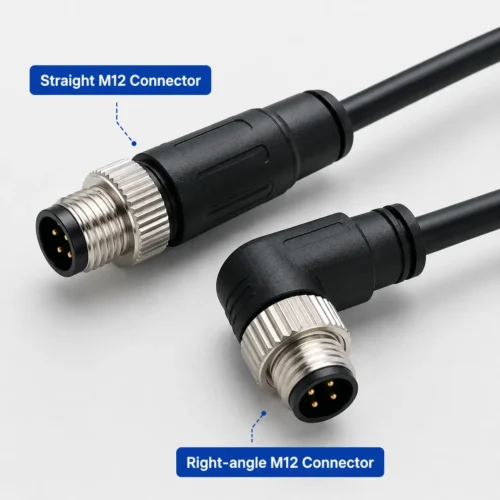
Straight and right-angle M12 connectors both solve the same basic problem: they create a reliable industrial connection in a compact form. The difference is how they handle space. Straight versions give you a direct cable exit. Right-angle versions let the cable leave sideways, which can make a huge difference in cramped machines, control panels, and moving assemblies.
That sounds simple. It isn’t always.
In real projects, the “best” connector shape often comes down to cabinet depth, adjacent components, bending radius, vibration, maintenance access, and how often the connector will be plugged and unplugged. Once you look at those factors together, the choice becomes much clearer. In this article, we’ll walk through each of these factors and show you how to pick the right M12 connector shape for your machine.
1. What are Straight and Right-Angle M12 Connectors
Straight M12 connectors keep all cables in a straight line. The cable exits directly from the back of the connector body, extending along the same axis as the plug and socket. This is the shape most engineers think of when they think of an M12 connector. It’s like a direct extension of the cable path—no bends, no changes in direction.
Right-angle M12 connectors, on the other hand, rotate the cable 90 degrees relative to the insertion direction. The connector body is “L”-shaped, so the cable extends parallel to the panel or device surface, rather than perpendicularly. This design difference changes how the connector is installed in the machine, how the cable is routed within the chassis, and the overall size of the component.
The core difference between the two is physical, but the ripple effects touch cable management, mechanical protection, and service access. Straight connectors keep the layout visible and predictable. Right-angle connectors tuck the cable out of the way. Neither is universally better—the right one depends entirely on what surrounds the port.
2. Straight M12 Connectors: Advantages and Best Use Cases
Straight M12 connectors are the default choice in many industrial setups because they are easy to understand and easy to install. The cable runs in line with the connector body, which makes them a natural fit for standard layouts and front-access connections.
They work especially well when the equipment has enough clearance in front of the port. They also fit neatly into high-density installations where connectors are arranged in rows. If you are building a system that needs simple service access and a clean mating path, straight connectors are often the safer bet.
Here’s the thing: straight connectors also make inspection easier. Technicians can see the cable path clearly. That helps during commissioning and during later maintenance.
3. Right-Angle M12 Connectors: Advantages and Best Use Cases
Right-angle M12 connectors shine when space gets ugly. And in industrial machines, space often gets ugly fast. If there is a wall, bracket, moving arm, or neighboring component blocking the cable path, a 90° exit can solve the problem immediately.
This is one of the biggest reasons engineers choose right-angle M12 connectors. They let the cable run along the machine surface instead of sticking straight out. That reduces protrusion, protects the cable path, and often makes the whole assembly look and feel more compact.
We have noticed that right-angle connectors also make sense when you want to protect the cable from accidental impact. In crowded machines, that matters.
4. Straight vs Right-Angle M12 Connectors: Key Differences
| Factor | Straight M12 Connector | Right-Angle M12 Connector |
|---|---|---|
| Cable exit direction | Direct, inline | Side exit, 90° |
| Best for | Open layouts, aligned ports, frequent access | Tight spaces, low-clearance areas, side obstructions |
| Installation style | Simple front-facing connection | Better for compact routing |
| Mechanical exposure | More exposed cable projection | Lower profile, less protrusion |
| Maintenance access | Easier to inspect and replace | Can be trickier in very tight assemblies |
| Cable stress | Usually more direct loading | Can reduce strain in compact layouts |
| Visual layout | Clean and straightforward | Compact and space-saving |
| Installation height | Standard housing length | Some low-profile designs as low as 42.5 mm height |
| EMI/EMC shielding | Requires 360° shield design | Requires 360° shield design; can achieve same level |
| Cable bending transition | May require larger bend radius | Provides more natural transition, reduces stress |
| Panel PCB orientation | Straight PCB pins (vertical) | Right-angle PCB pins (parallel to board) |
| Tightening torque | 0.4–0.6 N·m | 0.4–0.6 N·m |
If you are choosing based only on appearance, straight connectors usually look cleaner. If you are choosing based on real enclosure constraints, right-angle connectors often win.
5. How to Choose Between Straight and Right-Angle M12 Connectors
The best way to choose is to start with the machine, not the connector catalog.
5.1 Check the Available Space
If the port sits in an open area and the cable can run straight out without interference, a straight M12 connector is usually fine. If the connector sits near a panel edge, bracket, moving component, or adjacent port, a right-angle version may be the better fit.
Look, this is usually the first question we ask in design reviews. Can the cable actually leave the connector without getting pinched, bent too sharply, or forced into a weird path?
5.2 Think About Cable Routing
Straight M12 connectors are easier when the cable can travel forward in a clean line. Right-angle M12 connectors are better when the cable needs to turn immediately and stay close to the housing.
That is especially useful in compact control cabinets, machine vision systems, robotics, and sensors mounted on moving equipment.
5.4 Consider Maintenance Access
If technicians need to unplug and replug connectors often, straight M12 connectors can be more convenient because they leave more room for hand access. Right-angle connectors may be tighter to reach in some installations, especially when they sit behind brackets or inside deep enclosures.
5.5Look at Mechanical Stress
If a cable sticks out into a traffic path, it can take more abuse. A right-angle connector can help reduce that exposure. On the other hand, if the cable must repeatedly move or flex, the routing direction and strain relief matter just as much as the connector shape.
5.6 Match the Connector to the Machine Behavior
For stationary machines, either option may work well. For equipment with vibration, movement, or frequent rearrangement, the right-angle shape can be helpful if it supports a safer cable path. But there is no universal rule. The physical layout always comes first.
5.7 Factor in Cable Bending Radius
Every M12 cable assembly has a minimum bending radius that must be respected. We typically recommend a minimum bend radius of 5× the cable diameter for fixed installations and 10× the cable diameter for moving or flexing applications. A right-angle connector can help you stay within these limits by directing the cable immediately along the surface, preventing sharp bends right at the connector exit. Ignoring bending radius limits is one of the most common causes of premature cable failure.
5.8 Account for Shield Continuity in High-Speed Applications
If you are using X-coded M12 connectors for Gigabit or 10-Gigabit Ethernet, the choice between straight and right-angle does not release you from the requirement of 360° shield continuity. Both straight and right-angle connectors must maintain a continuous conductive path from the cable braid to the connector housing. Well-engineered right-angle M12 connectors achieve the same level of EMI/RFI shielding as straight versions. When selecting a right-angle connector for high-speed data, confirm that the design provides full 360° shielding through the angled body.
5.9 Include Torque and Locking Mechanism in the Evaluation
Regardless of shape, all M12 connectors require a defined tightening torque to ensure proper sealing and contact. The standard value according to IEC 61076-2-101 is 0.4–0.6 N·m. Under-tightening compromises the IP seal, while over-tightening can damage threads. For equipment subjected to strong vibration or shock, consider M12 connectors equipped with self-securing ratchet coupling nuts. These nuts prevent gradual loosening without adding installation complexity, and they are available for both straight and right-angle configurations.
6. When to Use Straight M12 Connectors
When the port faces outwards and there is ample space, allowing cables to exit directly without touching nearby components, the through-hole M12 connector is ideal. It is also suitable for situations requiring easy cable insertion and removal, and for linear, front-facing layouts. In these cases, through-hole connectors simplify installation, make cable paths clearly visible, and facilitate future maintenance.
7. When to Use Right-Angle M12 Connectors
A right-angle M12 connector becomes the right choice when the installation space is narrow or the cable must run along a surface. It also helps when nearby components block a straight cable exit, or when you simply want a lower-profile connection. In these situations, the 90° exit lets you tuck the cable out of the way, reduce protrusion, and avoid interference without rethinking the entire layout.
8. Panel-Mount M12 Connectors: Straight vs Right-Angle PCB Layouts
In many devices, the M12 interface is not a cable-end connector but a panel-mount receptacle soldered to a PCB. Here, the straight vs. right-angle decision moves to the inside of the enclosure. A straight panel-mount connector has pins that extend vertically from the PCB, while a right-angle panel-mount version has pins that lie parallel to the board. The right-angle PCB variant is widely used when internal height is limited, such as in slim sensors, compact I/O modules, and densely packed control units. When you specify the external connector shape, also consider what happens on the other side of the panel.
9. Common Mistakes When Choosing Straight or Right-Angle M12 Connectors
- Selecting a straight connector where a right-angle is needed, forcing the cable into a tight bend that violates the minimum bending radius.
- Choosing a right-angle connector without verifying the exact angle orientation (some connectors allow locking at specific angles; others are fixed).
- Neglecting to confirm that the right-angle connector’s 360° shield continuity is maintained, especially in Ethernet applications.
- Tightening by feel instead of using a torque wrench, leading to either loose connections or stripped threads.
- Overlooking the internal PCB pin direction when using panel-mount connectors, which can make assembly impossible.
10. Summary
If you are building out a broader connector strategy, it helps to think beyond just one part number. Our M12 connector can support different cable exits and configurations, while our M-series connector solutions cover a wider range of industrial connection needs.
That matters because some applications need more than one style across the same machine. A front-access panel may work better with a straight connector, while a side-mounted sensor may need a right-angle version. In other words, the right mix often beats a one-size-fits-all choice.