




Military-Grade vs. Industrial Connectors: Key Differences

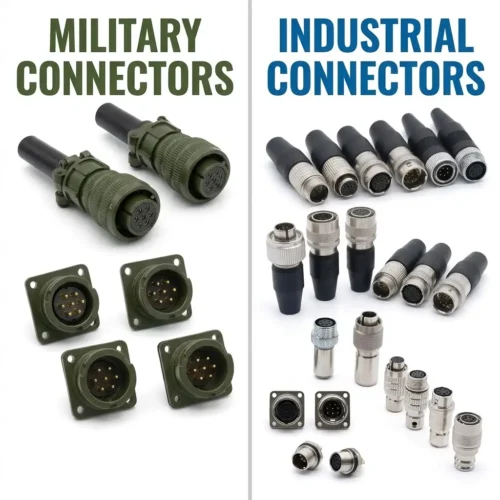
In aerospace, defense, factory automation, and heavy machinery, the choice of connector has a direct impact on system reliability and long-term maintenance costs. For engineers and system integrators, one of the most common decisions is whether to use Military Standard (MIL-SPEC) connectors or Industrial-Grade connectors.
A common industry misconception is that “MIL-SPEC” simply means “higher quality” and “Industrial” simply means “lower cost.” In practice, these two categories are built to different standards, with different testing philosophies and environmental requirements.
This guide explains the key differences between MIL-SPEC and industrial-grade connectors in terms of standards, performance, cost, and application scenarios. The goal is to help you reduce system risk and choose the right connector class for your project and budget.
1. What Are MIL-SPEC and Industrial-Grade Connectors?
The main difference between military and industrial connectors lies in the standards and compliance frameworks that define their design, materials, and testing.
MIL-SPEC Connectors
MIL-SPEC connectors are designed, manufactured, and tested according to military standards issued by defense organizations (for example, the US Department of Defense) or equivalent international military frameworks.
Key specifications commonly used in defense and aerospace include:
- MIL-DTL-38999 – high-density circular connectors (Series I, II, III, IV)
- MIL-DTL-26482 – miniature circular connectors with bayonet coupling
- SAE AS85049 – backshells and strain relief accessories for MIL-DTL-38999
Some MIL-SPEC programs require parts from the Qualified Products List (QPL). For QPL products, manufacturers must pass independent audits, and each material lot, plating thickness, and dimensional tolerance must match the governing standard. Not all military-grade connectors are QPL-listed, but QPL parts provide a higher level of traceability and compliance assurance.
Industrial-Grade Connectors
Industrial-grade connectors are engineered for commercial, manufacturing, and process automation applications.
They are commonly based on international and industry standards such as:
Industrial standards focus on meeting application-specific performance and cost-efficiency within commercial lifecycles. They do not enforce the same level of global interoperability and traceability as military specifications.
2. Key Differences Between MIL-SPEC and Industrial Connectors
The two categories differ significantly in their environmental and mechanical performance. The main differences appear in four areas: temperature, vibration and shock, corrosion resistance, and EMC/shielding.
2.1 Temperature Range
Military connectors are typically rated for extreme temperature ranges, commonly from -55 °C to +125 °C, with some specialized variants supporting higher temperatures. This ensures reliable performance in high-altitude avionics, desert environments, and other extreme thermal conditions.
Industrial-grade connectors generally operate within a narrower range, such as -40 °C to +85 °C or +105 °C. This range is well-suited for factory floors, server rooms, and standard outdoor machinery.
2.2 Vibration and Shock
Military-spec connectors are designed for high-vibration and high-shock environments, such as military vehicles, aircraft, and naval platforms. They often use robust coupling mechanisms, such as triple-start threads with anti-decoupling features or spring-loaded self-locking systems, and are tested according to standards like MIL-STD-202 and MIL-STD-810.
Industrial connectors focus on secure retention and ease of mating in fixed or predictable environments. Common locking methods include push-pull locking, standard bayonet coupling, or lever-actuated latching for heavy-duty rectangular connectors (e.g., on robotic arms).
2.3 Corrosion Resistance and Plating
MIL-SPEC connectors are often required to withstand severe corrosion, especially in marine and salt-spray environments. Common finishes include:
- Olive Drab Cadmium (typically up to 500 hours of salt spray)
- Black Zinc Nickel (ZnNi) – RoHS/REACH-compliant, cadmium-free, with high corrosion resistance
Industrial connectors use finishes based on local exposure risks. Common choices include nickel-plated brass, anodized aluminum, or high-performance engineering plastics. These provide strong resistance to industrial chemicals, oils, and washdowns, usually at a lower cost than military-grade platings.
2.4 Electromagnetic Compatibility (EMC) and Shielding
MIL-SPEC connectors typically provide 360° low-impedance electrical continuity between mating shells. Integrated grounding fingers and conductive plating are common to shield sensitive communication and radar signals from high levels of EMI/RFI.
Industrial connectors treat EMI/RFI shielding as a configurable option. High-end industrial systems (e.g., servo drives, VFD loops) often use shielded interfaces, while many standard sensor, power, and signal lines use unshielded plastic shells where EMI risk is low.
3. MIL-SPEC vs. Industrial Connectors Comparison Table
The table below summarizes the key differences in standards, performance, and supply chain:
| Evaluation Vector | MIL-SPEC Connectors | Industrial-Grade Connectors |
|---|---|---|
| Governing Standards | MIL-DTL-38999, MIL-DTL-26482, GJB series | IEC 61076, UL, ISO, NEMA |
| Temperature Range | Typically -55 °C to +125 °C (some specialized variants may support higher) | Typically -40 °C to +85 °C or +105 °C |
| Mating Interoperability | Standardized within defined mating families; cross-vendor intermateability within the same part number family | Ecosystem-based; standards exist (e.g., M12), but proprietary layouts are common |
| Plating / Finish | Strictly regulated (ZnNi, Cadmium, Electroless Nickel) | More flexible (Nickel, Zinc die-cast, polymer bodies) |
| Supply Chain Profile | Full lot traceability; longer lead times due to QPL audits and certification | Commercial-Off-The-Shelf (COTS); rapid scaling and stock availability |
4. Interoperability: MIL-SPEC vs. Proprietary Industrial Connectors
A key difference between military and industrial connectors is cross-vendor mating capability.
Cross-Vendor Mating: MIL-SPEC Interoperability
MIL-SPEC connectors within the same series and part number family are designed to be interchangeable across approved vendors. For example, a plug from Vendor A and a socket from Vendor B should mate properly if they share the same shell size, insert arrangement, and keying (e.g., W, X, Y, Z). This design supports field serviceability and reduces dependence on a single supplier.
Proprietary Industrial Connector Ecosystems
The industrial market combines standardization with proprietary innovation. Standard circular interfaces like M12 follow explicit international pinouts (A-coded, D-coded, X-coded, etc.), but many manufacturers also offer proprietary quick-lock interfaces or custom layouts. These can provide high performance or easier installation, but may tie the design to a specific vendor’s ecosystem.
In summary:
- MIL-SPEC: intermateability is a core requirement within defined families.
- Industrial: a mix of open standards and proprietary designs, depending on the application and vendor.
5. Material Selection and Lifetime ROI: MIL-SPEC vs. Industrial
The economic value of a connector depends on its intended lifecycle and application.
MIL-SPEC connectors typically use premium materials such as aerospace-grade aluminum (6061-T6) and stainless steel (316L), with substantial gold plating on contact points to maintain low contact resistance over many mating cycles in demanding conditions. The higher upfront cost reflects rigorous material validation, extensive testing, and long-term regulatory compliance.
Industrial-grade connectors are optimized for realistic operating lifecycles. They often use engineering plastics (such as PBT or glass-filled Nylon) along with optimized plating thicknesses tailored to typical industrial lifespans (for example, hundreds of mating cycles). This approach allows industrial connectors to deliver reliable performance at a lower cost than military alternatives.
6. How to Choose: MIL-SPEC vs. Industrial-Grade Connectors
When deciding between MIL-SPEC connectors and industrial-grade connectors, use this quick checklist to match your application needs with the right connector class.
When to Use MIL-SPEC Connectors
Choose MIL-SPEC (Military Standard) connectors if your project meets one or more of the following conditions:
- Application field: Aerospace, defense, avionics, naval systems, or tactical ground vehicles
- Documentation requirements: Full lot traceability and a Certificate of Conformance (CoC) are contractually required
- Environmental demands: The connector must operate under extreme temperature ranges (e.g., high-altitude deployment) combined with high levels of vibration and shock
- Interchangeability: Cross-vendor intermateability within a defined connector family is required
These are typical scenarios where mission-critical reliability outweighs cost concerns.
When Industrial-Grade Connectors Are Enough
Choose industrial-grade connectors if your project fits these conditions:
- Application field: Factory automation, commercial EV infrastructure, medical devices, or standard industrial machinery
- Project timeline: Development speed, rapid prototyping, and immediate COTS (Commercial-Off-The-Shelf) availability are critical
- Environmental requirements: Protection needs are bounded (e.g., IP67/IP68 ingress protection is required, but defense-grade shock or extreme thermal requirements are not)
- Cost sensitivity: Cost optimization is important for high-volume commercial production
In these cases, industrial connectors often provide the best balance of performance and cost.
7. How We Supports Military and Industrial Connector Needs
Managing a global supply chain for interconnects requires a partner that can align manufacturing precision with specific compliance needs. HUADA GROUP supports both MIL-SPEC and industrial-grade applications under AS9100D and ISO9001 quality frameworks.
MIL-SPEC-Compatible Solutions
HUADA GROUP manufactures interfaces compatible with the MIL-DTL-38999 series (Series I, II, III, and IV) and SAE AS85049 backshell specifications. Spanning shell sizes 9 to 25, these components provide:
- Tight thread tolerances
- High shell-to-shell conductivity
- Intermateability with legacy military hardware (within the same series and part number family)
Rugged Industrial Solutions
For demanding industrial automation, commercial aerospace, and heavy-duty applications, HUADA GROUP uses advanced precision machining to deliver ruggedized industrial connectors, heavy-duty electrical contacts, and custom cable harness assemblies. This approach allows designers to achieve high mechanical robustness with the flexibility of an industrial supply chain
Customization and Engineering Support for MIL-SPEC and Industrial Projects
- Customized engineering: Supports non-standard cable entry sizes, customized insertion devices, and dedicated multi-core shielding configurations.
- Advanced plating options: In-house capabilities for low-resistance electroless nickel and RoHS/REACH-compliant Black Zinc Nickel (ZnNi) finishes.
- Turnkey manufacturing: Factory-tested cable assemblies with custom backshells and environmental protection boots.
For technical documentation, 3D CAD models, or engineering consultations on custom interconnect layouts, contact our technical support team at:
sales@connector-sensor.com
FAQ
1. Can industrial connectors replace MIL-SPEC connectors?
Sometimes in commercial systems, yes. In aerospace and defense programs, usually no. Military platforms often require connectors qualified to standards such as MIL-DTL-38999, along with traceability, controlled materials, and compliance documentation.
2. Why are MIL-SPEC connectors more expensive?
The higher cost mainly comes from qualification requirements, traceability, inspection, and controlled manufacturing processes. Military connector systems also often require qualified backshells, shielding accessories, and approved materials.
3. Are MIL-DTL-38999 connectors from different manufacturers compatible?
They can be intermateable within the same series, shell size, insert arrangement, and keying configuration. However, Series I, II, III, and IV are not universally interchangeable and should always be verified by part number.
4. Why are M12 connectors widely used in industrial automation?
M12 connectors are compact, rugged, and standardized under IEC 61076. They are commonly used in sensors, Industrial Ethernet, robotics, PLC systems, and servo drives because they combine reliable sealing with easy installation.
5. What is the biggest advantage of MIL-SPEC circular connectors?
Their biggest advantage is long-term reliability and consistency. Controlled dimensions, standardized accessories, and strict qualification requirements help maintain stable performance across aerospace and defense platforms with long service lifecycles.
6. Are industrial connectors suitable for high-vibration environments?
Many are. Industrial connectors used in robotics, rail systems, mining equipment, and heavy machinery are often designed for strong vibration resistance. The key is selecting a connector qualified for the actual operating conditions.