


Type K Thermocouple Temperature Sensors
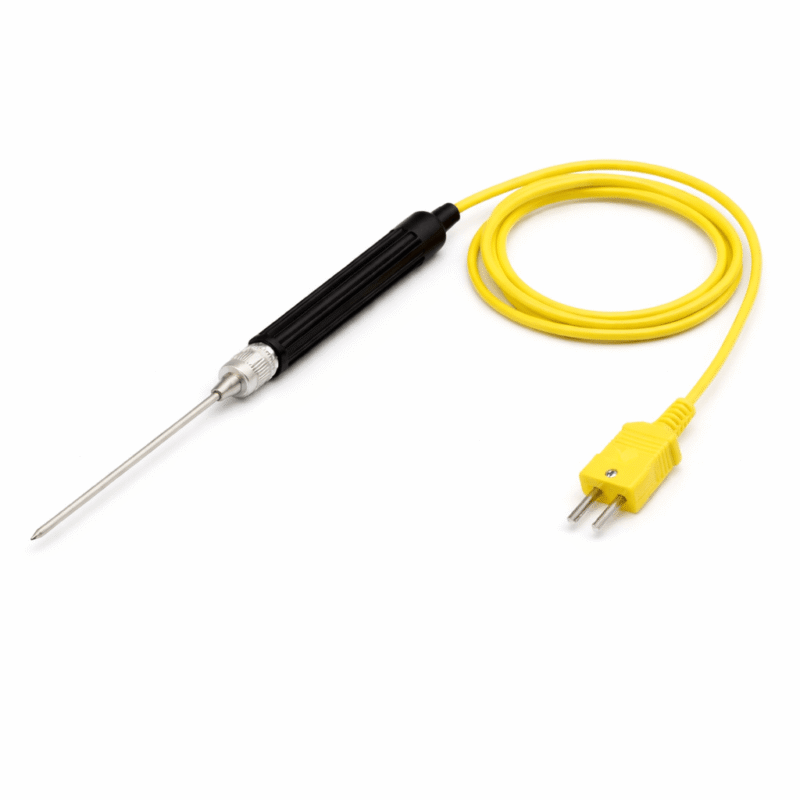
Type K Thermocouple Temperature Sensors
Key Features
- Wide temperature range from –200 °C to +1260 °C
- Chromel–alumel construction performs well in oxidizing atmospheres
- High sensitivity about 41 µV per °C, enabling precise detection
- Available with stainless steel or nickel‑alloy sheaths, filled with MgO insulation
- Fine‑diameter or bare‑wire junctions respond quickly to temperature changes
- Follows IEC / ANSI standards ,ensuring easy wiring and global compatibility
- Standard‑spec Type K thermocouples work with most controllers, PLCs, and DAQ systems
- Available as probes, wire, thermowell, surface‑mount, and dual‑element designs
- Widely supported by calibration labs and digital instruments, allowing straightforward verification
- sales@connector-sensor.com
- +86 15120067961
- Connectors129 products
- Sensors119 products
- Optoelectronic Modules1 product
Type K Thermocouple |Wide Range Temperature Sensor
What is Type K Thermocouple
Type K thermocouple is a common temperature sensor made from two specific nickel‑based alloys: chromel (nickel–chromium) as the positive leg and alumel (nickel–aluminum–silicon) as the negative leg.Our type K thermocouples feature an exceptionally wide temperature range, spanning from -200°C to +1260°C (-328°F to 2300°F).
Our Type K thermocouples are crafted from high-quality nickel-chromium alloy, offering exceptional stability even in oxidizing environments. Besides, they are suitable for use in both cold and hot environments, widely applied in settings ranging from industrial furnaces, ovens, and kilns to laboratories, HVAC systems, and beyond.
Main Types of Type K Thermocouples
At Huada, we offer an extensive range of K-type thermocouples, including but not limited to the following Types:
1. High Temperature K Type Thermocouple
2. Surface‑Mount Type K Thermocouple
3. Ceramic K Type Thermocouple
4. Magnetic Thermocouple Type K
5. Dual Element Type K Thermocouple
6. Thermocouple Type K 5M
7. K Type Thermocouple Probe
8. Type K Thermocouple Wire/K Type Thermocouple Cable
9. K Type Thermocouple to 4-20 mA Transmitter
10. K Type Thermocouple with Digital Display
Main Benefits of Type K Thermocouple
-Wide temperature range
Can measure from extremely low to very high temperatures, typically from ‑200°C to +1260°C, suitable for a wide variety of industrial, laboratory, and process‑control applications.
-High sensitivity
Generates a thermoelectric voltage of about 41 µV per °C, enabling the detection of small temperature changes and ensuring accurate temperature measurement.
-High cost‑effectiveness
Compared with noble‑metal thermocouples such as Type S or Type R, Type K offers lower cost and more affordable pricing, while still providing reliable performance.
-Wide application and strong compatibility
Type K is a general‑purpose thermocouple; its probes, extension wires, connectors, and accessories are highly standardized and easy to source. Many protective sheaths, calibration services, and digital instruments are designed specifically for Type K, making installation and maintenance more convenient.
-Corrosion and wear resistance
Available with stainless steel or nickel‑alloy sheaths, filled with electrically insulated magnesium oxide, providing a robust and durable construction for harsh environments.
-Fast response time
Fine‑diameter thermocouple probes or bare‑wire junctions offer quick thermal response, making them suitable for fast‑changing or dynamic temperature monitoring.
-Easy interchangeability and calibration
Our standardized Type K thermocouples are easy to replace or upgrade, and different probes of the same specification can be interchanged without major readjustment.
-Universal wiring and color coding
Type K follows IEC/ANSI standard plugs and color codes: yellow for the positive leg and red for the negative leg, ensuring global compatibility and simple wiring for international users.
-Excellent Compatibility
Designed to be compatible with standard Type K thermocouple probes and industrial controllers, including products from Omega, Fluke, WIKA, and similar brands.
Type K Thermocouple Specifications
| Parameter | Specification |
|---|---|
| Thermocouple Type | Type K Thermocouple (NiCr‑NiSi, chromel‑alumel) |
| Standards | IEC 60584, ANSI E230 |
| Temperature Range | –200 °C to +1260 °C (for continuous use in typical industrial applications) |
| Recommended Continuous Use | ≤ 1100 °C in oxidizing atmospheres (for long‑term service life) |
| Maximum Temperature | Up to 1372 °C (short‑term exposure, bare wire or inert/vacuum environment) |
| Accuracy Class 1 | ±1.5 °C or ±0.4% of reading (whichever is greater) |
| Accuracy Class 2 | ±2.5 °C or ±0.75% of reading (whichever is greater) |
| Insulation Type | MgO mineral‑insulated (MI) |
| Sheath Materials | Stainless Steel 304, SS310S, Inconel 600 |
| Probe Diameter | 1.0 mm, 1.5 mm, 2.0 mm, 3.0 mm, 4.0 mm, 6.0 mm |
| Response Time | t₀.₅ < 1 second (fine‑diameter probes or bare‑wire junctions; larger sheathed probes may be slower) |
| Working Environment | Oxidizing, inert, and vacuum atmospheres; avoid prolonged exposure to sulfur‑containing or strongly reducing environments |
| Protection Rating | IP65 (standard), IP68 (optional) |
| Installation Types | Threaded, flanged, welded, plug‑in |
| Certifications | CE, RoHS, ISO 9001 |
Use of Type K Thermocouple
Industrial Heating and Heat Treatment
Engineers use these sensors to monitor furnace temperature in high‑temperature furnaces, electric furnaces, melt furnaces, and heat‑treatment furnaces for processes such as annealing, quenching, and tempering.
During metal casting, welding, and hot‑working, operators rely on them to track temperature and ensure that process profiles meet required specifications.
In Manufacturing and Process Industries
Chemical, metallurgical, power, and oil & gas industries use these devices to monitor temperature in reactors, pipelines, and heaters.
Manufacturers also use them to measure barrel and mold temperatures in plastic injection molding machines, extruders, dryers, and similar equipment.
In HVAC and Home Appliances
HVAC systems use them to monitor air temperature, water temperature, and temperatures in heater and cooler loops.
Oven, stove, and water‑heater manufacturers commonly use them for internal temperature measurement and control in household and commercial appliances.
In Food and Pharmaceutical Industries
Food processors use them to monitor temperature during high‑temperature steps such as baking, boiling, sterilization, and drying.
Pharmaceutical and biotechnology companies use them to record and validate temperature in sterilizers, reactors, and drying equipment.
In Automotive and Aerospace Applications
Automotive engineers use them to monitor exhaust gas temperature (EGT) in engines and exhaust systems, which helps prevent overheating and optimize combustion control.
Aerospace engineers use them as temperature sensors in turbines, combustion chambers, and test stands operating in high‑temperature environments.
In Testing and Measurement Systems
Researchers and university labs use these sensors as general‑purpose temperature instruments, often combining them with data acquisition systems such as NI, PLCs, or DAQ devices.
In industrial automation and SCADA systems, engineers use them as field temperature elements for closed‑loop temperature control and alarm functions.
Huada Group – Your Trusted Temperature Sensors Manufacturer
With over 20 years of focus on manufacturing thermocouples and temperature sensors, we provide stable, reliable and cost-effective solutions for global industrial clients.
We own complete in-house production lines and professional testing equipment, supporting a monthly capacity of over 50,000 pieces. Stable mass production ensures consistent quality and on-time delivery.
We support full customization, including sheath material, diameter, length, thread type and connector. Sample orders can be finished in 3–7 days, and mass production leads are 7–15 days based on quantity.
As a direct manufacturer, we offer competitive factory price, fast response within 12 hours, and professional technical support. We aim to be a reliable long-term partner for your business.
FAQ
1. What are the two metals used in Type K thermocouple?
A Type K thermocouple uses chromel (a nickel–chromium alloy) for the positive leg and alumel (a nickel–aluminum–silicon–manganese alloy) for the negative leg. This combination gives Type K good oxidation resistance and a wide temperature range compared with many other thermocouple types.
2. What is the temperature range of Type K thermocouple?
Our Type K thermocouple measures from about –200 °C to +1260 °C (–328 °F to +2300 °F), depending on wire gauge and insulation. For continuous use, we recommend keeping it up to around 1100 °C in oxidizing environments, though short‑term exposure can reach higher temperatures.
3. What is the correct polarity for Type K thermocouple probes and sockets?
In the ISA / ANSI standard, the yellow lead is positive, and the red lead is negative. In the IEC standard, the green lead is positive, and white is negative. For Type K sockets and connectors, the orientation must match this polarity; reversing leads will cause a negative or incorrect temperature reading on most instruments.
4. How to Use a K Type Thermocouple?
Using a K-Type sensor is efficient, provided you handle the polarity and extension correctly.
Step 1: Identify Polarity (Standard US/ANSI)
- Yellow Wire: Positive (+) Chromel
- Red Wire: Negative (-) Alumel
Note: In the IEC (International) standard, Positive is Green and Negative is White.
Step 2: Secure Connection
Connect the leads to a thermometer or PID controller that supports Type K input. Ensure you use K-Type specific connectors (usually yellow-colored) to avoid cold junction errors.
Step 3: Correct Placement
The sensing junction (the welded tip) must have firm contact with the surface or be fully immersed in the medium you are measuring.
Step 4: Cold Junction Compensation (CJC)
Ensure your display device has built-in CJC. Since thermocouples measure a temperature differential, the device must “know” the ambient temperature at the connection point to provide an accurate absolute reading.
5. What is the accuracy of a Type K thermocouple?
Standard‑grade Type K thermocouples are typically accurate to about ±1.5 °C or ±0.4% of the measured temperature, whichever is larger, within their normal operating range. Higher‑precision “special‑limits‑of‑error” (SLE) versions can reach around ±0.5 °C or ±0.15%.
Actual accuracy also depends on proper installation, extension wiring, and the accuracy of the reference‑junction compensation in your instrument.
6. How to Test a K-Type Thermocouple with a Multimeter?
Before replacing a suspected faulty sensor, use a Digital Multimeter (DMM) to perform these three quick diagnostics:
Test A: Continuity & Resistance (Ω)
Set your DMM to the lowest Resistance setting. Touch the probes to the two wire ends.
- Healthy: Should read a very low resistance (typically < 10 Ω depending on length).
- Faulty: An “OL” (Open Loop) reading indicates a break in the wire or a blown junction
Test B: Millivolt (mV) Output
Switch the DMM to the DC Millivolt (mV) range. Apply heat to the sensing tip (even holding it in your hand works).You should see the voltage rise. At room temperature (around 25°C), a K-Type sensor output is approximately 1.0 mV.
Test C: Insulation/Ground Check
Check for continuity between either lead and the outer metal sheath.
- Ungrounded Type: There should be NO continuity.
- Grounded Type: Continuity is normal.
7. How to Calibrate a K-Type Thermocouple System?
Thermocouples themselves cannot be “adjusted,” but you can calibrate your system (Sensor + Controller) using these two gold-standard reference points:
a. The Ice Point Method (0 °C/ 32 °F )
- Create a “slush” of crushed ice and distilled water in a thermos.
- Submerge the probe tip into the center of the slush (do not touch the container walls).
- Once stabilized, your display should read 0 °C.
b. The Boiling Point Method (100 °C / 212 °F )
- Dip the sensor into boiling distilled water.
- Pro Tip: Atmospheric pressure affects boiling points. At sea level, it is 100 °C . If you are at a high altitude, your reference point will be lower.
c. System Correction (Offset)
If your display reads 101.5 °C in boiling water, go into your controller’s settings and apply a -1.5°C Offset (or Bias) to align the system with the physical truth.
8. What’s the difference between J‑type and K‑type thermocouples?
J‑type thermocouple uses iron–constantan, has a lower maximum temperature (about 750–800 °C), and is more susceptible to oxidation at high temperatures, but it is usually cheaper and slightly more accurate in the mid‑temperature range.
K‑type thermocouple uses chromel–alumel, covers a much wider range (from cryogenic up to about 1260 °C), resists oxidation better, and works well in industrial furnaces, process control, and general‑purpose applications.
9. What are Type K thermocouple cables and probes used for in industrial applications?
Type K cables (compensation or extension wire) carry the millivolt signal from the probe to the controller or PLC, while probes go directly into furnaces, reactors, molds, or exhaust systems to measure temperature. Users commonly apply them in heating equipment, process control, HVAC, food processing, and automotive exhaust monitoring because of their wide range, durability, and compatibility with most industrial instruments.
10. Are Type K thermocouple probes interchangeable with other brands?
Most standard‑spec Type K thermocouples are electrically interchangeable, so a probe from one brand will usually work with a controller or meter that accepts Type K inputs, as long as the polarity and connector type match. For high‑precision or critical applications, we recommend you verify compatibility with your instrument manufacturer and keep the same standards (ISA or IEC) across the entire system.
Related Thermocouple Products:
| Type B Thermocouple |
| Type C Thermocouple |
| Type E Thermocouple |
| Type J Thermocouple |
| Type N Thermocouple |
| Type R Thermocouple |
| Type S Thermocouple |
| Type T Thermocouple |
Send Message to get Datasheet.
Strict Production Process
Engineers develop optimized electronic circuits and structural designs based on real application needs.
High-quality components and materials are carefully selected from trusted suppliers to ensure long-term reliability.
Automated SMT and precision soldering technologies are used to build stable and high-performance circuit boards.
Sensor elements or connector terminals are assembled with the PCB and housing to ensure accurate operation and strong mechanical stability.
Each product undergoes strict calibration and functional testing to guarantee accuracy and stable performance.
Every unit is carefully inspected, labeled, and securely packaged to ensure it arrives safely and performs reliably for your applications.
Strict Production Process of Yafeite